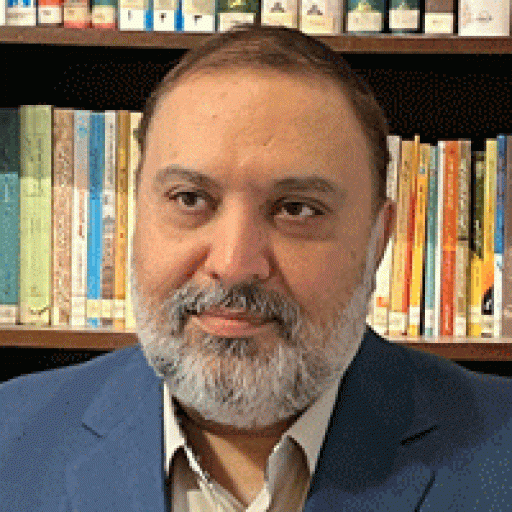
Dr. Reza Gholami
Member of the Faculty, Institute for Humanities and Cultural Studies
Freedom of Expression: A Pillar of Modern Societies
Freedom of expression is considered one of the fundamental pillars of modern societies. Democratic governments not only present themselves as defenders of this principle but also claim to provide the necessary conditions for its fullest realization. However, in practice, many citizens do not feel that freedom of expression exists in an unrestricted and genuine manner within their society. This issue primarily stems from unwritten limitations that define the boundaries of free speech, particularly in sensitive areas.
Measuring True Freedom of Expression
To assess the extent of freedom of expression in a society, it is insufficient to focus solely on the ability to express opinions on everyday or inconsequential matters that come with little to no risk. In reality, freedom of expression is truly tested when individuals seek to discuss issues directly related to the survival of political or economic power structures.
For example:
- Criticizing High-Level Government Corruption
A journalist who exposes financial corruption within a government institution may not only face legal threats but also informal pressures such as media blacklisting, reduced job opportunities, and even security threats.
- Challenging Fundamental Political Structures
In many countries, criticizing the overall structure of the government—whether regarding the form of governance, the distribution of power, or domestic and foreign policies—can result in severe repercussions. Such criticism may lead not only to official censorship but also to social ostracization, job loss, and security-related consequences.
- Criticizing Powerful Religious Figures
There should be no prohibition against critiquing religious leaders or their followers, especially when such critiques address unreasonable behavior in the name of religion or the misuse of faith for personal gain.
- Criticizing Israel for Genocide in Palestine—A Western Taboo
One of the most prominent examples of the unwritten costs of free speech globally is the treatment of individuals who condemn Israeli policies against Palestinians. In many Western countries, academics, artists, journalists, and even politicians who accuse Israel of genocide and war crimes are labeled as “anti-Semitic,” “terrorist sympathizers,” or “hate propagators.” Many have lost their jobs, been banned from media platforms, or been blacklisted by cultural and academic institutions.
Freedom of Expression: A Costly Concept
A crucial point to consider is that freedom of expression is not cost-free for governments or society as a whole. Mature civil societies are those that can bear the costs of free speech without resorting to suppression, labeling, or social exclusion. In such societies, individuals can criticize power, express diverse viewpoints, and defend individual and collective freedoms without fearing severe repercussions. However, in societies that have not yet deeply embraced freedom of expression, its social, professional, and political costs remain high.
Beyond the Individual, Beyond Red Lines
Fundamentally, freedom of expression gains meaning within a social context rather than at an individual level. If a person merely expresses their opinions in private, in a closed circle, or in a setting where their words have no impact on public discourse, this does not constitute true freedom of expression. Genuine freedom of speech means the ability to present ideas and criticisms openly in public spaces, influencing public opinion without fear of severe consequences.
Moreover, the existence of numerous “red lines” contradicts the very concept of free speech. In a truly free society, only justice should serve as a legitimate boundary, and even then, it must be clearly defined through a democratic process in a way that is unambiguous and legally sound. If predefined limits on free speech are set based on government interests or the benefits of the powerful, then speech is no longer truly “free”—it is merely a restricted permission to speak within “safe” boundaries.
The Consequences of Labeling and Social Repercussions
One of the most significant unwritten consequences of speaking out on sensitive issues is the loss of professional and social opportunities. Even if individuals are not directly suppressed by the state or powerful entities, they may still face informal restrictions.
Labeling is one such consequence. After expressing an opinion, an individual may find that their colleagues, social institutions, media, or professional networks now define them by a particular identity. This new label determines their social and professional trajectory and can lead to their gradual exclusion from job opportunities, professional circles, and even broader social engagement.
Some examples include:
- The Dismissal or Marginalization of Independent Journalists
A journalist working for a state-affiliated media outlet who investigates financial corruption by a high-ranking official may be dismissed after publishing their report or find it impossible to secure employment in major media outlets afterward.
- Restricted Academic Opportunities
A university professor who challenges national policies may be barred from participating in conferences, denied research funding, or face informal barriers to career advancement.
- The Cost of Criticizing Israel in the West
Well-known figures such as Professor Norman Finkelstein, who has criticized Israel’s policies in Palestine, have faced consequences such as being banned from teaching at universities and losing professional opportunities. Even politicians and parliament members in some countries have been pressured or excluded from elections after expressing support for Palestine.
Self-Censorship and Its Long-Term Effects
Over time, these pressures lead to widespread self-censorship among citizens. Observing the high costs of free speech, many people prefer to remain silent on sensitive issues or speak with extreme caution and limitation. As a result, freedom of expression, which should serve as a tool for intellectual and social development, gradually becomes a mere symbolic slogan. Public discourse shifts toward conservatism and caution, replacing truth-seeking and intellectual boldness.
This situation not only empties freedom of expression of its true meaning but also negatively impacts the intellectual and political development of societies. A society where individuals remain silent or hesitant out of fear of labeling and its consequences will ultimately drift toward apathy, conformity, and acceptance of the status quo, creating a significant barrier to progress and reform.
The True Test of Free Speech
Ultimately, the real test of freedom of speech in any society lies in its ability to tolerate sensitive discussions—not just the ability to discuss trivial matters. A society that claims to uphold free speech must demonstrate how it treats those who exercise this right in controversial areas, both directly and indirectly. If the costs of truth-telling remain high, and individuals are punished or ostracized for their opinions, true freedom of expression cannot exist.
A society reaches civil maturity only when it can bear the costs of free speech and refrain from imposing unequal consequences on individuals with dissenting views.