Iran Studies: Coordinates, Approaches, Capacities, and Challenges
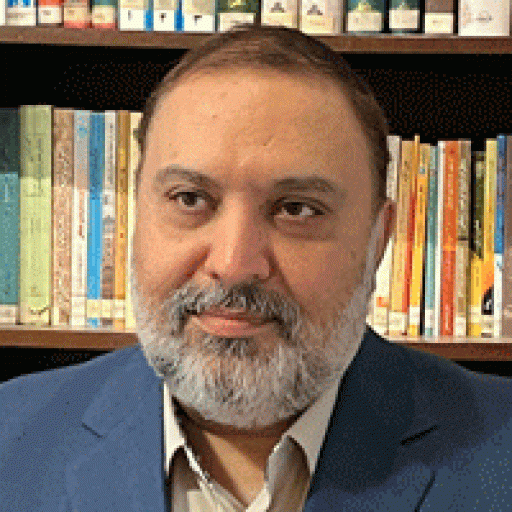
Dr. Reza Gholami, Assistant Professor at the Research Institute for Humanities and Cultural Studies
Introduction
Iranian Studies, as a broad academic field, encompasses various dimensions of Iran’s history, culture, language, literature, art, religion, society, and politics. This discipline, whose roots trace back to ancient times, has evolved over the centuries through intellectual interactions between Iran and its surrounding world. Today, Iranian Studies (Sajjadi, 2005) is recognized not only in academic centers within the country but also globally as an independent field of study.
Despite this breadth, Iranian Studies faces numerous challenges. These include methodological limitations, cultural and political biases, access to historical sources, and the influence of contemporary policies on Iranian studies research. Furthermore, the interdisciplinary and multidisciplinary nature of this field has led to the application of various approaches in analyzing Iran’s history and culture.
This article aims to provide a clear theoretical framework to explore the coordinates and approaches of Iranian Studies (Sajjadi, 2005), elucidating the capacities and challenges ahead. It will also address the importance of the Persian language (Pourdavoud, 1964), the connection between past and present in Iranian Studies (Sajjadi, 2005), and the role of Iranian civilization in shaping cultural identity. Ultimately, it emphasizes the necessity of a comprehensive, critical, and multifaceted approach in Iranian Studies (Sajjadi, 2005) to present a more accurate and holistic picture of Iran and its civilization.
Definition and Significance of Iranian Studies
Iranian Studies (Sajjadi, 2005) focuses on examining the history, culture, languages, literature, arts, religion, and society of Iran and its diaspora. This field encompasses various disciplines, including history, philosophy, linguistics, literature, art and architecture, religion, sociology, political science, and archaeology. It is closely related to fields such as Oriental Studies, Islamic Studies (particularly Shi’a Studies), Iranian historical and civilizational studies, archaeology, and Islamic philosophy. Iranian Studies is pursued both within Iran and in academic centers worldwide.
The Interdisciplinary and Multidisciplinary Nature of Iranian Studies
Iranian Studies is not a singular, unified discipline but rather a broad academic field that involves diverse scholarly interactions, with varying degrees of interdisciplinary collaboration.
In some cases, this collaboration takes a multidisciplinary approach, where multiple disciplines study a subject independently without deep integration. For instance, in research on the Elamite civilization, archaeologists focus on excavating ancient sites, while linguists analyze Elamite cuneiform texts. However, these two fields operate largely independently, each analyzing the subject from its own perspective without significant methodological overlap.
At a more integrated level, the interdisciplinary approach (Alavi, 2010) emerges, where different methods and concepts merge to provide a more comprehensive understanding. For example, in studying the social life of the Achaemenids, historians, archaeologists, and anthropologists can collaborate by analyzing historical records, archaeological discoveries, and cultural patterns to reconstruct a fuller picture of the social structure and daily life of that era.
Going beyond interdisciplinary collaboration, transdisciplinary interaction leads to a deeper fusion of knowledge and methodologies, resulting in entirely new frameworks or perspectives. A prime example of this can be seen in the study of ancient Iranian languages, where linguists, epigraphists, and archaeologists work together, using shared methodologies and combined analyses to gain new insights into the expansion and evolution of early Iranian languages.
Additionally, there is the cross-disciplinary approach, where one field borrows concepts or methods from another without direct collaboration. For example, an archaeologist analyzing Parthian pottery motifs using semiotic linguistic theories employs a cross-disciplinary method, as they apply linguistic techniques without direct engagement with linguists.
Finally, the post-disciplinary perspective challenges traditional academic boundaries and emphasizes solving problems without reliance on conventional disciplinary divisions. For instance, in researching the ethnic identities of Iranian peoples based on geographic place names, scholars might integrate historical data, linguistic studies, anthropological findings, and archaeological evidence without being confined to predefined academic categories, thereby constructing a holistic narrative of Iran’s ethnic transformations throughout history.
These various approaches demonstrate different levels of scholarly convergence, each selected and applied based on the nature of the research and its objectives.
Iranian Studies in the Classification of Sciences
Since Iranian Studies is a broad and diverse field rather than a single discipline, determining its exact place within the classification of sciences is not straightforward. Generally, it can be categorized under the humanities, regional studies, cultural studies, religious studies, archaeology, and social sciences. However, in many cases, it goes beyond these classifications and crosses interdisciplinary boundaries.
The Geographic Scope of Iranian Studies
Geographically, Iranian Studies traditionally focuses on the region known today as Iran. However, its scope extends beyond modern political borders and includes the following areas:
- Present-Day Iran: The country of Iran in West Asia, recognized as the historical and cultural heart of Iranian Studies.
- Greater Iran: A term referring to regions that, at various points in history, have been influenced by Iranian culture, language, or politics. These include:
- Central Asia: Countries such as Uzbekistan, Tajikistan, Turkmenistan, and parts of Afghanistan and Kazakhstan, where Iranian languages like Pashto and Tajik are spoken.
- The Caucasus: Parts of Azerbaijan, Armenia, and Georgia, which have historically been influenced by Iranian culture.
- The Middle East: Certain areas of Iraq (especially Iraqi Kurdistan), Syria, and Turkey (particularly Kurdish regions), where Iranian-speaking populations or Iranian cultural influence exist.
- The Iranian Diaspora: Communities of Iranians worldwide who maintain Persian culture, language, and traditions, contributing to the study of Iranian identity beyond national borders.
Thus, the geographic scope of Iranian Studies extends not only to present-day Iran but also to historically Iran-influenced regions and Iranian communities across the world.
Trans-Geographic Iranian Studies
Beyond geography-based Iranian Studies, there is also the concept of trans-geographic Iranian Studies, which examines Iran and Iranian culture beyond its current geographical boundaries. This concept includes:
- Iranian Studies in a Global Civilizational Context: Investigating the presence and influence of Iranian culture, language, history, and civilization in lands beyond Greater Iran, especially in regions that have historically interacted with Iran.
- Iranian Studies in Migration: Analyzing the cultural, social, and economic conditions of Iranian migrants worldwide, from Iranian communities in North America and Europe to Persian-speaking populations in Central Asia and the Persian Gulf.
What Defines Iran as Iran?
Why is it important to ask what makes Iran, Iran? This question is crucial not only for understanding Iran’s civilizational identity and distinguishing it from other civilizations but also for shaping Iranian Studies (Sajjadi, 2005) as a field. In answering this question—not merely a historical inquiry but a means of understanding identity, past, and future—several key factors have been proposed:
- Ancient Civilization and Shared Culture: Iran is home to one of the world’s oldest civilizations, with enduring cultural values, myths, literature, wisdom, and philosophy that have shaped and sustained Iranian identity over time.
- The Persian Language: As a cultural, scientific, and literary language, Persian has connected diverse Iranian ethnic groups and reinforced their common identity.
- An Ancient Bureaucratic State Structure: From the Achaemenids to the Safavids, Iranian governments have managed ethnic diversity through a bureaucratic and administrative system that has maintained relative unity.
- Iranian-Adapted Islam: The integration of Islam with Iranian cultural elements—such as Sufism, philosophy, and Shi’ism—has contributed to the coherence of Iranian identity.
- Stable Historical and Cultural Borders: Despite geopolitical changes, Iranian identity has persisted throughout history.
- A Shared Historical Experience: Collective experiences of wars, resistance, and cultural flourishing have shaped the national consciousness of Iranians.
The Role of Iranian Studies in Orientalism
There is no doubt that Iranian Studies is an integral part of Orientalism, as Iran, as one of the most significant Eastern civilizations, has played a key role in shaping Eastern culture, history, and thought. Orientalism explores the societies, languages, religions, and histories of Eastern countries, and Iranian Studies, as a major branch, contributes significantly to this field.
Iran’s rich cultural heritage—including its philosophy, literature, mysticism, art, and political traditions—has influenced neighboring civilizations such as India, the Ottoman Empire, China, and the Arab world. Moreover, Iran played a crucial role in transmitting and Islamizing Greek-Roman sciences and ideas, thereby fostering intellectual growth across the Eastern world. Additionally, Persian literature and Iranian thought have greatly contributed to the development of Islamic mysticism and Eastern philosophical schools.
In modern times, Iranian Studies offers deeper insights into the historical, social, and political dynamics of the East. Understanding Iran’s transformations from ancient times to the present helps scholars comprehend broader cultural and civilizational patterns in the East. Thus, a comprehensive understanding of Orientalism is incomplete without a thorough study of Iran.
Problematics in Iranian Studies
In Iranian Studies, “problematics” refers to a set of challenges that researchers face. These challenges include cultural and political biases that can influence research outcomes. Additionally, access to resources—particularly historical documents and literary texts—can be difficult due to linguistic barriers or cultural policies that restrict availability.
Language and translation issues are also significant because many key texts are written in Iranian languages, making their interpretation complex. Furthermore, rapid political and social changes in Iran complicate analyses, as evolving conditions influence historical and contemporary perspectives.
Iran’s ethnic and linguistic diversity adds another layer of complexity to cultural and social studies. Moreover, identity debates—including national, ethnic, and religious identities—interact with global influences, creating further research challenges.
Other key problematics in Iranian Studies include:
- Globalization and the Iranian diaspora
- Historiography and the interpretation of Iran’s past
- Gender issues and equality in Iranian society
- Cultural heritage preservation
Given these complexities, Iranian Studies requires interdisciplinary approach (Alavi, 2010)es that are both context-sensitive and methodologically diverse.
Theoretical Frameworks in Iranian Studies
Iranian Studies is a multidisciplinary field that applies diverse theoretical approaches to examine Iran from historical, cultural, linguistic, philosophical, social, geographical, and political perspectives. These approaches can be categorized into six main frameworks:
- Historical and Civilizational Approaches:
- Traditional historiography
- Modern historical analysis
- Civilizational studies focusing on Iran’s historical transformations
- Linguistic and Literary Approaches:
- Historical linguistics
- Literary criticism
- Hermeneutics of Persian and classical texts
- Philosophical and Intellectual Approaches:
- Philosophical Iranian Studies
- Studies of Iranian mysticism (Sufism)
- Postcolonial discourse analysis related to Iran
- Sociological and Anthropological Approaches:
- Social structures and transformations in Iran
- Popular culture studies
- Modernization processes in Iranian society
- Geographical and Economic Approaches:
- The impact of natural environments on Iranian culture
- Historical and contemporary economic developments in Iran
- Political and International Approaches:
- Iran’s role in international relations
- National identity and foreign policy
- The interaction of Iran with global political structures
It is important to note that these approaches often intersect and complement each other, creating a more comprehensive understanding of Iran.
The Importance of Recognizing the Relativity of Iranian Studies
A critical aspect of Iranian Studies is acknowledging its relative nature. Due to the vast scope of topics, diverse research methodologies, and overlaps with multiple disciplines, it cannot be confined to a fixed or absolute framework.
Iranian Studies has evolved within different historical, cultural, social, and religious contexts, leading to varied interpretations and shifting boundaries based on researchers’ perspectives and research methods.
Thus, accepting the relativity of definitions and classifications in Iranian Studies allows for a more flexible and precise understanding of this dynamic academic field.
Historical Background of Iranian Studies
Iranian studies date back to ancient times, when the Greek historian Herodotus provided an account of the Achaemenid Empire. During the medieval period, Islamic geographers and historians such as Ibn Khordadbeh and Mas’udi wrote about Iran and its history. However, the academic discipline of Iranian studies in the West emerged in the 18th and 19th centuries, when European Orientalists began translating and analyzing ancient Persian texts. One of the major milestones in this field was the discovery and translation of Achaemenid inscriptions by Henry Rawlinson.
In the 20th century, with the expansion of universities and research institutions, Iranian studies developed as an independent discipline, focusing on linguistics, history, literature, art, and archaeology. Today, in addition to these traditional areas, Iranian studies also encompass contemporary issues related to Iran and the Iranian diaspora.
It is worth noting that over the past century, Iranian studies have gradually expanded within the Iranian cultural sphere, particularly in Iran, as the heart of Iranian civilization. Iranian universities and research centers have conducted extensive studies on Iran’s history, language, literature, and culture, producing valuable academic works. Furthermore, scientific collaborations between Iran and other countries in the region have played a crucial role in strengthening this field of study.
Unqualified Researchers in Iranian Studies
- Those with Bias, Prejudgment, or Political Influence
Individuals who approach Iranian studies with strong cultural, political, or religious biases, or whose perspectives are excessively shaped by contemporary political agendas, often fail to conduct objective and scholarly research. Bias restricts the researcher’s viewpoint and prevents a comprehensive and accurate understanding of Iran. Studying Iran requires an open and analytical approach that moves beyond one-dimensional perspectives.
- Those Without Firsthand Experience or with Superficial and Stereotypical Views
A deep understanding of Iran’s culture, history, and society requires firsthand experience or direct engagement with Iranian life. Those who analyze Iran from an external perspective and rely only on stereotypes often present an incomplete and distorted picture.
To understand Iran, one must recognize its ethnic, cultural, and social diversity and identify the underlying elements that unify this diversity into a meaningful whole. This requires a deep understanding of the shared world of Iranians, which is rooted in language, history, mythology, shared values, and historical experiences. Without immersing oneself in this world and uncovering its fundamental connections, it is impossible to gain a precise and comprehensive view of Iran.
- Those Who Avoid Dialogue, Collaboration, and Mutual Criticism
A fundamental flaw in some researchers is their reluctance to engage in academic dialogue, collaboration, and, most importantly, mutual criticism. Constructive criticism and intellectual exchange are essential for the progress of Iranian studies.
The Colonialist Influence on Orientalist Studies of Iran
Some Orientalists associated with colonial interests have had a significant negative impact on Iranian studies. They interpreted Iran’s history and culture in ways that aligned with colonial objectives, leading to distortions, oversimplifications, and cultural denigration. In some cases, these Orientalists reinforced negative stereotypes about Iran, such as despotism or cultural backwardness, and portrayed Iranian culture as inferior to Western civilization.
Such approaches oversimplified Iran’s complex cultural landscape, controlled narratives by selectively presenting historical sources, and restricted access to certain information to maintain intellectual dominance. This widened the gap between East and West, often overlooking indigenous perspectives.
Regarding religion, particularly Islam and Shiism, some Orientalist interpretations sought to discredit or misrepresent these beliefs, affecting Western perceptions of Iran. These challenges highlight the need for a critical reassessment of past research and a greater focus on diverse and indigenous perspectives in Iranian studies.
The Unique Contributions of Independent and Dedicated Orientalists to Iranian Studies
Alongside colonial-influenced Orientalists, there have been dedicated and independent scholars who have made invaluable contributions to Iranian studies. These scholars, driven by a genuine passion for uncovering the mysteries of human civilization, played a major role in preserving, translating, and analyzing classical Persian, Arabic, and Iranian texts.
They introduced the works of great Iranian figures such as Ferdowsi, Hafez, and Saadi to the Western world, creating a bridge between cultures. Their contributions also extended to archaeological discoveries, including Achaemenid inscriptions and the deciphering of ancient Persian cuneiform scripts.
Through rigorous and scholarly research, these Orientalists prevented historical and cultural distortions and helped correct misunderstandings about Iran and Islam. Their work expanded global knowledge of Iranian civilization, contributing not only to historical and cultural awareness but also to Iran’s own self-perception and cultural identity.
The Pitfall of Iranian Studies from the Perspective of Certain Social Groups Throughout History
One of the major pitfalls of Iranian studies has been the dominance of a single perspective or social group in shaping historical, cultural, and social narratives. Throughout history, various groups—including rulers, political elites, religious scholars, and specific social classes—have controlled the production and transmission of knowledge. Consequently, their narratives have often reflected their own interests and worldviews.
For instance, ruling elites and political authorities, from the Achaemenid and Sassanian dynasties to the modern era, have played a crucial role in recording history. They often documented events in ways that legitimized their own power, while the voices of the defeated, minorities, or political dissidents were largely excluded. As a result, many significant aspects of Iran’s social and cultural history—such as the lives of the lower classes, women, and ethnic groups—have been marginalized or distorted.
Religious elites have also influenced the writing of history and the cultural interpretation of Iran at various points. In some cases, Iran’s ancient traditions were either placed in opposition to religious discourse or reinterpreted to align with prevailing religious beliefs. These narratives have sometimes diminished or altered the meaning of certain cultural, mythological, and historical elements of Iran.
Similarly, modern intellectuals and elites—particularly during the Constitutional Revolution and beyond—have often approached Iran’s history and culture through a Westernized lens. Some have emphasized Iran’s historical backwardness, portraying its past in a largely negative light and presenting aspects of Iranian culture as obstacles to progress. Conversely, others have adopted an extreme nationalist approach, mythologizing the past and constructing an idealized image of Iranian history that does not always align with historical realities.
In summary, the main pitfall in Iranian studies is that Iran’s history and culture have often been written from the perspective of a single group or class, while the voices of many social groups, ethnic minorities, women, and the lower classes have been overlooked. Overcoming this issue requires a comprehensive, critical, and multifaceted approach that reflects all perspectives and provides a more accurate picture of Iran’s past and present.
From the Initial Conflict Between Iran and Islam to Their Reciprocal Contributions in Iranian Studies
The historical relationship between Iran and Islam evolved from initial conflict to mutual contributions. Following the Arab-Muslim conquest of Iran in the 7th century, cultural and political tensions existed in some regions. However, over time, not only did Islamic teachings transform aspects of Iranian society, but Iran also integrated Islamic thought and culture with its own traditions. This fusion led to the advancement of literature, sciences, arts, and Islamic philosophy, which were deeply influenced by Iran’s rich intellectual heritage. Ultimately, this interaction enriched Islamic civilization and turned Iran into a major scientific and cultural hub of the Islamic world.
In Iranian studies, this reciprocal relationship has played a crucial role in understanding the Iranian-Islamic identity, prompting research on how these two cultures have mutually shaped and influenced one another.
Assessing the Strengths and Weaknesses of Different Disciplines in Iranian Studies
In Iranian studies, various disciplines—including philosophy, history, empirical sciences, linguistics, and hermeneutics—each have their own opportunities and challenges.
Empirical sciences face the greatest challenges due to fieldwork limitations, lack of resources, and difficulty accessing real data. These obstacles make research in areas such as sociology, economics, and environmental studies particularly difficult.
Philosophy, particularly in the fields of Islamic philosophy and mysticism, holds a stronger position in Iranian studies. However, it could benefit from a closer connection to contemporary issues.
History, despite its rich sources, often focuses on specific periods while transitional eras remain underexplored. The dominance of certain historical narratives can lead to gaps in understanding the full scope of Iran’s past.
Linguistics primarily concentrates on Persian and classical Iranian languages, but less-documented regional languages require greater attention.
Hermeneutics plays a key role in interpreting historical, literary, and religious texts, yet the influence of elites and political authorities in historical writing can sometimes lead to biased interpretations.
Biology and archaeology also face significant obstacles due to research limitations, insufficient international collaborations, and restricted access to data and historical sites.
Overall, empirical sciences remain the weakest field, followed by challenges in linguistics, biology, and archaeology. Meanwhile, history and hermeneutics are influenced by political and ideological factors, which can impact their objectivity.
The Indispensable Role of the Persian Language in Iranian Studies
A deep and comprehensive knowledge of the Persian language (Pourdavoud, 1964) is fundamental in Iranian studies. This proficiency allows scholars to access primary historical, literary, philosophical, legal, and religious sources without relying on intermediaries, which is essential for accurate interpretation. Persian, with its complex nuances and expressions—especially in poetry and literature—requires profound understanding for precise analysis. Additionally, mastering the language enhances comprehension of Iranian culture, traditions, and social dynamics, as language serves as a reflection of these elements.
In field research, proficiency in Persian is crucial for conducting interviews and engaging directly with people. From a linguistic perspective, studying the evolution of Persian and its influence on other Iranian languages—and vice versa—provides a broader understanding of Iran’s cultural and historical development. Moreover, a deep knowledge of Persian is vital for accurately translating Iranian works into other languages and facilitating international communication. Without this linguistic proficiency, Iranian studies may face significant limitations in accurately understanding and conveying Iran’s history and culture.
Furthermore, familiarity with ancient languages of the Iranian civilization, as well as the diverse dialects of Persian throughout history, is highly important. Equally significant is the understanding of languages that have played a role in preserving Iranian intellectual heritage, such as Arabic during the post-Islamic period in Iran.
Blind Spots in Iranian Studies
Iranian studies contain certain blind spots that can limit a comprehensive understanding of this field. One major issue is the excessive focus on well-known historical periods, such as the Achaemenid or Sassanian dynasties, while transitional periods receive less scholarly attention. Similarly, the ethnic and linguistic diversity of Iran is often overlooked, with a predominant focus on Persian culture.
Restricted access to historical and literary sources due to political or security reasons presents another challenge. Gender studies and the role of women in Iranian history have been relatively underexplored. Research on contemporary Iranian issues is also constrained due to political sensitivities. Additionally, the lack of translations of key Persian sources into major international languages remains a weakness.
Cultural and political biases can influence research, often prioritizing foreign perspectives over indigenous viewpoints. Environmental and geographical studies related to Iran have also been relatively neglected. Likewise, contemporary Iranian art and culture tend to receive less scholarly attention compared to classical art. These blind spots highlight areas where further research can significantly enrich the field of Iranian studies.
Bridging the Past and Present: A Key to Deeper Understanding and Sustainable Progress in Iranian Studies
Establishing a connection between Iran’s past and present fosters a deeper understanding of its cultural, social, and historical identity. Through a comparative analysis of historical events and contemporary conditions, scholars can better comprehend historical transformations and identify factors influencing today’s cultural and social structures. This approach not only enhances awareness of Iran’s civilizational heritage but also helps prevent the repetition of past mistakes and enables the application of historical experiences to address modern challenges.
The link between past and present is crucial for preserving and revitalizing cultural heritage, strengthening national identity, and formulating effective strategies for sustainable development. A thorough understanding of Iran’s history and civilization fosters a stronger sense of belonging and self-confidence among its people. Additionally, analyzing historical economic, social, and political structures allows policymakers to identify successful models from the past and integrate them into contemporary governance. As a result, a dynamic and practical approach to Iranian studies can play a key role in the country’s advancement.
However, establishing this connection is a methodologically delicate and complex task that deserves a more detailed discussion in its own right.
Final Thoughts
Iranian Studies, as an interdisciplinary field, plays a key role in understanding Iran’s history, culture, civilization, and social developments. This field not only examines Iran’s cultural and historical heritage but also analyzes the contemporary aspects of Iranian society and its interactions with the world. However, it faces challenges such as an excessive focus on certain historical periods, overlooking cultural and ethnic diversity, the impact of politicization on research, and limited access to original sources.
A key solution to strengthening Iranian Studies is adopting a comprehensive, critical, and interdisciplinary approach (Alavi, 2010) that can provide a more realistic and complete picture of Iran. The role of the Persian language (Pourdavoud, 1964) in this field is undeniable, as deep familiarity with it allows for precise examination and interpretation of historical, literary, and philosophical texts. Additionally, bridging the past and present helps researchers better understand historical developments and use historical experiences to analyze current conditions.
In summary, Iranian Studies requires an impartial and scientific perspective, avoiding political and cultural biases, and striving for a comprehensive understanding of Iran within its historical and civilizational context. Strengthening this approach will not only expand the knowledge of Iranian Studies globally but also enhance the understanding of Iranian identity and foster more constructive interactions between Iran and other nations.
References
Alavi, M. (2010). Theoretical Foundations of Interdisciplinary Research. Tehran: University Press.
Floor, W. (2004). Social History of Iran in the Safavid Era. Translated by Yaghoub Azhand. Tehran: Nashr-e Ney.
Jafarian, R. (2007). Introduction to Historical Research Methods. Tehran: SAMT.
Pourdavoud, E. (1964). Notes on Iranian Studies. Tehran: University of Tehran Press.
Sajjadi, M. (2005). The Nature, Necessity, and Methodology of Iranian Studies. National Studies Quarterly, 6(23), 123-145.