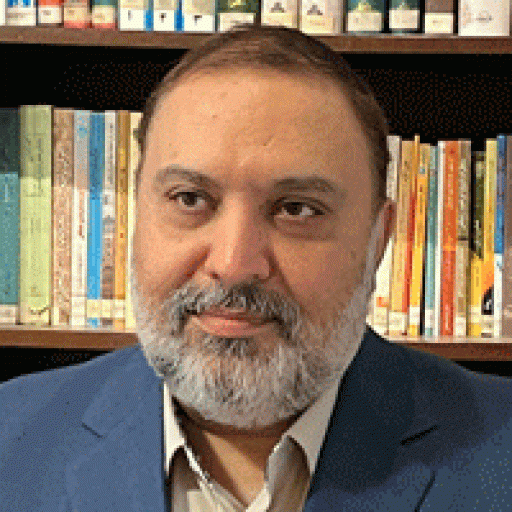
Full text of the speech by Dr. Reza Gholami, faculty member of the Institute for Humanities and Cultural Studies, delivered at the Second Symposium of Iranian Studies, accompanied by a night honoring the late Professor Bert Fragner, the distinguished Austrian Iranologist, on April 3, 2025 (14 Farvardin 1404), at the House of Iranian Wisdom, Vienna.
In the Name of God
Greetings to all the esteemed ladies and gentlemen present here. I would like to thank each and every one of you for attending this symposium.
Today, I want to talk about how Iranians relate to their thousands-year-old history. For every nation, history is not just a list of past events—it is the basis on which cultural, intellectual, and social identities are built. In this talk, I will look at the ideas of six great philosophers—Hegel, Schleiermacher, Dilthey, Husserl, Heidegger, and Gadamer—who all, in one way or another, focused on the ongoing and evolving connection between humans and history.
The main idea that connects these philosophers is their approach to historical phenomenology. Although Hegel’s view may not fit perfectly into this idea, his work serves as an important starting point and inspiration for later thinkers.
By examining these views, we can offer a fresh reading of how Iranians connect with their own history. Finally, I will discuss this reading in relation to the Persian language and Iranian wisdom, showing how these two elements are inseparable in the Iranian experience of history.
- The Six Philosophers and Their Views on History
1.1. Hegel: History as the Movement of the World Spirit
Hegel sees history as a rational and dialectical process where the “absolute spirit” or “world spirit” moves toward freedom and self-awareness through conflicts. For him, history is not just a sequence of events but a meaningful flow shaped by social, cultural, and political struggles. Each person and nation plays a part in this process, even though history also follows its own inner logic beyond individual actions.
1.2. Schleiermacher: History as Interpretation and Empathy
Schleiermacher, known as the founder of modern hermeneutics, believes that understanding historical texts requires empathy. We must grasp the language and psychological background of past people. He sees interpretation as a dynamic process, where today’s reader connects with the thoughts of those from the past. Every historical event has meaning in its own time and culture, and we can understand it only by stepping into that world.
1.3. Dilthey: History as Lived Experience
Dilthey does not see history as a general, logical process. Instead, he views it as a collection of lived experiences. Every historical period and culture has its unique traits that we must understand through empathy. For Dilthey, history comes alive only when we look at the personal experiences, everyday life, and feelings of people.
1.4. Husserl: History as Part of Our Consciousness
Husserl believes that history is not just a list of external events. He places history within the structure of human consciousness by using ideas like “retention” and “protention.” This means that in every present moment, we carry traces of the past and expectations for the future. In Husserl’s view, history is part of our inner experience, and strictly scientific approaches might make us lose sight of the true, lived meaning of history.
1.5. Heidegger: History as “Being-in-the-World”
Heidegger, in his work “Being and Time,” explains that history is an inseparable part of human existence. From the moment we are born, we are thrown into a historical context that shapes who we are. Unlike Hegel’s idea of history moving toward freedom, Heidegger emphasizes the personal experience of being in the world and facing time.
1.6. Gadamer: History as the Fusion of Horizons
Gadamer, who developed philosophical hermeneutics further, sees history as a living process of human interpretation. He argues that our understanding of history is influenced by our own preconceptions and traditions. History changes as the horizons of the past and present merge in an ongoing dialogue.
- A New Reading of Iranians’ Relationship with Their History
Inspired by these views, we can see the Iranian connection to history in several ways:
– Rational and Dialectical Aspect (Hegel):
Iranians have actively shaped their own cultural and social changes as part of global history. Their civilization has not only been influenced by outside forces but has also played a key role in shaping regional and even world history.
– Lived and Experiential Aspect (Dilthey):
Iranian history is not only an official story but also a collection of memories, myths, and living traditions. Celebrations like Nowruz, reading the Shahnameh, and rituals like Ta’zieh all show a deep, personal connection with history as a lived experience.
– Hermeneutic Process (Schleiermacher and Gadamer):
Iranians have always re-read and reinterpreted their history through literature, poetry, and mysticism. Great figures like Ferdowsi, Hafez, and Rumi have used the past not only to tell stories but also to give new meaning to it in their own time.
– Existential Connection (Heidegger):
Festivals, rituals, and national ceremonies reflect how deeply Iranians feel connected to their history. From the moment they are born, people are immersed in a rich cultural and historical environment that forms an essential part of their identity.
- Persian Language and Iranian Wisdom: The Container and the Contained
In this connection, the Persian language plays a key role in Iranian identity. Persian is not just a tool for communication; it is a medium that naturally expresses deep wisdom. The language makes it easy to share philosophical and mystical ideas through poetry and prose.
3.1. Features of the Persian Language in Connection with Wisdom
- Pictorial and Metaphorical:
Persian is full of similes and metaphors that help explain deep historical and philosophical ideas.
- Flexible and Creative:
The language can form new expressions and ideas, allowing it to express a wide range of philosophical and mystical concepts.
- Connected to Mysticism:
Unlike many languages that focus on describing the physical world, Persian is traditionally used to express intuitive experiences and practical wisdom. Words like “secret,” “mystery,” “love,” “light,” and “truth” carry deep meanings that show the strong connection between Iranian views on history and existence.
3.2. Iranian Wisdom and Its Connection with History
Iranian wisdom, which has developed through the teachings of ancient traditions, Islamic philosophy, and mysticism, always links the metaphysical with the historical. In this tradition, history is seen not only as a material process but also as a reflection of deeper truths.
– The Wisdom of Khosrow:
This view recognizes a cosmic understanding that connects human beings, nature, and time.
– Islamic-Iranian Philosophy:
Inspired by Greek thought and traditional wisdom, it creates a rational view of existence. Even though many philosophical texts are in Arabic, their influence on Persian literature is clear.
– Islamic-Iranian Mysticism:
History is not only an external event but also a basis for personal growth. This journey is often expressed through poetry.
Thus, in the Persian language, history is seen as a living reality that is expressed in poetry, mysticism, wisdom, and philosophy. Through their poets and thinkers, Iranians have not only recorded history but also continuously reinterpreted it.
The Core of Iranian Wisdom
The core of Iranian wisdom can be looked at in three main ways:
- A) The Perfection of Man:
In Iranian wisdom, a person is not only a physical being but also capable of reaching a higher state of understanding. This idea is often expressed through the concept of a spiritual journey, where one moves toward higher levels of awareness.
- B) The Interconnection of the World and the Hereafter:
Instead of separating the material world and the spiritual world completely, Iranian wisdom sees them as closely linked. Life in this world is a step toward a deeper understanding of truth. Traditions like Nowruz and Yalda show how time and life are connected, leading to both material and spiritual progress.
- C) The Link Between Thought and Action:
A key aspect of Iranian wisdom is that theory and practice are not separated. The wisdom of Iran appears not only in ideas but also in everyday life, politics, art, and lifestyle. This practical wisdom has been important in shaping Iranian culture from ancient times to the present.
Conclusion: History as a Living Story
In this talk, we have seen that Iranian history is not just a buried past—it is a living story that continues in poetry, wisdom, and cultural traditions. The views of the great philosophers show us that history can be understood in many ways:
– Hegel shows that Iranian history is part of the global journey of the world spirit.
– Schleiermacher and Gadamer remind us that history must be reinterpreted and re-read, just as the Iranian literary tradition does.
– Dilthey and Husserl view history as a collection of lived experiences, woven into human consciousness.
– Heidegger emphasizes “being-in-the-world,” which is clearly seen in the rituals and customs of Iranians.
Throughout all of this, the Persian language has played a central role. It is not just a means of communication but also a space where wisdom is expressed and history is reinterpreted.
In short, Iranians have not only lived their history, but they have also continuously reinterpreted it through their language and wisdom. This living connection between language, wisdom, and history is one of the most important features of Iranian identity.
Thank you for your attention. I hope this talk helps open a new window for a deeper understanding of the connection between Iranians and their rich history and culture.