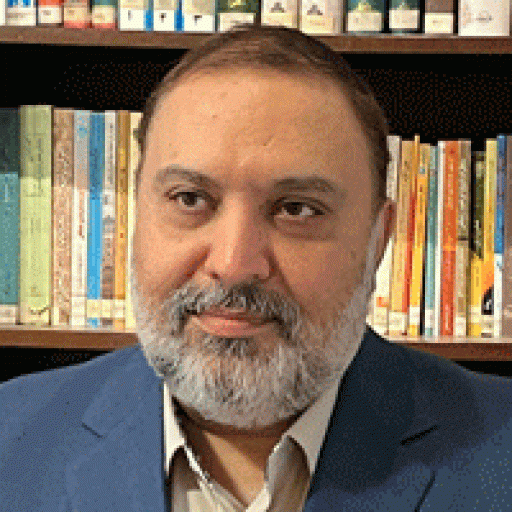
Text of the Speech by Dr. Reza Gholami, Seminar on Global Theories of Peace: Towards Critique and Completion, Hosted by The International Institute for Peace (IIP) and the Iranian Wisdom House, Date: Thursday, 13 March 2025, Vienna
Good morning, everyone.
I am happy to be here at this seminar. I appreciate the professors who accepted our invitation to speak, and I especially thank Mag. Stephanie Fenkart, Director of IIP,for coordinating this seminar.
I am excited to share my research on the theory of the “Global-City,” global governance, and its challenges and opportunities for peace. I will explain why we must update our ideas of human rights and governance for today’s interconnected world.
Introduction
Today’s world is more connected than ever. We can assume that, with the growth of new technologies, the process of globalization is on a path of progress. Traditional human rights were designed for separate nation-states, but now we should, considering the vision of globalization’s progress, think about a new theory for peace that works effectively. In fact, we need to protect new issues such as digital privacy, environmental health, and cultural diversity. My research suggests that by updating our human rights declaration, we can create a fairer system for all.
What Is a Global City?
A global city is a vibrant center where diverse cultures, technologies, and ideas meet. Advances in the internet, social media, and digital tools have shrunk distances, making global connections possible. In these cities, local issues mix with global challenges. They act like mini-governments that not only serve local needs but also address worldwide problems.
Now, in my article, beyond global cities, I have said it’s possible that the world could become one single city. Some people, thinking about the obstacles, say it’s unlikely the world will become one city, but new thecnologies particular the AI and its revolution could make this idea stronger.
How Technology Is Changing Governance
we need to realize that as the world turns into one big city, we need a new way of governing.
Modern technology is making government work more efficient and transparent. Tools like artificial intelligence, blockchain, and the Internet of Things improve communication and accountability. Most importantly, they bring humans closer together than ever before. Digital platforms let citizens share their views easily and help leaders monitor public needs. As a result, digital rights—such as protecting personal data and online privacy—are now a must. Our legal and human rights frameworks should grow along with these technologies. These are signs that prove a new way of governing is forming.
But, new technologies have two sides: on one side, they help peace, and on the other side, they create big obstacles to peace. I think the first side is more likely.
The Need to Revise Our Human Rights Declaration
In my opinion, the most important resource we have for spreading peace in the future is relying on the Universal Declaration of Human Rights; however, the Human Rights was a breakthrough in its time, but it does not fully cover today’s challenges. We now face issues that require new protections, including:
- Digital Rights: Ensuring our online privacy and fair use of technology.
- Environmental Rights: Addressing climate change and securing access to natural resources.
- Cultural Rights: Respecting diverse traditions and local identities in a global framework.
In the revised human rights declaration, it is essential to end the double standards imposed by some Western countries on human rights. Drawing on John Rawls’ idea of the social contract—and his concept of the veil of ignorance, where we make decisions without knowing our social position—we can create a fair system that protects everyone equally.
Opportunities and Challenges of the Global City
Global cities offer many opportunities:
- Innovation and Cultural Exchange: They create environments where diverse ideas and cultures merge, fostering creativity and progress.
- Economic Growth: By connecting different parts of the world, they boost economic activity and share resources.
However, challenges exist:
- Loss of Local Culture: The drive for global unity might erase unique local traditions.
- Inequality: Benefits of globalization may not reach everyone equally.
To make global cities work for all, we must invest in education about human rights and also ensure that new technologies benefit everyone.
Innovations in My Research
My research introduces several key innovations:
- A New Model for Global Governance:
Cities become part of a larger, interconnected system that addresses both local and global challenges.
- A Revised Human Rights Framework:
Updating the human rights declaration to include digital rights, environmental protection, and respect for cultural diversity.
- Integration of Modern Technologies:
Using digital tools to enhance transparency and efficiency in governance.
- A Fair Social Contract:
Applying Rawls’ ideas to design a system that is just for everyone, regardless of background.
Working Together for a Peaceful Future
Building a peaceful global society requires cooperation:
- Strengthen International Institutions:
Improve organizations that monitor human rights and ensure fair governance.
- Use Technology for Transparency:
Digital tools can help citizens keep governments accountable.
- Promote Global Education:
Teach everyone about their rights in the digital age and the importance of cultural diversity.
- Encourage Collaborative Governance:
Cities and nations must work together to solve problems like climate change and inequality.
Conclusion
In conclusion, rethinking global governance through the lens of the global city offers a promising path to lasting peace. By updating our human rights declaration and embracing modern technology, we can create a system that protects all citizens fairly. Although challenges remain, the potential for a just and peaceful future is within our reach.
Thank you for your attention. I look forward to your questions and ideas in my lecture.
***
“The full text of the article will be published in the book of collected seminar papers.”