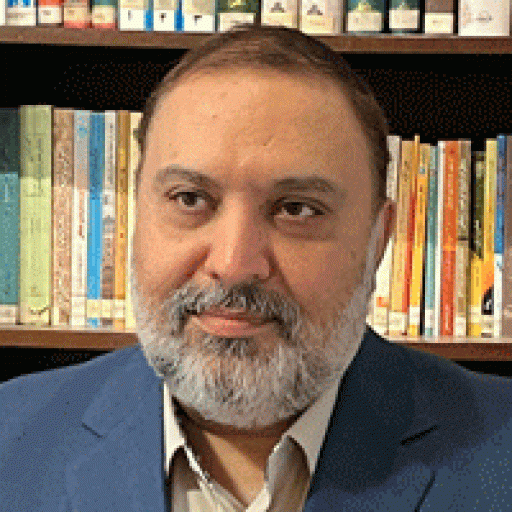
Reza Gholami, Faculty Member at the Institute for Humanities and Cultural Studies
https://en.r-gholami.ir/
Introduction
The modern world faces unprecedented challenges that have shaken the current global order and exposed the inefficiency of some international institutions, such as the United Nations and the Security Council. The unlawful actions of certain powerful states—violating international law, applying double standards in human rights, remaining silent or even supporting the massacre of people in Gaza under the pretext of Israel’s right to self-defense, and launching unlawful attacks on Iran by Israel and the United States based on unproven claims about nuclear weapons—have weakened democracy and civil institutions in some countries. Media censorship, soft restrictions on free expression, the shift of political rivalry into hostility in some regions, declining trust in diplomacy, and the weakening of global cooperation in the face of issues like climate change all point to the need for a rethinking of fundamental political philosophy concepts such as sovereignty, justice, legitimacy, and order. This article, using frameworks such as critical pluralism, postcolonial critique, and ethics of suffering, analyzes these challenges and suggests ways to redefine these core ideas.
1. Unlawful Actions and Double Standards in Human Rights
Certain global powers—especially permanent members of the Security Council—have undermined the legitimacy of the world order by violating international law and applying double standards. For example, the massacre of people in Gaza by Israel, under the claim of self-defense and often met with silence or support from some Western states, shows clear human rights violations. Military interventions in the Middle East—in Iraq, Afghanistan, Syria, and Yemen—have been justified using human rights rhetoric but have instead fueled humanitarian crises (UNHCR, 2023). Edward Said, in Orientalism (1978), argued that Western portrayals of the non-Western world as a backward “Other” enabled such interventions (Said, 1978, p. 7). The unequal distribution of COVID-19 vaccines (WHO, 2021) also reflects ongoing postcolonial structures that silence marginalized voices (Spivak, 1988, p. 308).
2. Inefficiency of the United Nations and Security Council
The actions of permanent Security Council members—such as supporting military operations and killings in Gaza or in the Ukraine crisis—highlight the UN’s failure to reduce global tensions. The veto power has become a tool to preserve the interests of major powers and has blocked global justice. The unlawful attack on Iran by Israel and the United States without credible legal evidence is an example of power misuse in international institutions. Chantal Mouffe (2000), through her concept of “agonism,” suggests that true democracy requires a space for non-hostile political competition (Mouffe, 2000, p. 103). Her view offers a framework for reforming international institutions and enhancing global dialogue.
3. Weakening of Democracy and Civil Institutions
In some countries, weakening public participation in coexistence and global peace has gone hand in hand with the erosion of democracy and civil institutions. Public opinion is often shaped by digital censorship and mainstream media that justify events like the Gaza massacre or attacks on Iran. This undermines democratic participation and weakens civil society, including NGOs. Nancy Fraser (2008) argues that structural inequality and silencing of marginalized groups hollow out democracy from within (Fraser, 2008, p. 16). Critical pluralism, by recognizing diverse perspectives, can revive democracy, as seen in indigenous movements in Bolivia that redefined political structures and strengthened civil society through public participation.
4. Media Censorship and Public Opinion Engineering
In some cases, censorship on digital platforms and in global media has led to the engineering of public opinion in favor of powerful states. Selective coverage of the Gaza crisis or distorted narratives about attacks on Iran limit society’s ability to critique power structures. Gayatri Spivak (1988) warns that global power structures often silence or distort the voices of the oppressed (Spivak, 1988, p. 308). Redefining free speech through postcolonial critique can enhance critical dialogue—for example, digital activists in South Africa have worked to expose social inequalities.
5. Soft Restrictions on Free Speech for Intellectuals
In some Western countries, soft restrictions on free speech are applied, especially to scholars and intellectuals. Criticism of certain state policies—such as military support for actions in Gaza or Iran—is sometimes suppressed through political or economic pressure. Jürgen Habermas (1989) argues that weakening the public sphere by imposing conditions from powerful actors endangers democracy (Habermas, 1989, p. 27). This view is relevant for analyzing restrictions on critical intellectuals in the West and highlights the need to strengthen public discourse.
6. Decline of Rational Governance in Some Systems
The rise of populism in parts of Europe and the United States has in some cases led to a decline in rational decision-making. Support for military actions in Gaza or against Iran, without legal evidence, represents emotionally driven decisions that worsen crises like climate change. According to the UN, over 150 million people had been displaced by environmental disasters by 2023 (UNHCR, 2023). Emmanuel Levinas (1961), by emphasizing responsibility toward the “Other,” offers an ethical framework for restoring rationality to governance (Levinas, 1961, p. 199).
7. Turning Political Rivalry into Hostility
In some regions, political rivalry between states and nations has turned into open or hidden hostility. The Gaza crisis and attacks on Iran are examples where tensions escalated through military and economic tools like unilateral sanctions. Geopolitical tensions in the South China Sea also reflect the replacement of dialogue with confrontation. Chantal Mouffe (2000) insists that agonism, rather than antagonism, can transform competition into cooperation (Mouffe, 2000, p. 103). Managing conflicts in a non-hostile environment requires redefining political competition.
8. Decline in Global Cooperation on Major Challenges
Unequal behavior by certain powerful states—such as monopolizing resources or supporting military operations in Gaza and Iran—has, in some cases, weakened global cooperation on major challenges like climate change and pandemics. A WHO report (2021) shows that the unfair distribution of COVID-19 vaccines deepened the divide between high-income and low-income countries. Nancy Fraser (2008) argues that justice must include the recognition of differences (Fraser, 2008, p. 16). Rebuilding global cooperation requires addressing structural inequalities.
9. Diplomacy Undermined by Powerful States
Some powerful nations, by supporting unilateral actions such as military operations in Gaza or attacks on Iran, have sidelined diplomacy. Destroying dialogue channels—such as withdrawing from international agreements—has weakened trust among nations. Levinas (1961) emphasizes that responsibility toward the “Other” can offer a framework for restoring diplomacy (Levinas, 1961, p. 199). Rebuilding diplomacy demands commitment to equal dialogue and its prerequisites.
10. Rethinking Political Philosophy’s Core Concepts
To address global challenges—from structural inequality to environmental crises and geopolitical tensions—contemporary political philosophy must rethink concepts such as “justice,” “legitimacy,” “sovereignty,” “responsibility,” and the “Other” in light of emerging realities. For example, the idea of “environmental justice,” rooted in indigenous movements like climate protests in the Amazon, combines social justice with environmental sustainability (Schlosberg, 2007, p. 14).
Political philosophy can foster intercultural dialogue through Walter Mignolo’s (2011) concept of “local cosmopolitanism,” which respects local differences and strengthens global cooperation (Mignolo, 2011, p. 23), as seen in climate diplomacy initiatives in the Pacific Islands. Likewise, Carol Gilligan’s (1982) ethics of care redefines responsibility in light of global suffering, such as climate refugees in East Africa (Gilligan, 1982, p. 19).
Several real-world anchors also increase the transformative potential of political philosophy:
- A strong global turn toward ethics: A worldwide inclination toward ethical thinking has become a valuable asset for change.
- Rising global literacy: The growth of education empowers citizens to become politically aware and critical of power (UNESCO, 2023).
- Widespread communication platforms: Digital platforms have amplified the voices of marginalized communities.
- Independent and free parties: In some influential countries, independent political parties offer diverse views and keep political reform alive.
- Capable governments and global cooperation: States committed to reform and cooperation serve as models for diplomacy.
These frameworks and anchors connect theory to practice and lay the foundation for transformative theories.
Conclusion
In the face of global challenges—from the inefficiency of some international institutions to the weakening of democracy and reduced cooperation among nations—contemporary political philosophy must fundamentally rethink its core concepts such as justice, legitimacy, and order.
Frameworks such as critical pluralism, postcolonial critique, and the ethics of suffering provide tools for analyzing these challenges and proposing transformative solutions. For example, climate justice movements—such as protests by indigenous communities in the Amazon—demonstrate political philosophy’s potential to unite social justice with environmental sustainability (Klein, 2014, p. 56). Similarly, local diplomacy efforts—like those of Pacific Island nations pushing major powers to cut carbon emissions—can serve as models for rebuilding global cooperation. Empirical data, such as the displacement of over 150 million people due to environmental disasters by 2023 (UNHCR, 2023), highlight the urgent need to redefine these concepts based on tangible realities and to amplify marginalized voices. By linking theory to action—through fostering intercultural dialogue and supporting factors like rising global literacy, independent political parties, and governments committed to cooperation—political philosophy can help shape a more just global order. The future of this field depends on its ability to listen to the suffering of others, address structural inequalities, and create space for conflict management in a non-hostile framework.
References
- Fraser, N. (2008). Scales of Justice: Reimagining Political Space in a Globalizing World. Polity Press.
- Gilligan, C. (1982). In a Different Voice: Psychological Theory and Women’s Development. Harvard University Press.
- Habermas, J. (1989). The Structural Transformation of the Public Sphere. MIT Press.
- Klein, N. (2014). This Changes Everything: Capitalism vs. The Climate. Simon & Schuster.
- Levinas, E. (1961). Totality and Infinity: An Essay on Exteriority. Duquesne University Press.
- Mignolo, W. (2011). The Darker Side of Western Modernity: Global Futures, Decolonial Options. Duke University Press.
- Mouffe, C. (2000). The Democratic Paradox. Verso.
- Said, E. (1978). Orientalism. Pantheon Books.
- Schlosberg, D. (2007). Defining Environmental Justice: Theories, Movements, and Nature. Oxford University Press.
- Spivak, G. C. (1988). “Can the Subaltern Speak?” In Marxism and the Interpretation of Culture. University of Illinois Press.
- UNHCR (2023). Global Trends: Forced Displacement in 2023. United Nations High Commissioner for Refugees.
- UNESCO (2023). Global Education Monitoring Report 2023. United Nations Educational, Scientific and Cultural Organization.
- WHO (2021). World Health Statistics 2021. World Health Organization.
“This article, after being translated into German under the title “Rationale Wiedergeburt”, was published in the July 2025 issue of International magazine in Austria”