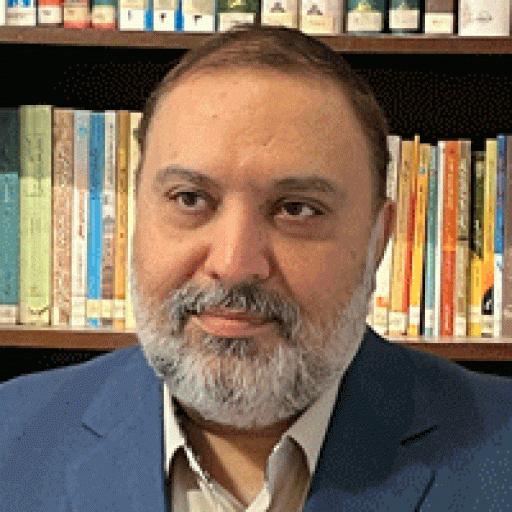
Full Text of Dr. Reza Gholami’s Speech at the Annual Conference of the European Academy of Religion, University of Vienna, July 11, 2025
It is my pleasure for being here. I would like to appreciate the conference team and panel chairman for his excellent management.
I present my article in 5 steps and 15 key points. The title of my article is: Islamic Moderation: Promoting Tolerance and Coexistence in a Multicultural World
In this article, I use both words “tolerance” and “moderation.” I believe moderation in social life can be another aspect of tolerance.
🟪 Introduction: A Civilizational Choice
In today’s interconnected world, physical borders are fading, yet cultural and emotional divides persist.
We face a pivotal question: Can we transform our differences into opportunities for growth, or will they fuel hatred, fear, and conflict?
The answer lies in embracing a balanced interpretation of religion—particularly Islam—that emphasizes moderation, reason, and respect for diversity.
actually, there are various interpretations of Islam based on the Quran and Sunnah. Among these, one interpretation emphasizes moderate Islam.
This interpretation moves beyond historical prejudices and biases, and by relying on the foundations of Islam in the Quran and Sunnah, opens the way for Islam to extend according to the needs of the time.
Far from being a source of division, this approach positions Islam as a path to unity and coexistence.
🟦 Step 1: Understanding the Challenge – Why Tolerance Matters Today
- Globalization connects us but doesn’t guarantee trust.
Globalization connects us but doesn’t guarantee trust. It has brought people closer, but without inclusive cultural policies, it can lead to tension, identity loss, or division. Cities like Jakarta and Toronto show how thoughtful policies can turn diversity into a source of innovation and harmony.
However, globalization still has not succeeded in truly supporting cultural pluralism—first in theory and then in practice. Instead, it often tries to make the world uniform.
This has caused many people and cultures to resist globalization, as they feel their unique identities are being ignored or threatened.
- Diversity drives creativity—or conflict.
In open societies, cultural diversity sparks creativity, as seen in the vibrant economies of London and Istanbul. However, in closed societies, differences can foster isolation or extremism if not embraced. - Tolerance is essential for stability.
Tolerance is not a luxury—it’s a necessity, like oxygen for society. Countries like Malaysia and Austria demonstrate that embracing mutual respect leads to greater peace and prosperity.
Moderate Islam aligns with this need, promoting inclusive governance and social harmony based on Islamic principles of fairness, without requiring a secular framework detached from faith.
I would like to draw your attention to this point:
although the relationship between Islam and secularism needs to be re-examined in its own right, here we should avoid three things:
First, secularism is not black and white – it has different levels, so we shouldn’t see it as all or nothing.
Second, not all forms of secularism are necessarily in conflict with social Islam.
Third, social Islam can be compatible with moderation.
🟨 Step 2: Religion – A Source of Unity or Division?
Religion can unite or divide, depending on interpretation.
Religion has the power to build bridges or create divides. Moderate Islam chooses unity by embracing diversity and dialogue, drawing on Islam’s universal values.
- Islam teaches justice and kindness toward all.
The Qur’an (60:8) instructs Muslims to act with kindness and fairness toward non-Muslims who seek peace. This principle provides a clear framework for coexistence in diverse societies. - The Prophet Muhammad (PBUH) modeled coexistence.
The Constitution of Medina, established by the Prophet, united Muslims, Christians, Jews, and others in a shared community. It demonstrates that Islam inherently supports living together with mutual respect.
Here, I would like to share an important and key point with you:
In moderate Islam, pluralism in understanding and practicing religion is considered an important principle. This approach allows for diversity of thought and practice. The most important mechanism for giving substance to moderation is implementing pluralism.
As Islamic scholars explain: “Pluralism has two transformative principles: first, understanding religion is relative, and second, no religion can claim to have all absolute truth. In fact, this principle states that all religions have a share of truth.” This perspective fosters mutual respect, encouraging dialogue while honoring core Islamic beliefs.
🟩 Step 3: Rethinking Tolerance – From Dialogue to Divine Guidance
Tolerance is about genuine dialogue.
my article inspired by philosopher Hans-Georg Gadamer.
Maybe we can say that intercultural philosophy depends a lot on his ideas.
he emphasized that understanding emerges from honest conversations between diverse perspectives, a principle echoed by moderate Islam, which encourages dialogue to bridge cultural divides.
The most effective way to promote moderate Islam is to foster open fields for dialogue and enhance understanding of its teachings.
Gadamer’s key idea about moderation and balance in religion centers on what he calls the “fusion of horizons.” He argues that understanding religious texts and traditions does not involve setting aside our own beliefs and ideas but requires a creative conversation between the historical context of the text and our modern perspective.
In this approach, religious moderation is not a fixed or predefined stance but an ongoing process of interpreting and reinterpreting tradition in response to contemporary challenges.
Gadamer emphasizes that this interpretive process demands what Aristotle called “phronesis” or practical wisdom, enabling balanced judgment tailored to specific situations.
Thus, religious moderation is not merely a moral stance but an essential component of accurately understanding and sustaining religious traditions in the modern world.
So, the most important way to spread moderate Islam is to open the field for dialogue and increase renew and contemporary understanding of Islam.
- The Qur’an calls for mutual understanding.
In Qur’an 49:13, diversity is celebrated as a means to “know one another,” inviting Muslims to engage, learn, and build connections across differences. Similarly, Qur’an 49:11 warns against mocking others, reinforcing respect as a foundation for tolerance. - Reason and faith align in moderate Islam.
I know that there has always been a serious tension between the Enlightenment movement — and later, modernism — and religions.
Let me share a point about this:
The Enlightenment movement, in all its interpretations, was not anti-religious but was against superstitions and delusions that were promoted in society in the name of religion.
As the Stanford Encyclopedia of Philosophy notes: “Though the Enlightenment is sometimes represented as the enemy of religion, it is more accurate to see it as critically directed against various (arguably contingent) features of religion, such as superstition, enthusiasm, fanaticism and supernaturalism.” Like Enlightenment thinkers, moderate Islam integrates reason with faith, as seen in historical examples like the pluralistic society of Andalusia, where rational dialogue and coexistence thrived.
🟥 Step 4: Reason and Moderation – The Heart of Islamic Ethics
Reason is central to Islamic thought.
When we examine Islamic teachings more closely, we find that “an interpretation of Islam can be found that fully opens the umbrella of reason over Islam.
It seems that drawing the relationship between reason and religion is the key to moderation in Islam.”
Furthermore, “the enlightened interpretation of Islam clearly tells us that Islam’s invitation is completely Rational, and a believer in Islam is someone who has made a conscious choice with their reason and after sufficient research.”
- Reason prevents extremism.
The Qur’an (16:44) urges reflection, protecting against superstition, violence, or impulsive decisions. By prioritizing reason, moderate Islam fosters balanced and ethical responses to modern challenges. - Moderation defines the Muslim community.
In Qur’an 2:143, Muslims are called a “moderate nation,” tasked with being fair, wise, and balanced.
If we stop looking at Islam from a narrow perspective and take a comprehensive view, moderation is in the nature of Islam.
In fact, we do not intend to import moderation into Islam! This identity rejects all forms of excess, promoting a harmonious approach to coexistence.
🟫 Step 5: Practical Steps to Promote Tolerance
Islam’s history proves coexistence is possible.
The Constitution of Medina and the multicultural society of Andalusia demonstrate that Islam has long supported diverse communities living in harmony. These examples inspire practical solutions today.
- Blend Islamic principles with new practices.
We can promote tolerance by:
- Encouraging intercultural dialogue through community forums and interfaith initiatives, as seen in Malaysia and Turkey.
- Teaching reasoning, critical thinking and moderation in schools to combat superstition and extremism.
- Fostering a balanced Muslim identity that embraces both faith and reason.
- Reimagine modernity through Islamic wisdom.
as I said, Modernity need not reject faith. Europe can cooperate and interact with moderate Islam in the best way if it expands intercultural philosophy and gain a deeper understanding of Islam.
By applying Islamic values of justice and compassion, we can create an ethical, inclusive world. We should not forget that we are all on the same ship today and share a common destiny. Therefore, we must abandon absolute thinking and intellectual superiority.
🟩 Special Recommendations for the European Academy of Religion
To deepen and expand a culture of moderation within Islamic communities in Europe, two practical steps are worth considering:
- 1. Promoting Genuine Interfaith and Intercultural Dialogue
– This should go beyond formalities and be conducted independently of state control, focusing on trust-building, mutual understanding, and shared ethical concerns.
We should not forget that: In a real dialogue, both sides should recognize that the other may also have a share of the truth.
I must admit that serious interfaith dialogue in Europe has declined today, or has become decorative and ineffective.
- Supporting Authentic and Committed Religious Intellectualism
– Encouraging voices from within the Islamic tradition that combine faith, reason, Reformist thought and global responsibility is essential to shaping a credible and future-oriented vision of moderate Islam.
🟪 Conclusion: Moderation as a Universal Language
Islamic moderation—rooted in reason, justice, and compassion—is more than a guiding principle for Muslims; it is a message of hope for the entire world.
In an age marked by fear, division, and conflict, what humanity needs is not louder voices, but wiser ones.
Moderate Islam speaks a language of peace, turning difference into dialogue, conflict into cooperation, and fear into mutual understanding.
By embracing this balanced and inclusive approach, we open the door to a future where diversity is not a burden to manage but a strength to celebrate.
Thank you for your attention.