
Dr. Reza Gholami
Faculty Member, Research Institute for Humanities and Cultural Studies
Introduction: Karl Popper, Iran, and a Somewhat Shallow Encounter
Although Karl Popper was not unknown to philosophy professors and researchers in Iran, widespread familiarity with his ideas in the Iranian philosophy and humanities community largely stems from Dr. Abdolkarim Soroush’s presentation of the theory of “Theoretical Contraction and Expansion of the Shari’a” in articles published in Keyhan-e Farhangi magazine during the late 1980s and early 1990s (late 1360s and early 1370s in the Persian calendar).
From the viewpoint of traditional conservative circles-both in seminaries and universities-that insisted on preserving an official, fixed, and sacred interpretation of religion, this theory was perceived as an intellectual earthquake.
At the time, some sought to weaken the theory by associating it with Popper, while others aimed to explain or critique it. Opponents often tried to present Soroush’s theory as a reworking or localized version of Popper’s ideas, perhaps to attach the label of “Westernization” to it or even portray it as part of a broader “cultural invasion” project. Others, without intending to undermine it but seeking a deeper critique, assumed that a fuller understanding required turning to Popper’s philosophy of science as its primary source.
Yet, although the contraction and expansion theory drew inspiration from the tradition of critical rationalism and certain Popperian concepts in the philosophy of science, it was not directly indebted to Popper and drew nourishment from a broader range of intellectual sources. Still, this contentious linkage brought Karl Popper’s name and ideas prominently into Iran’s intellectual discourse.
In some closed academic environments during the 1990s, even mentioning Popper in certain scholarly or university settings was occasionally regarded as an “academic sin” and provoked sharp, at times ideological, reactions from narrow-minded individuals. During those years, as a young student, I personally experienced this atmosphere and followed Popper’s ideas with both caution and genuine interest. His views opened horizons of questioning and rational critique more than they offered ready-made answers. In that climate, even criticizing Popper had become controversial; figures such as Dr. Reza Davari Ardakani authored books critiquing him, some parts of which were later accused by critics of not fully aligning with Popper’s actual positions.
From the late 1990s onward, conditions gradually changed. Many previously untranslated works by Popper appeared in Persian, and his ideas became subjects of discussion, critique, and dialogue not only in humanities circles but even in some religious studies groups. Although some still argue that Popper’s theories have not been grasped with sufficient philosophical precision, today discussing his views-particularly among philosophy and humanities students-is relatively common and accepted.
Against this background, my own engagement with Popper’s thought later took on a more concrete and reflective form, leading me to examine his ideas in detail in various lectures and articles.
Now, on 8 Bahman 1404 (corresponding to January 28, 2026), during a visit to Klagenfurt in southern Austria and the Karl Popper Archives at the University of Klagenfurt, I had the opportunity to revisit the interest in his philosophy of science that began during my doctoral studies. Walking through a space dedicated to Popper’s life and work involuntarily revived memories of those earlier years-when in Iran, Popper’s name symbolized epistemological and ideological conflicts more than it represented philosophical understanding.

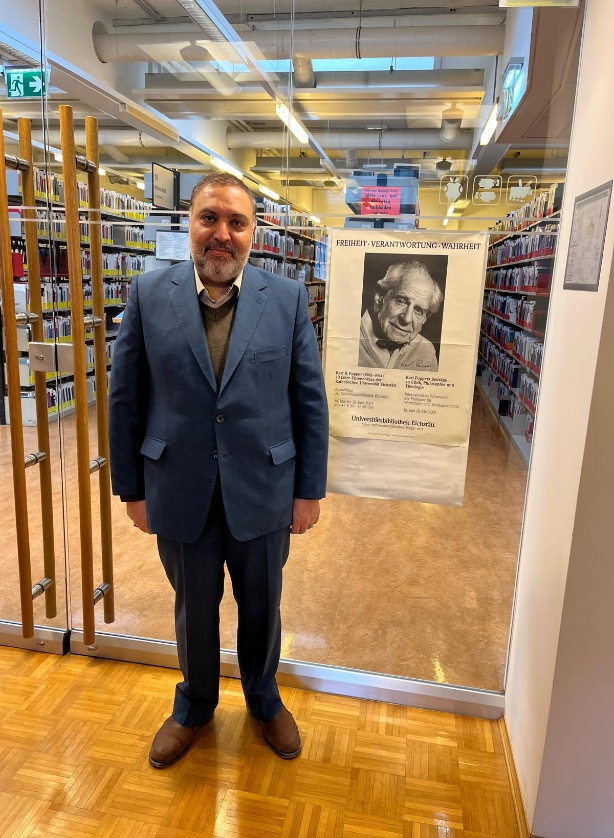
This note is an attempt to reflect once again on the possibilities and limits of applying Popper’s ideas in the humanities-a field today facing not only methodological crises but also deeper questions about its meaning, power, and purpose. Perhaps returning to Popper-not as an ultimate authority, but as a reminder of critical rationality, the fallibility of knowledge, and the necessity of ongoing critique-can still inspire fresh dialogue in this challenging domain.
Before proceeding to the main discussion, one common misunderstanding about Popper must be clarified: he does not deny access to truth. What he opposes is the claim of certain and final access to truth. By fostering a constructive skepticism regarding ultimate attainment of truth, he steers us away from naive essentialism and absolutism toward a more dynamic notion: approaching truth through criticizability (Popper, 1963).
Falsifiability and criticizability in Popper are governed by a specific methodology he developed: he accepts falsification not on the basis of logical positivism or induction, but within the framework of hypothetical-deductive methodology and critical rationalism-where falsification arises from deductive reasoning, methodological decisions, and commitment to continual critique. In Popper’s methodology, rationality consists in adhering to criticism, rigorous testing, avoiding the immunization of theories, and preferring theories that, compared to rivals, possess greater empirical content and explanatory power-not those that claim certainty. This approximation to truth is achieved not through confirmation and accumulation of evidence, but through persistent efforts to falsify one’s own theories.
- The Humanities within the Spectrum of Critical Rationality: Beyond the Science/Non-Science Binary
From Popper’s perspective, the humanities should not be forced into a rigid dichotomy between “science” and “non-science.” Rather, they should be viewed along a spectrum of modes of critical appraisal, all contributing to the common enterprise of problem-solving (Popper, 1972).
At one end are theories that make empirical claims and must therefore be formulated so as to be open to empirical testing and potential falsification-following Popper’s hypothetical-deductive approach, in which theories are bold conjectures exposed to severe critical tests. At the other end lie domains such as philosophy, hermeneutics, or parts of social theory that, while not strictly empirically falsifiable, remain firmly within the sphere of critical rationality.
In these areas, epistemic judgment occurs not via empirical testing but through rational critique, assessment of internal coherence, conceptual clarification, and evaluation of problem-solving capacity. Thus, within the Popperian framework, criticizability is not an alternative to falsifiability but a different articulation of the same critical rationality that underpins all forms of scientific and pre-scientific knowledge.
This perspective enables us to avoid reducing the humanities to the strict model of the natural sciences without lapsing into epistemological relativism. A sociologist, historian, or anthropologist can work rigorously and rationally even if their theory is not falsifiable in the strict Popperian sense—provided they remain open to criticism and critical judgment.
- Falsifiability: A Criterion of Demarcation, Not a Closed Boundary
Falsifiability is a simple but revolutionary concept: a theory is scientific if it can be subjected to testing and potentially refuted. Popper designed this criterion to separate science from pseudo-science, not to exclude fields lacking this feature (Popper, 1959).
Popper’s famous examples are illuminating: Einstein’s theory of relativity was falsifiable because it made specific predictions (such as the bending of light in a gravitational field) that could be tested. If those predictions had failed, the theory would have been rejected. In contrast, historical Marxism or Freudian psychoanalysis, in Popper’s view, were pseudo-sciences because they could explain any event and no occurrence could refute them (Popper, 1963).
The subtle but crucial difference is this: falsifiability differs from verifiability. No scientific theory can be definitively proven (since exceptions are always possible), but it can be refuted (by finding a counterexample). Science advances not by confirming theories but by falsifying incorrect ones and retaining those not yet falsified.
This ongoing cycle of conjecture and refutation drives science forward (Popper, 1963). However, in his later works-especially regarding metaphysical research programs-Popper himself acknowledged that the boundary between science and metaphysics is not as rigid as he once thought. Even metaphysical theories can play an exploratory and guiding role in science (Popper, 1983).
- From Falsifiability to Criticizability: Critical Rationality as an Epistemic Ethic
Falsifiability is not merely a logical criterion; it is the source of an epistemic ethic rooted in Popper’s hypothetical-deductive methodology, which equates rationality with criticizability. If we accept that our theories are always open to falsification, we must create a space where criticism is not only allowed but necessary and desirable.
This is the point Popper addresses in The Open Society and Its Enemies: a society where theories and ideologies are immune to criticism is closed and totalitarian. A society that accepts criticism as a tool of progress is open (Popper, 1945).
In the humanities, this point has added importance. Theories in this domain are often intertwined with values, ideologies, and cultural identities. Criticizing a social or historical theory is sometimes perceived as an attack on fundamental beliefs. Yet Popper reminds us: criticizing a theory is not criticizing the person. Accepting the possibility of error is not a sign of weakness but of scientific maturity.
Criticizability means being willing to reject one’s favored theory in the face of evidence. It means preferring truth over being right. It means turning science into a collective conversation where all participants-even critics-contribute to approaching truth.
- Approaching Truth: A Normative Guide, Not a Complete Logical Solution
One of Popper’s most appealing-and controversial-concepts is the idea of verisimilitude (truthlikeness or approaching truth). This concept attempts to offer a third way between two extremes: dogmatism, which claims certain access to truth, and extreme relativism, which denies truth altogether.
Popper argues that truth exists (as a regulative idea), but we cannot know with certainty that we have reached it. What we can have is an approximation to truth-meaning we can say one theory is closer to truth than another without claiming to possess final truth (Popper, 1963).
However, it must be admitted honestly that Popper faced serious technical difficulties in precisely formulating this concept. His attempts to define verisimilitude logically were met with strong criticism, particularly from David Miller and Pavel Tichý, who showed that Popper’s definition leads to inconsistencies in certain cases (Miller, 1974; Tichý, 1974). Popper himself accepted these problems.
Nevertheless, the idea of approaching truth can be viewed not as a fully rigorous logical concept but as a normative guide or inspiring idea. In this sense, we can use-albeit imperfect-criteria to evaluate theories: Does the new theory have greater empirical content? Does it make more precise predictions? Is it more consistent with available evidence?
For the humanities, this normative approach-despite its technical limitations-is liberating. A sociologist, psychologist, or economist does not need to claim discovery of eternal laws of human society. They can honestly say: “My theory is the best available approximation to truth, but I am ready to revise it in light of new criticism and evidence.”
- Popper and Today’s Crisis in the Humanities: Beyond Methodology
The humanities today face crises that go beyond methodology alone. The replication crisis in psychology (Open Science Collaboration, 2015), the crisis of meaning in sociology, the crisis of purpose in economics, and the crisis of power in cultural studies—all indicate deeper issues than mere lack of methodological adherence.
The replication crisis in psychology, which showed that many famous findings could not be reproduced, suggests researchers were more interested in confirming their theories than falsifying them. But why? Was it only methodological weakness, or institutional structures that reward “positive” and “innovative” results?
In sociology, the crisis is deeper: many theories are not only unfalsifiable but unclear about what problem they solve. Is merely interpreting social phenomena enough, or should social sciences contribute to social change?
In economics, models that failed to predict financial crises raise fundamental questions about the relation between theoretical abstraction and real-world complexity.
Popper cannot provide direct answers to all these crises, but he reminds us that transparency, criticizability, and focus on problem-solving must be central to any scientific activity. The Popperian solution is clear: Open Science. Transparency in methods, data, and analysis. Willingness to share raw data and analytical code so others can re-test results. Pre-registration of hypotheses before data collection to avoid confirmation bias (Nosek et al., 2015).
- Falsifiability in the Age of Artificial Intelligence: New Challenges for Science and Knowledge
Today, the humanities are being transformed by new tools such as artificial intelligence, machine learning, and big data analysis. This transformation brings serious challenges to Popper’s falsifiability criterion.
Machine learning algorithms are often “black boxes” whose decision-making processes are not transparent. If a model predicts that person X will commit a crime or patient Y will not recover, how can this prediction be tested and potentially refuted? These algorithms work based on statistical patterns in historical data, which may reflect existing biases and inequalities.
Popper reminds us that technological progress should not distance us from science’s foundational principles. This is especially important in cognitive sciences, where we deal with the complexities of human behavior and mind. If cognitive sciences want to be scientific, their hypotheses about cognitive processes, decision-making, and human behavior must be testable and falsifiable. But the challenge is that human behavior is complex, variable, and influenced by many factors, making precise testing difficult. Algorithmic transparency and model interpretability are the modern version of Popperian falsifiability, making every model and algorithm open to critical testing.
Some key questions in artificial intelligence:
- How can “black box” algorithms be designed to allow testing and falsification?
- Can an algorithm that merely reproduces patterns from historical data be falsifiable, or do new criteria need to be defined?
- What mechanisms are needed to ensure algorithmic transparency and prevent reproduction of biases in AI systems?
Some key questions in cognitive sciences:
- Can behavioral and cognitive predictions about individuals be meaningfully falsifiable, given the complexity and variability of human behavior?
- What criteria can be defined for critical testing of cognitive models in the era of advanced technologies?
- How can we balance the use of big data for understanding human behavior with ethical and scientific principles of falsifiability?
- Limitations of the Popperian Model in the Humanities
Despite the attractions of Popper’s philosophy, its limitations must also be acknowledged. Serious critiques have been leveled against the Popperian model that cannot be ignored.
Thomas Kuhn, in The Structure of Scientific Revolutions, showed that real science does not progress as Popper described. Scientists in “normal science” are not constantly critically testing their theories; they solve puzzles within a “paradigm.” Fundamental theory change occurs not through gradual falsification but through sudden “scientific revolutions” in which paradigms are replaced (Kuhn, 1962).
Imre Lakatos, Popper’s student, showed that scientific theories are rarely tested in isolation. They belong to “research programs” with a “hard core” and a “protective belt.” Scientists usually protect the hard core and adjust auxiliary hypotheses (Lakatos, 1970).
- V. O. Quine, in his critique of the analytic-synthetic distinction, showed that theories are not tested in isolation but as a whole (“holism”). Thus, one can always adjust other parts of the knowledge system to preserve a favored theory (Quine, 1951).
In the humanities, these limitations are more prominent. Many social theories are not isolated empirical statements but overall interpretive frameworks. Rejecting such a framework is not possible with a single counterexample.
Moreover, in the humanities, values play a stronger role that cannot be ignored. Choice of research topic, theoretical framework, and even data interpretation are influenced by the researcher’s value commitments. Popper was aware of this issue, but his solution—complete separation of the context of discovery from the context of justification—is difficult in practice.
Methodological limitation: In the author’s view, one important limitation of the Popperian model is that falsifiability and criticizability are products of and tied to Popper’s specific hypothetical-deductive methodology and critical rationalism. It is likely possible to use the core concepts of falsifiability and criticizability with different methodologies—not limited to Popper’s hypothetical-deductive approach. In other words, critical rationality might be redefined within interpretive, phenomenological, or even pragmatist frameworks without being confined to the hypothetical-deductive method. This possibility could open new doors for applying the Popperian spirit in the humanities.
- A Path to Escape Relativism: Maximizing Methodical Critique
Despite all these criticisms, I believe Popper’s philosophy offers a way to escape epistemological relativism-the relativism resulting from Kuhn’s theories, late Wittgenstein, and others (Wittgenstein, 1953; Kuhn, 1962).
If paradigms or “language games” are incommensurable and carry their own evaluation criteria, then rational judgment between rival theories becomes impossible. But Popper’s theory has the property that by maximizing falsifiability and methodical critique, it can lead us-albeit provisionally and temporarily-to theories that, because of their resilience against falsification and criticism, are probably closer to truth than others.
This approach is based not on positive confirmation but on critical survival. A theory that has faced the hardest possible criticisms and tests and still survives is likely closer to truth than one never seriously tested. This survival is neither permanent nor certain, but it is the only reliable guide we have.
Unlike Kuhnian relativism, which invites surrender to paradigm incommensurability, Popper offers a way for rational comparison of theories: Which has greater empirical content? Which makes bolder and more precise predictions? Which has greater problem-solving ability? Which is more consistent with available evidence?
These criteria are not perfect, but they save us from the abyss of relativism. They allow us to say: “This theory is better than that one,” without claiming to have reached final truth.
Conclusion: Popper, an Incomplete but Essential Guide
Popper’s philosophy is not a closed and complete system but a spirit and a normative guide. He taught us that the only path to truth passes through the gate of criticism. That we do not reach truth by insisting on being right, but by being ready to be wrong. That approaching truth is not a final achievement but an endless journey.
The humanities today need this spirit-not as a rigid instruction manual, but as a normative horizon toward which we move. Falsifiability and criticizability are not sufficient conditions for scientific progress, but they are necessary. Without them, science turns into dogma, and dogma leads nowhere.
In an era facing information explosion, artificial intelligence, cognitive sciences, and epistemological crises, Popper’s message remains alive and relevant: epistemic humility, courage for critical testing, and commitment to truth-seeking without claiming certainty. These three principles can guide us in a world where the boundaries between knowledge and ignorance, truth and falsehood, grow blurrier every day.
Popper reminds us that science is not a place of certainty but a field of struggle among ideas and testing of hypotheses. And perhaps his greatest lesson is that the greatness of science lies not in its certainties but in its readiness for self-criticism and self-correction. This is exactly what the humanities need more than ever today: not more certainty, but more humility and honesty in facing the complexity of the human world.
References
- Kuhn, T. S. (1962). The Structure of Scientific Revolutions. Chicago: University of Chicago Press.
- Lakatos, I. (1970). Falsification and the methodology of scientific research programmes. In I. Lakatos & A. Musgrave (Eds.), Criticism and the Growth of Knowledge (pp. 91–196). Cambridge: Cambridge University Press.
- Miller, D. (1974). Popper’s qualitative theory of verisimilitude. British Journal for the Philosophy of Science, 25(2), 166–177.
- Nosek, B. A., Alter, G., Banks, G. C., Borsboom, D., Bowman, S. D., Breckler, S. J., … Yarkoni, T. (2015). Promoting an open research culture. Science, 348(6242), 1422–1425.
- Open Science Collaboration. (2015). Estimating the reproducibility of psychological science. Science, 349(6251), aac4716.
- Popper, K. R. (1945). The Open Society and Its Enemies (2 vols.). London: Routledge.
- Popper, K. R. (1959). The Logic of Scientific Discovery. London: Hutchinson. (English translation of Logik der Forschung, 1934)
- Popper, K. R. (1963). Conjectures and Refutations: The Growth of Scientific Knowledge. London: Routledge.
- Popper, K. R. (1972). Objective Knowledge: An Evolutionary Approach. Oxford: Clarendon Press.
- Popper, K. R. (1983). Realism and the Aim of Science. London: Hutchinson.
- Quine, W. V. O. (1951). Two dogmas of empiricism. The Philosophical Review, 60(1), 20–43.
- Tichý, P. (1974). On Popper’s definitions of verisimilitude. British Journal for the Philosophy of Science, 25(2), 155–160.
- Wittgenstein, L. (1953). Philosophical Investigations. Oxford: Blackwell.