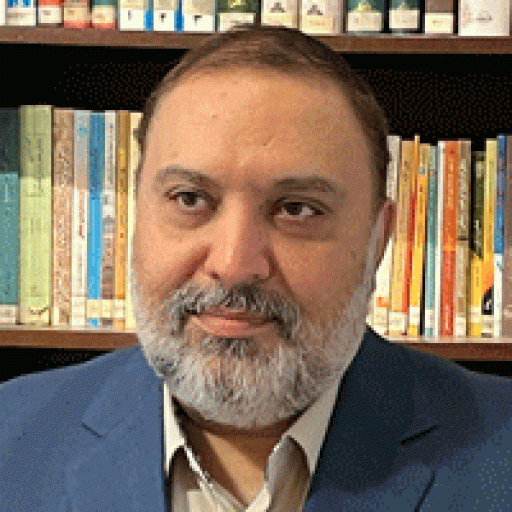
The Full Text of Dr. Reza Gholami’s Speech at the Third Webinar of the International Conference Series “Youth and Religion for a Peaceful World” by Topic: Religious Upbringing and Family Resilience for a Peaceful World- December 17, 2025 – Organizer: University of Religions and Denominations
Good day everybody;
Thank you for having me. Let me begin my discussion directly.
Part one: The family’s importance
Divine religions place strong emphasis on strengthening the family, because the family is the most basic and influential educational and social institution in which a person’s upbringing character, morals, and identity are formed. The family is not only the smallest social unit and the foundation of society – whose stability directly leads to the health of the whole community – but also the only environment that truly meets a person’s deep emotional, psychological, and spiritual needs and provides real security and peace.
The family offers a legitimate framework for fulfilling natural needs, a proper environment for the birth and upbringing of the next generation, and a space for passing religious and moral values from one generation to the next. It is also the first network of support and mutual care, giving its members a safe refuge in times of hardship and crisis. Without healthy families, achieving high human and spiritual goals and maintaining a sound social fabric would not be possible.
The high status of the family in religious teachings has led the followers of religions to firmly oppose phenomena such as the rise of divorce, abortion, cohabitation without marriage, homosexuality, adultery and unlawful sexual relations, living together outside of marriage, and gender transition.
Anyway, from the perspective of divine religions, the family is so important that if a religion does not lead to strengthening the family based on moral principles, one has good reason to question the truth and authenticity of that religion.
So, In Islamic teachings, the family is described as the most important place of safety for every person – a space where peace, kindness, and lasting companionship grow.
The Qur’an speaks of marriage as a deep bond whose purpose is emotional security and shared growth.
It says that a husband and wife are like “clothing” for one another, meaning they give each other support, comfort, and protection. (2:167)
This bond is not just a formal contract; it is a strong moral commitment built on respect and mutual responsibility.
The sayings of the Prophet also describe the family as the environment where a caring, responsible, and ethical human being is formed – the place where the next generation learns love, compassion, and human values.
In this way, Islam sees the family as the core of society and a source of human stability and growth.
The Prophet Muhammad also taught that the best gift parents can give their children is good upbringing.
In his view, a loving and ethical family is the place where a child’s character is formed and where a human being learns how to live with kindness and responsibility.
Part two: Religious Upbringing and Its Role
As I mentioned, in Islamic teaching, the family plays a central role in a child’s moral and spiritual development.
The Qur’an encourages parents to guide their families toward a meaningful and responsible life and to protect them from harmful influences.
It presents the family as the first environment where faith, values, and good habits take shape.
The story of wise parents in the Qur’an, such as the advice of Luqman to his son, shows how teaching children about honesty, kindness, and responsibility begins at home.
This fact – namely, the story of the wise family in the Qur’an – shows that religion cares not only about the moral upbringing of children, but also about their intellectual training, and considers these two to be two sides of the same coin.
The sayings of the Prophet Muhammad also emphasize that the greatest gift parents can give their children is good upbringing.
He taught that children grow into healthy and ethical adults when they are raised with love, respect, and guidance.
Islamic tradition also highlights the strong influence of both mother and father on a child’s character, noting that the early family environment shapes a person’s sense of right and wrong.
In this view, a family is not only a social unit but also the first school of character – a place where children learn compassion, self-discipline, and the values that will guide them throughout life.
Of course, sometimes in religious communities, extremism leads to depriving family members of certain basic freedoms and their right to free choice in the name of protecting the family, or it results in neglecting justice. Such behavior, however, does not seem compatible with rationality and moderation, which are two key principles in Islam, even though it cannot be denied that ensuring individual freedoms or achieving justice within religious teachings is a difficult and complex task.
Part Three: Building Resilient Religious Families
At any rate، in Islam, the family is not only a place for raising children but also the foundation of a healthy society.
The Qur’an says, “My Lord, make me steadfast in prayer and [also] my descendants” (14:40), showing that raising children with good morals and faith helps ensure a strong and stable society.
In the story of Luqman, God emphasizes teaching children ethics and values at home: “And We have enjoined upon man [care] for his parents” (31: 14–15).
This shows that the home is the first school where children learn responsibility, kindness, and human values.
The Prophet Muhammad also said, “The best of you are those who are best to their families.” Good behavior in the family becomes a model for behavior in the wider society.
He also said, “Teach your children well, for they are the men and women of tomorrow.” Imam Ali added, “The foundation of important matters is in the home, and your house is a school of virtue and ethics for society.”
Thus, in Islam, the family is the first school where children learn morals, responsibility, and human values, preparing them to live as ethical, responsible members of society.
The family is the first environment where children learn values, ethics, and how to live peacefully with others.
In Islam, parents are encouraged to raise their children with kindness, respect, and justice, teaching them that differences of opinion or belief should never lead to violence or disrespect.
The Qur’an says: “Invite to the way of your Lord with wisdom and good instruction, and argue with them in a way that is best” (16:125). This principal guides families in teaching and upbringing children how to interact peacefully with others in society.
Islam also emphasizes moderation, fairness, generosity, and helping those in need.
Parents are encouraged to act with balance in their behavior, speech, and decisions, and to show care for the less fortunate.
Thus, the family is not only a place to raise individuals with good character but also a school for learning tolerance, empathy, peaceful coexistence, generosity, and balance. Children who grow up in such families are prepared to live responsibly and ethically in society and to face social challenges with compassion, cooperation, and peace.
Maybe I can conclude that، if a family is raised with proper moral upbringing and – I would add – sound rational training, one can expect it not only to show resilience in the face of all types of crises, but also to help reduce or even resolve those crises.
Today, we are talking about the family at a time when the world has become like a small village, and families, in addition to their own internal problems or social, religious, and national challenges, are also facing global crises.
Part Four: Toward a Peaceful World
So, it is not unreasonable to expect that upbringing based on religious teachings, particularly Islamic teachings, can help in managing crises and in promoting and deepening peace in the world.
Of course, I would like to clarify – just to avoid any misunderstanding – that moral upbringing, along with intellectual upbringing, is not the only factor that creates resilience, but it is certainly a key factor.
Now, let me focus the discussion on today’s global conditions, the predictions for the future, and the role of religious families in successfully facing present and future challenges.
It is clear that in today’s globalized world, the world has become very small.
I prefer to compare this smaller world to a large ship in which all the people of the world – or more precisely, all nations – are passengers. When people of every race, ethnicity, religion, and nationality, whether from underdeveloped, developing, or developed countries, are all on the same ship, it no longer matters in which part or which room of the ship they are staying; what matters is that their safety and survival share the same fate.
Therefore, it is completely natural and rational that, in order to protect each other’s survival, we should live peacefully together, help each other in times of challenges or crises, and, while respecting one another’s beliefs, traditions, and ideas, cooperate and work together for mutual success.
Now my question is this: in a world where more than 55 percent of the population follow Abrahamic religions, what can be expected from religious families, who have the opportunity to benefit from the advantages of religious upbringing, in terms of living peacefully, being kind, and helping one another on this “global ship”?
In my view, it is reasonable to expect that religious families, in their moral and religious upbringing, avoid absolutism and consider respect for the beliefs of other religions and sects as essential. More precisely, they should instill religious pluralism deeply in the minds of young people.
Understanding that no religion holds absolute truth and that all religions can have a share of truth not only prevents takfir (excommunication) and the violence that comes from it, but also makes mutual respect and even cooperation and constructive interaction possible.
In addition, it is very important that in the process of religious upbringing, respect for the rights of others, fairness, and goodwill, alongside respect for individual freedoms that do not conflict with social rights, are properly encouraged and practiced within families.
Of course, all of this requires that the followers of religions free themselves from sectarianism or rigid legalism, focus on ethics, and give proper weight to collective reason.
It is not an exaggeration to say that in the future, the most important asset for humanity – one that can ensure its survival against crises such as global warming and climate change, contagious diseases, world wars, threats from new technologies like artificial intelligence, and so on – is ethics.
It is difficult to talk about the core of ethics, but I cautiously hold the view that ethics is based on three main principles: honesty, benevolence, and moderation. In other words, there is no ethical principle that conflicts with honesty, benevolence, or moderation.
I would like to end my remarks by saying that when we speak about human rights, we should remember that most of the principles behind these rights are rooted in ethics.
Even the principles that come from social contracts are, in one way or another, linked to morality and to the natural human understanding of ethical values.
Of course, I agree that judging what is ethical and what is not is not always easy.
There are many disagreements, and the judgments can be complicated.
However, the opinion of the majority of a “council of wise and reasonable people” – those who think beyond personal interests – can eventually help overcome these dead ends and clarify the right path.
Thank you for your attention.