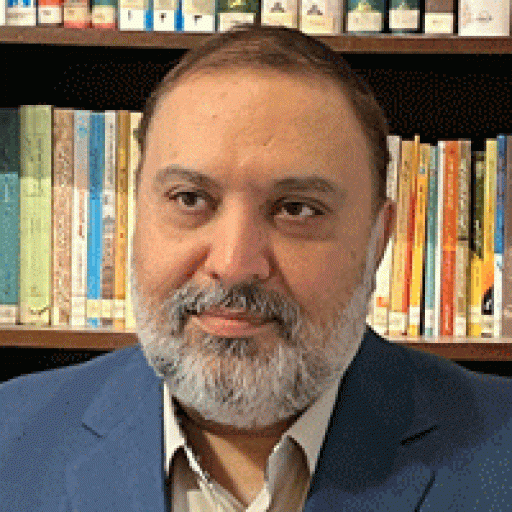
Written Lecture by Dr. Reza Gholami, January 27, 2025, House of Iranian Wisdom, Vienna
I am honored to speak today about one of the most fascinating topics at the intersection of philosophy, art, and the body. Drawing on Michel Foucault’s profound theories, we will explore the concepts of power, the human body, and art. Foucault’s meticulous analysis shows that in modern societies, power not only binds individuals to themselves, preventing them from seeing others, especially the inner world, but also transforms the body into an instrument for productivity and control through disciplinary and surveillance systems.
This perspective invites us to reflect on the fundamental differences between modern and traditional art and their relationship with the body. In “Discipline and Punish,” Foucault argues that the body is not merely a natural entity but the product of social, economic, and political processes. In modern art, the body, in addition to being a tool for creating art, is used as a means to critique power, norms, and disciplinary systems. In contrast, traditional art uses the body as a capacity for detachment from the self (and primarily from the body) to convey spiritual values and metaphysical order, far from an individualistic perspective.
Some traditional approaches to human and art view the body as a space for the expression of collective spirit and transcendence. This traditional approach sees the body not only as a means to create artworks but also as a capacity for detachment from the self to reach meanings that transcend individualism.
Analyzing these two approaches through Foucault’s lens (without removing Foucault from the modern world) provides a deeper understanding of how the body is represented in art within different historical and theoretical frameworks. This lecture highlights the evolving relationship between power, the body, and artistic expression, offering a precise lens for examining the intersection of tradition and modernity.
Part I: Foucault’s Theory of the Worker’s Body
Michel Foucault, in his works, delves deeply into the relationship between power and the human body. He argues that in modern societies, power is not merely repressive but productive, transforming the body into a tool of efficiency and compliance through disciplinary systems. Foucault emphasizes that the body is not simply a natural entity but a product of social, economic, and political processes.
In Discipline and Punish, Foucault asserts: “Discipline produces subjected and practiced bodies, docile bodies” (Foucault, 1975, p. 138). This concept is particularly evident in the notion of the “worker’s body,” which is both physically dominated and ideologically shaped to institutionalize productivity and conformity.
From this perspective, art, as part of the social system, either reflects or challenges these power relations.
Part II: Art and the Body in the Modern World
In the modern and contemporary era, influenced by social, cultural, and philosophical transformations, the body becomes central to artistic focus. In this era, the artist’s body shifts from being merely a tool for creation to becoming the very subject of art itself.
- Focus on the Artist’s Body
Contemporary art, especially in performance art, utilizes the artist’s body as a means to express individuality, social critique, and personal experience.
As Foucault states: “The body is directly involved in a political field; power relations have an immediate hold upon it” (Discipline and Punish, 1975, p. 25).
For example, artists like Marina Abramović use their bodies to convey emotional, social, and political messages.
- Critique of Power and Discipline
Modern and contemporary art frequently employs the body as a medium to critique disciplinary and biopolitical systems. These critiques target gendered, aesthetic, or utilitarian norms imposed on the body by power structures.
Foucault, in The History of Sexuality, writes: “Power is not an institution, nor a structure, nor a certain strength we are endowed with; it is the name that one attributes to a complex strategical situation in a particular society” (Foucault, 1976, p. 93).
- Liberation from Traditional Norms
In modern art, the body becomes a medium of personal freedom and expression. Unlike traditional art, which adhered to collective norms, modern art breaks these boundaries and reclaims the body as a space of free expression.
For example, Marina Abramović’s works, such as Rhythm 0 (1974), use her own body to confront societal norms around violence, vulnerability, and control.
Part III: Art and the Body in the Traditional World
Foucault is a modern philosopher and does not belong to the traditional world. However, in this discussion, the advantages of the traditional world can be used to balance the harm caused by the modern focus on art itself and its degraded aspect, which is the body, by bringing in a different perspective and experience from the traditional world.
In traditional art, the artist’s body was rarely presented as an independent subject. Instead, the body was viewed as a medium for creating artworks that reflected collective values and spiritual ideals.
- Absence of the Artist’s Body in Artworks
In traditional art forms, the primary focus was on transcendent ideas, such as spirituality, divine order, or moral ideals.
Here, I would like to quote Seyyed Hossein Nasr:
“The source of forms, symbols, frameworks, and colors in every type of traditional art is the metaphysical and spiritual realm, which elevates the artist. This is the root of the profound difference between traditional and modern art.”
For example, in Persian miniature painting, artists conveyed mystical and divine concepts through abstract and non-realist depictions, avoiding personal or bodily representation.
- The Body as a Tool, Not a Subject
In traditional art, the artist’s body was seen as a tool for creating beauty or conveying social and religious values rather than as an independent subject.
- Harmony and Order Over Individuality
Traditional art emphasized harmony, order, and shared cultural ideals. Excessive emphasis on individuality was avoided, and the human body was perceived within the broader context of nature and spirituality.
Part IV: Comparing Art in the Modern and Traditional Worlds
Perhaps some may consider the basis of comparing the two worlds—modern and traditional—regarding how art engages with itself, society, or the transcendent as insignificant. However, it seems that this comparison, without straying from realism, can still be valuable.
This comparison can be described in four key points:
- Perception of the Body: Tool vs. Independent Subject
Traditional art regarded the body as a tool for creating beauty or expressing transcendent ideals, while modern art treats the body as an independent subject and, at times, the artwork itself.
- Individuality vs. Collectivism
Traditional art prioritized collective values and spirituality, often downplaying the artist’s individual presence. Modern art, on the other hand, celebrates individuality, personal experience, and freedom of expression.
- Relationship with Power
Traditional art often served religious, cultural, or political systems, offering limited room for critique. Modern art, however, critiques power structures and uses the body as a site of resistance, echoing Foucault’s claim that “where there is power, there is resistance” (The History of Sexuality, 1976, p. 95).
- Worldview: Metaphysical vs. Human-Centric
Traditional art operated within a metaphysical framework, emphasizing spiritual and universal truths. Modern art, influenced by humanism and individualism, places the human body and experience at the center of its concerns.
Conclusion: Toward a Balanced Perspective
Foucault’s theory of the worker’s body highlights how shifts in power dynamics reshape perceptions of the body in art. Traditional art regarded the body as a tool for realizing transcendent ideals, situating it within the greater harmony of the cosmos. The modesty in Islamic art exemplifies this view, where bodily representation is abstracted to emphasize spiritual values. In contrast, modern art positions the body as both the subject and object of artistic expression, using it as a medium for critique, resistance, and personal narrative. This evolution reflects a shift in human self-understanding—from a collective metaphysical identity in traditional eras to an individualized, human-centered outlook in modernity.
However, a deeper reflection suggests the necessity of forging a middle path that incorporates the advantages of both approaches. This balanced perspective could harmonize the spiritual and universal truths emphasized in traditional art with the freedom of expression, individuality, and critical engagement championed by modern art. Such an integrated approach would not only honor the transcendence and order of tradition but also embrace the creativity, self-expression, and resistance inherent in modernity.
As Foucault writes: “Each society has its regime of truth… its general politics of truth” (Power/Knowledge, 1980, p. 131). Understanding these transformations—and choosing to adopt the best elements of each approach—can help reconcile the tensions between traditional and modern views of art and the body. By leveraging the strengths of both, we can create a more inclusive and enriched artistic framework that transcends the binary divide between tradition and modernity.
References
- Foucault, Michel. Discipline and Punish: The Birth of the Prison. Translated by Alan Sheridan. New York: Vintage Books, 1977 (originally published in French as Surveiller et punir, 1975).
- Foucault, Michel. The History of Sexuality, Volume 1: The Will to Knowledge. Translated by Robert Hurley. New York: Pantheon Books, 1978 (originally published in French as La volonté de savoir, 1976).
- Foucault, Michel. The Order of Things: An Archaeology of the Human Sciences. New York: Vintage Books, 1994 (originally published in French as Les mots et les choses, 1966).
- Foucault, Michel. The Birth of the Clinic: An Archaeology of Medical Perception. Translated by A. M. Sheridan Smith. New York: Pantheon Books, 1973 (originally published in French as Naissance de la clinique, 1963).
- Foucault, Michel. Madness and Civilization: A History of Insanity in the Age of Reason. Translated by Richard Howard. New York: Random House, 1965 (originally published in French as Folie et déraison, 1961).
- Foucault, Michel. Power/Knowledge: Selected Interviews and Other Writings, 1972–1977. Edited by Colin Gordon. New York: Pantheon Books, 1980.