
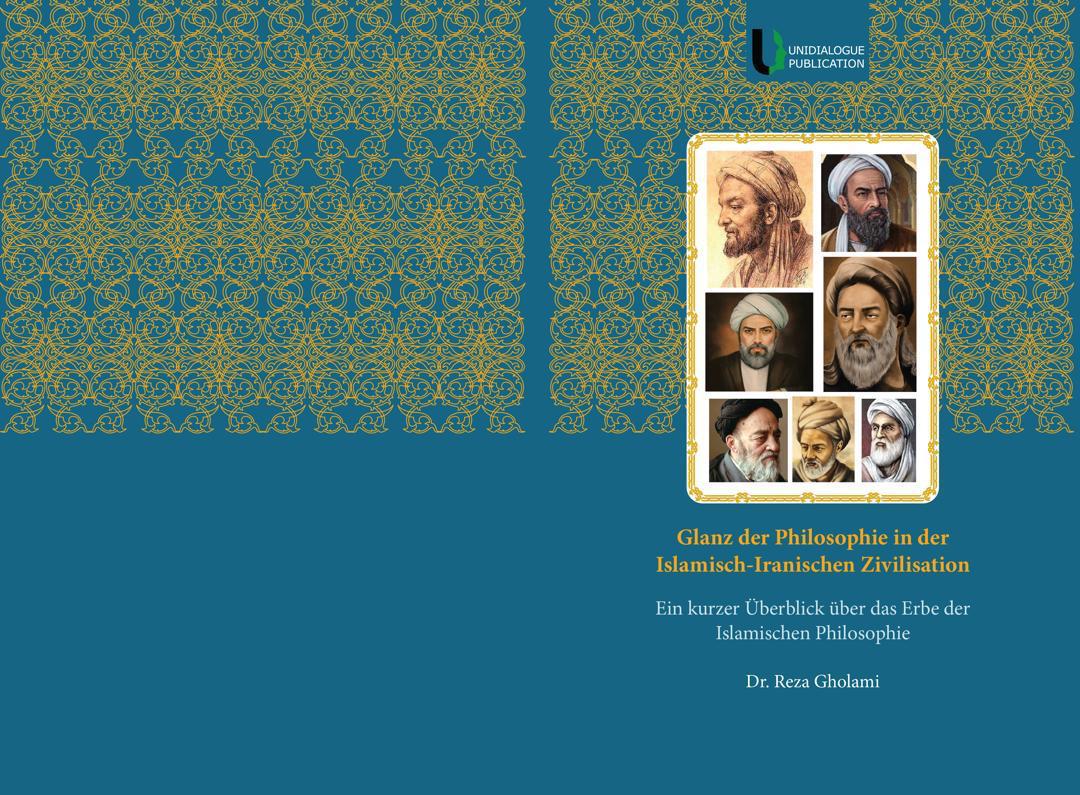
Title of the Book: The Brilliance of Philosophy in the Islamic-Iranian Civilization
(A Brief Overview of the Legacy of Islamic Philosophy)
With Introduction and Editing by: Dr. Reza Gholami
Published by: Uni-Dialogue Publications, Vienna, 2025
Introduction
Islamic philosophy is one of the most prominent philosophical traditions in human history, which has brought about significant transformations in thought and the humanities from its inception to the present day. Rooted in the teachings of Islam, Greek philosophy, and Iranian wisdom, Islamic philosophy has introduced groundbreaking theories in metaphysics, epistemology, and ethics, playing a pivotal role in shaping Islamic culture and civilization.
- The Origins of Islamic Philosophy
Islamic philosophy began in the second century AH (8th century CE) with the translation of Greek philosophical texts into Arabic. This period marked the efforts of translators such as Hunayn ibn Ishaq and Al-Farabi, who worked to preserve the philosophical heritage of Greece. From its very beginning, Islamic philosophy charted its own path by integrating Islamic elements such as belief in the oneness of God, the divine nature of humanity, and ethics, distinguishing itself from ancient Greek philosophy.
Prominent philosophers such as Al-Farabi, Avicenna (Ibn Sina), later Suhrawardi (Sheikh al-Ishraq), and Mulla Sadra brought Islamic philosophy to its zenith. These philosophers responded to the challenges of their time, including religious and social issues, transforming philosophy into a vibrant and dynamic field.
Although Muslims of all denominations contributed to the development of Islamic philosophy, Shia Muslims, particularly Iranians, played a significant role in its evolution due to their closer alignment with rational teachings.
- Differences Between Islamic Philosophy and Ancient Greek Philosophy
While Islamic philosophy was profoundly influenced by ancient Greek thought, especially the ideas of Plato and Aristotle, it distinguished itself through its emphasis on concepts such as revelation, prophecy, and the afterlife. Ancient Greek philosophy primarily focused on rational explanations of nature and existence, but Islamic philosophy combined reason with concepts like intuitive knowledge and divine truths.
Whereas Greek philosophy—particularly Aristotle’s works—centered on the pursuit of truth in nature and logic, Islamic philosophy sought to understand the relationship between the Creator and creation by incorporating the teachings of Islam.
- The Influence of Iranian Wisdom (Khosrowani Philosophy) on Islamic Philosophy
The Khosrowani wisdom, which refers to the philosophical and spiritual traditions of the Sassanid era, had a significant impact on Islamic philosophy. This influence is particularly evident in the theories of Illuminationist Philosophy (Hikmat al-Ishraq), predominantly articulated in the works of Suhrawardi. These ideas, rooted in Zoroastrian concepts, emphasized themes like light and darkness.
Philosophers such as Al-Farabi and other Islamic thinkers integrated metaphysical and ethical concepts from Khosrowani wisdom—such as cosmic order and divine justice—into Islamic philosophy. This fusion imbued Islamic philosophy with mystical and spiritual dimensions, moving beyond mere rational analysis.
- The Importance of the Major Schools of Islamic Philosophy
Islamic philosophy can be divided into three main schools:
- The Peripatetic School (Aristotelian Philosophy): Represented primarily by Avicenna (Ibn Sina), this school focused on applying Aristotelian logic and rational reasoning to address philosophical and religious questions.
- The Illuminationist School (Ishraq): Founded by Suhrawardi, this school emphasized intuitive knowledge and the philosophy of light, asserting that true knowledge is attained through mystical experience.
- The School of Transcendent Philosophy (Hikmat al-Muta’aliyah): Established by Mulla Sadra, this school combined reason, intuition, and revelation to address profound metaphysical questions.
- Similarities and Differences Between Islamic Philosophy and Islamic Theology (Kalam)
Both Islamic philosophy and theology (Kalam) aim to address fundamental questions about God and existence, and both are grounded in religious teachings. However, their primary distinction lies in their methodology. Islamic theology focuses on defending religious doctrines through religious and philosophical arguments, while Islamic philosophy employs rational analysis and logic to seek the truth.
Islamic philosophers went beyond the limitations of theology, delving into deeper philosophical issues such as causality and the essence of beings. Unlike Western philosophy, which was influenced by scholasticism, Islamic philosophy maintained an independent rational approach.
- Hostility of Religious Extremists and Authoritarian Governments Toward Philosophers
One of the main challenges faced by Iranian philosophers throughout history was persecution and, at times, excommunication by religious extremists. Many philosophers were pressured and attacked by traditionalist clerics, who often had a limited understanding of philosophy or the complexity of mystical theories.
Independent philosophers, especially those who engaged in critical thinking, also clashed with authoritarian and totalitarian governments. These thinkers were often suppressed for promoting critical thought and posing challenging questions, making them prime targets of repression and hostility.
- The Key Achievements of Islamic Philosophy
Islamic philosophy has made significant contributions to metaphysics and epistemology. Avicenna’s theories on existence and essence, the distinction between “existence” and “essence,” and the concept of the necessary existence of God remain highly influential.
Suhrawardi introduced the philosophy of light and the doctrine of illumination, while Mulla Sadra proposed the theory of substantial motion (harakat al-jawhariyah) and the graded reality of existence (tashkik al-wujud), addressing profound metaphysical issues.
- The Comparative Study of Islamic and Western Philosophy
Since the 19th century, Western philosophers such as Hegel and others have studied Islamic philosophy, particularly the works of Avicenna and Mulla Sadra. Contemporary Western scholars like Henry Corbin have sought to connect the mystical aspects of Islamic philosophy with Western existentialism.
Conversely, Islamic philosophers like Allama Tabatabai and Morteza Motahhari have critiqued Western philosophy—especially the theories of Descartes, Kant, Hegel, and Marx—from an Islamic philosophical perspective.
- The Influence of Islamic Philosophy on Islamic-Iranian Civilization
Islamic philosophy has profoundly influenced the development of legal, ethical, and educational systems in Islamic civilization. Philosophers like Al-Farabi played a crucial role in advancing political theories, which contributed to the formation of Islamic civil society.
Furthermore, Islamic philosophy has significantly impacted Islamic literature and mysticism, as reflected in the works of Rumi and Ibn Arabi.
- Is Islamic Philosophy Relevant to Contemporary Needs?
Although Islamic philosophy is currently in decline, it still holds potential—particularly in addressing spiritual and ethical issues. To remain relevant, Islamic philosophy must engage in dialogue with modern sciences and contemporary philosophies to address new challenges.
Efforts by thinkers like Allama Tabatabai and Morteza Motahhari demonstrate that Islamic philosophy can adapt to new conditions. One of its most significant roles in the contemporary era is its ability to help individuals find meaning and purpose in life, providing an alternative to nihilism. Islamic philosophy, with its critical and complex metaphysical foundations, explores a meaningful worldview while drawing a distinct line from atheistic existentialism.
This introduction has been written for philosophy students in Austria to introduce them to Islamic philosophy. It has been translated into German with the assistance of artificial intelligence and subsequently reviewed and edited by an Austrian editor named … to ensure accuracy. I hope this small project inspires interest in Islamic philosophy, especially among philosophy students in Austria.
Dr. Reza Gholami
Member of the Faculty of Humanities and Cultural Studies
January 2025