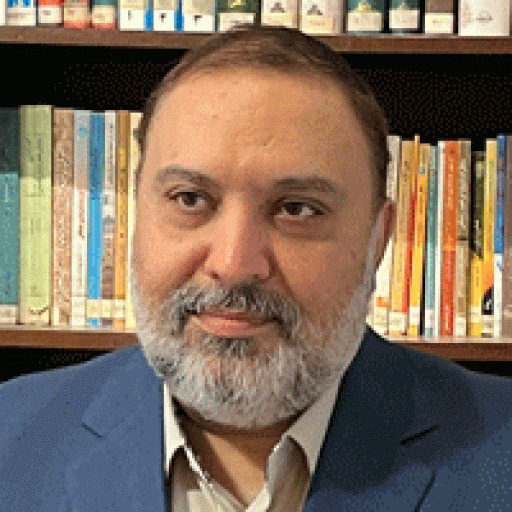
Written Speech by Dr. Reza Gholami, January 14, 2025, House of Iranian Wisdom, Vienna
Today, I am going to explore the fascinating and controversial world of one of history’s most influential philosophers: Friedrich Nietzsche. Nietzsche’s bold ideas and poetic writing challenged traditional values, questioned absolute truths, and redefined the way we think about morality, power, and human potential. His philosophy has inspired countless thinkers, and his work remains a central topic in philosophy, literature, and even art.
But Nietzsche is not just a figure to admire. He is also a thinker who has sparked deep criticisms. His ideas are as complex and ambiguous as they are powerful. Nietzsche denied absolute truths, attacked traditional values, and envisioned a new kind of human—the “Übermensch.” But were his ideas practical solutions for humanity’s problems, or were they poetic expressions of his own struggles?
In this speech, I will explore Nietzsche’s philosophy from four perspectives:
- Why Nietzsche Matters: Why his ideas are still relevant today.
- Nietzsche: Now and the Future: How his philosophy continues to shape modern and future thought.
- Common Criticisms of Nietzsche: From nihilism to the concept of the Übermensch, what are the main critiques of his philosophy?
- My Criticisms of Nietzsche: Exploring his poetic language, contradictions, and his limited view of social structures.
This is not a speech to simply praise or dismiss Nietzsche. Instead, it is an invitation to think critically about his ideas—both their brilliance and their flaws. Nietzsche himself encouraged us to question everything, and today, we will question him.
With that, let us begin the first part of this journey: Why Nietzsche Matters.
Part One: Why is Nietzsche Important?
- Critique of Traditional Morality
Nietzsche fundamentally challenged Christian morality and metaphysical ethical systems. He believed these systems emphasized values like humility, self-sacrifice, and self-denial, which he saw as life-denying. He contrasted “master morality” (values such as power, creativity, and grandeur) with “slave morality” (values such as humility, compassion, and obedience).
- The Death of God
Nietzsche’s famous phrase, “God is dead,” serves as a metaphor for the end of metaphysical thinking and the loss of religion’s power to provide meaning in modern life. He warned that this loss of meaning could lead to nihilism. This idea remains central to discussions about meaning, values, and modern life.
- The Will to Power
Instead of searching for absolute truth, Nietzsche identified the “will to power” as the driving force of life and the world. He interpreted it not as domination over others but as a drive for creativity, growth, and self-overcoming.
- Existentialism and Individualism
Nietzsche is considered a precursor to existentialism. His ideas on individuality, freedom, and the responsibility to create one’s own values inspired thinkers such as Jean-Paul Sartre and Albert Camus.
- The Übermensch (Superman)
Nietzsche introduced the concept of the Übermensch as an ideal for transcending traditional values and creating new ones. The Übermensch represents someone who rises above human limitations and lives with creativity and strength.
- Confronting Nihilism
Nietzsche was one of the first philosophers to recognize nihilism as a major crisis of the modern world. Rather than surrendering to meaninglessness, he proposed creating new values and affirming life in a way that says “yes” to existence.
- A Poetic Style of Philosophy
Rather than relying on dry philosophical arguments, Nietzsche used metaphors, poetry, and rich narratives. His works, such as Thus Spoke Zarathustra, reflect an artistic and poetic approach to philosophy, making his ideas accessible to a wider audience.
- Critique of Modernity and Scientism
Nietzsche criticized modernity for its over-reliance on science, logic, and rationality. He believed this trend risked erasing imagination, passion, and the spiritual dimensions of life.
- Impact on Philosophy, Literature, and Art
Nietzsche’s ideas have profoundly influenced philosophy, literature, psychology (especially Freud and Jung), and modern art. His concepts continue to spark debates in philosophy, politics, and culture.
Through his radical critiques, innovative ideas, and distinctive style, Nietzsche became one of the most prominent figures in philosophy. He challenged the worldview of modern humanity and explored questions about meaning, morality, and values that remain central to philosophical inquiry today.
Part Two: Nietzsche, the Present, and the Future
Nietzsche’s ideas, with their depth and breadth, remain highly relevant for understanding today’s and tomorrow’s challenges. Below are key ways Nietzsche’s philosophy applies to contemporary and future issues:
- Addressing Nihilism and the Crisis of Meaning
Modern life, especially with the rise of science and technology, has seen the decline of traditional values and a crisis of meaning. Nietzsche, by warning about nihilism, teaches us how to overcome the collapse of values and reconstruct life by creating new ones. This is particularly important for societies grappling with a spiritual void.
- Individual Freedom in the Age of Technology
Nietzsche emphasized individuality and creativity. In a world dominated by technology and artificial intelligence, people may face a loss of identity. Nietzsche’s ideas about the Übermensch and the will to power can inspire individuals to move beyond passivity and define their own goals and identity.
- Critique of Consumerism
Modern culture struggles with consumerism and materialistic values. Nietzsche’s critique of shallow values and his emphasis on living an authentic and meaningful life can help redefine individual and social priorities.
- Encouraging Critical Thinking and Challenging Stereotypes
One of Nietzsche’s key legacies is his critique of stereotypes and his willingness to question deeply ingrained social, political, and cultural structures. He encourages us to challenge conventional authority and question deeply held beliefs. This is crucial in today’s world, where misinformation and distortions are rampant.
- Inspiration for Creating New Values
Nietzsche believed that in the absence of traditional values, individuals must create their own. This perspective is essential for addressing modern ethical challenges, such as human rights in the digital age, artificial intelligence ethics, and environmental concerns.
- Affirming Life and Embracing Responsibility
Nietzsche reminds us that life, despite its hardships and challenges, is worth living. His concept of “eternal recurrence” invites us to fully embrace life and take responsibility for shaping our future. This perspective is vital for combating depression and despair in today’s crisis-laden world.
- Rethinking Political and Social Systems
Nietzsche offered important critiques of democracy, socialism, and the ideologies of his time. While his views aren’t always directly applicable, they provide valuable tools for analyzing political crises, social inequality, and the rise of populism in today’s world.
- Art, Culture, and Literature in the Future
Nietzsche’s poetic vision and emphasis on creativity and imagination have inspired artists, writers, and philosophers. In a future where science and technology may dominate culture, Nietzsche’s focus on art and aesthetics can restore balance.
Nietzsche as a Philosopher for the Future
Nietzsche is not just a philosopher of his time but also a thinker whose insights continue to inspire the present and future. He helps us face spiritual and ethical crises, the absence of meaning, and emerging challenges while redefining life in a creative, powerful, and meaningful way.
He remains a guiding light for those seeking freedom, meaning, and authenticity in their lives.
Part Three: Common Criticisms of Nietzsche
Nietzsche’s ideas have always been the subject of serious and deconstructive critiques. These critiques, based on philosophical, ethical, and historical analyses, address fundamental aspects of his thought. Below are the most notable criticisms of Nietzsche’s philosophy:
- Critique of Nihilism and Contradiction in Nietzsche’s Thought
Nietzsche criticizes nihilism but simultaneously paves the way for it by rejecting absolute values (like religion and traditional metaphysics). Philosophers such as Heidegger have accused Nietzsche of, despite his efforts to overcome nihilism, leading to a form of nihilism himself because he does not provide any absolute values to replace those he rejects.
- Ambiguity in the Concept of the Übermensch
The concept of the Übermensch (Superman) is one of Nietzsche’s most debated ideas. Critics like Walter Kaufmann have argued that it is so vague that it allows for multiple interpretations, including dangerous misinterpretations. For instance, the idea was mistakenly appropriated by Nazi ideology to justify racial superiority, even though Nietzsche himself opposed such views.
- Rejection of Absolute Truth and the Risk of Relativism
Nietzsche dismisses the notion of absolute truth and emphasizes perspectivism (the idea that all viewpoints are relative). Critics argue that this approach can lead to extreme relativism, where no shared ethical or epistemological standards remain. This undermines the basis for rational dialogue or moral judgment.
- Criticism of Master and Slave Morality
Nietzsche’s division of morality into “master” and “slave” has been heavily criticized. Thinkers like Albert Einstein argue that this perspective risks justifying violence, oppression, and disregard for human values. Critics also suggest that Nietzsche romanticizes and idealizes master morality, which does not align with historical realities.
- Social and Historical Critiques
Nietzsche places significant emphasis on individualism and the will to power, but critics such as Karl Marx and his followers argue that Nietzsche neglects the importance of social relations, history, and economic structures in shaping human behavior. They view Nietzsche’s approach as overly individualistic and incapable of addressing social and historical problems.
- Misogyny in Nietzsche’s Works
Nietzsche’s works contain statements often interpreted as misogynistic, such as: “Are you going to women? Don’t forget the whip!” Feminist philosophers, including Simone de Beauvoir, have criticized these views as dismissive of women’s abilities and societal roles.
- Psychological and Ethical Criticisms
Critics such as Jacques Lacan and Sigmund Freud have argued that Nietzsche overemphasizes the will to power and individualism while neglecting emotional, unconscious, and relational aspects of human nature. This focus may lead to an egocentric ethic that disregards others’ well-being.
- Contradictions in the Eternal Recurrence
The concept of “eternal recurrence” is central to Nietzsche’s philosophy, but critics contend that Nietzsche neither logically proves this idea nor provides philosophical or scientific justification for it. Karl Popper described it as “poetic but unscientific.”
- Limited Practical Impact on Politics and Society
Some critics, such as Reinhart Koselleck, argue that Nietzsche’s ideas, despite their philosophical depth, are too focused on individualism and power to offer practical guidance for politics or social change.
- Misinterpretations and Influence on Dangerous Ideologies
Although Nietzsche opposed nationalism and racism, his ideas—particularly the will to power and the Übermensch—were misappropriated by the Nazis. This has led some critics to hold Nietzsche partially responsible for the unintended consequences of his philosophy.
Conclusion
The deconstructive critiques of Nietzsche often focus on internal contradictions, conceptual ambiguities, and the social and ethical implications of his ideas. However, rather than diminishing his importance, these criticisms highlight the complexity and richness of Nietzsche’s philosophy. His work continues to inspire contemporary philosophical thought and debate, precisely because of its depth and enduring relevance.
Section Four: My Criticism of Nietzsche
It should be noted that some of my critiques align with the common critiques others have made of Nietzsche, while others are new. However, the important thing is that my critiques are the result of my personal reflections on Nietzsche’s ideas.
- Nietzsche and “Complexes”
One main criticism is that Nietzsche cannot separate himself from his own personal struggles and complexes. His philosophy is deeply tied to his inner pain and life experiences. This has two effects:
- Limited Perspective: Nietzsche’s philosophy is highly personal, making it less connected to external realities.
- Intentional Use of Limits: Nietzsche uses this personal perspective to reject absolute truths and emphasize individualism. However, this choice can reduce the value of his philosophy for a broader audience.
- Superficial View of Society
Nietzsche, compared to thinkers like Marx or Durkheim, takes a superficial approach to social structures. He focuses on individual wills and overlooks the importance of relationships, history, and economics in shaping societies. This is a significant weakness in his philosophy, especially when applied to social or political issues.
- Nietzsche’s Pessimism About Humanity
Nietzsche has a pessimistic view of humanity, especially in his concept of the “last man,” whom he sees as lazy, aimless, and mediocre. He criticizes values like compassion and empathy as weaknesses. This causes him to ignore the role of human virtues in creating stronger individuals and healthier societies.
- Nietzsche’s Rejection of Tradition
Nietzsche sees tradition as a tool of control and oppression, failing to recognize its healing and constructive aspects. His overly critical mindset prevents him from appreciating the positive psychological and social roles of traditions.
- Emotions and Understanding Existence
Nietzsche relies heavily on personal feelings and emotions to analyze existence, which sometimes keeps him from deeper, rational insights. This makes it harder for his philosophy to be seen as a unified system of thought.
- Nietzsche’s Creation of Values
Nietzsche argues that values are created by individuals rather than discovered. This clashes with other philosophical systems that base morality on nature or religion. It also assumes humans have unlimited ability to create new values, which is questionable.
- The Concept of the Übermensch (Superman)
The idea of the Übermensch is vague and impractical. It lacks clear guidelines for improving society and feels more like a metaphor or utopian ideal. You argue that it reflects Nietzsche’s frustration and inability to propose real solutions to societal problems.
- Nihilism and Nietzsche
Although Nietzsche criticizes nihilism, his rejection of absolute values leads to a form of nihilism. By not offering a convincing alternative, he unintentionally strengthens the problem he aims to overcome.
- Poetry and Philosophy in Nietzsche’s Work
Nietzsche uses poetic language to express his ideas, making his philosophy less clear and logical. While this style may make his work emotionally impactful, it often blurs the line between philosophy and poetry.
- Ambiguity: Readers may struggle to distinguish between his philosophical ideas and poetic inspiration.
- Misinterpretations: This poetic style can lead to either overly serious or dismissive interpretations of his work.
- Lack of Systematic Philosophy: Unlike thinkers like Kant or Hegel, Nietzsche’s work lacks clear methods or logical consistency.
Some argue that Nietzsche intentionally mixed poetry and philosophy to make philosophy closer to life. However, this approach sometimes makes his work more emotional than enlightening and harder to critique.
Final Words: Nietzsche, from Praise to Critique
At the end of this philosophical journey, Nietzsche can be seen as one of the boldest and most profound thinkers in history, but not without reflection and critique. He challenged absolute truths, redefined traditional values, and, with unmatched passion and poetry, offered new perspectives. However, as we have seen, his philosophy is not without contradictions, ambiguities, and limitations.
What I have learned most from Nietzsche is the importance of “boundless Inquiry”. He invites us to reflect on the current condition of humanity, but in my critiques of him, it is clear that Nietzsche sometimes became too entangled in his personal experiences, missing the broader picture—especially in social matters. Ideas like “the Overman” or “will to power” are inspiring, but in practice, they do not lead to tangible solutions and instead resemble dreamy ideals that cannot truly guide real human life.
Nietzsche’s philosophy, at its best, serves as a mirror that reflects both the strengths and weaknesses of humanity. However, this mirror can sometimes be overly ambiguous, and at times, overly personal. From my perspective, Nietzsche, in his efforts to escape nihilism, ends up trapped in it. He rejects traditional values but does not create new ones strong enough to illuminate the world.
Through all of this, Nietzsche remains for me not as a model to follow, but as a challenge. A challenge that pushes us to step beyond our own intellectual comfort zones, even to question his own ideas. Perhaps the greatest gift Nietzsche offers is this: an invitation to bold thinking—especially when it means confronting himself.
Thank you for your attention.