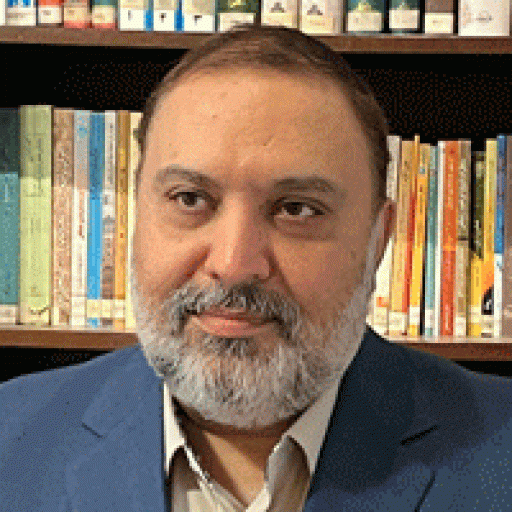
Reza Gholami
In the history of politics, one of the most
dangerous moments occurs when an evil power adopts the language of sanctity; when an unjust war is presented not as a political decision open to criticism, but as a divine mission. At such a moment, what is endangered is not only human lives, but the very language of morality itself.
The positions expressed by Pete Hegseth, U.S. Secretary of War, in justification of the illegitimate and joint American-Israeli war against Iran—especially his repeated emphasis that “God is on our side”—are a striking example of precisely this discourse. A discourse in which the abuse of power, aggression, and the slaughter of another nation present themselves under the guise of faith and virtue. This is not religiosity; this is the hijacking of religion.
When an Illegitimate War Becomes “Sacred”
In this worldview, war is no longer a legitimate or illegitimate conflict between states. It is transformed into an ethical—and indeed metaphysical—battle. And this transformation has profound and lasting consequences: when war is portrayed as the will of God, the possibility of moral criticism of it is severely undermined. Opposition to the war is implicitly interpreted as opposition to faith. Doubting the killing comes to resemble blasphemy.
In this way, religion—which ought to serve as the moral conscience of power—turns into a shield against criticism. And power—which ought to be accountable—hides itself behind the heavens.
Four Consequences of the Sanctification of Violence
This language brings four clear and serious consequences:
First: the stimulation of religious emotions and the mobilization of religious sentiments in the service of the war machine. People are drawn to war not through reasoning, but through their faith.
Second: the transformation of a political enemy into a sacred enemy. One who is no longer merely God’s enemy is neither a subject for negotiation, nor worthy of compromise, nor deserving of mercy.
Third: the insinuation that political power possesses heavenly legitimacy. That is, authority derives not from the vote of the people, but from divine permission.
Fourth: and perhaps the most criminal consequence: the washing away of the blood and filth of war in the name of the sacred. Crime is cleansed, and the killer appears in the garb of a saint.
Religious Extremism Colored by Racism
However, Hegseth’s rhetoric cannot be regarded merely as a theological error or a piece of political eloquence. What he articulates is the reflection of a specific ideology that has continued from the Crusades to the present: religious extremism intertwined with racism, which has turned into an evil and dangerous force.
In this ideology, “we” are not only more faithful, but superior. The enemy is not only an infidel, but inferior. This combination—the sanctification of the self and the degradation of the other—is the very mental structure that throughout history has laid the groundwork for the worst human crimes: from the Crusades to colonialism, from apartheid to genocide.
Hegseth expresses this rhetoric not from the margins, but from the very center of power. He represents an intellectual current in which white Christian identity is defined as both national and divine identity, and the “other”—whether Muslim, non-white, or non-Western—is an entity that must be contained, humiliated, or destroyed. When such a worldview becomes fused with sacred language, we are no longer dealing with a fanatical politician; we are facing a dangerous ideologue.
One Man, One Ideology, One Unparalleled Army
And here the danger transcends the theoretical realm and becomes a real and immediate threat to the world.
Pete Hegseth is the Secretary of Defense of the United States—a country that possesses the largest, most advanced, and most destructive military machine in human history. Aircraft carrier fleets, nuclear arsenals, military bases across the globe, war technologies that no other country even comes close to—all of them are now under the command of someone who views the world through the lens of a holy war between a superior “us” and an inferior “them.”
History has taught us what horrors occur when religious-racial extremism comes to power. But those horrors took place with limited resources, in limited geographies, and with limited weapons. Now, for the first time in history, such an ideology has access to an unparalleled military power capable of changing the fate of a nation, a region, or even all of humanity within a few hours.
This is no longer merely an abstract concern. It is a simple and terrifying equation: dark ideology + limitless power = consequences that history has not yet witnessed.
From a Theological Perspective
Such a claim is problematic not only politically but theologically as well. In almost all major religious traditions—from Christianity and Islam to Judaism and Buddhism—there exists this fundamental warning: no earthly power can claim with certainty to be the bearer of God’s will. This claim, within the very logic of religion, constitutes a great arrogance.
Whenever politics makes such a claim, religion falls from its moral position and becomes an instrument of justification. God is no longer the judge of power; He becomes a title that power has appropriated for itself.
The Real Danger
The main issue here is neither defending one side nor condemning the other. The issue is the danger of the sanctification of violence—regardless of who commits it.
When war is justified in the name of God, power places itself beyond moral and legal accountability. Accountability becomes obsolete. Prosecution appears impossible. And what takes place is not religiosity, but the instrumental use of faith to legitimize violence.
Perhaps the most precise description of this situation is this: power seeks to conceal its own evil in the garb of sanctity.
And history has repeatedly shown that the most dangerous form of violence is violence that speaks in the name of God—not because it believes in God, but because it knows that this name is a weapon against which it is very difficult to stand.
But today this violence is no longer just a language. Behind this language stands the greatest army in history.
And that is precisely what should shake the world.
March 15, 2026