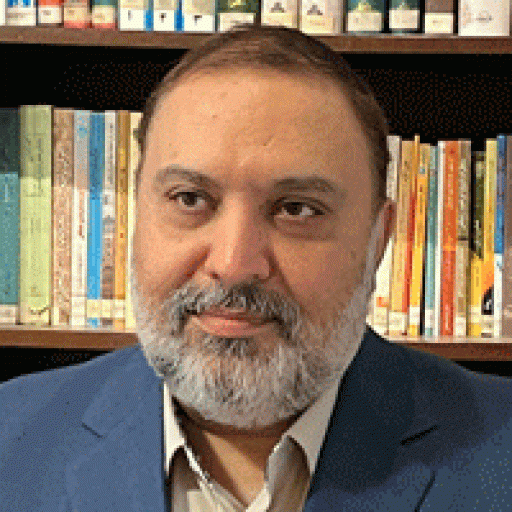
The full text of the speech delivered by Dr. Reza Gholami at the opening ceremony of the International Conference on Iranian–Islamic Civilization, 18 February 2026, Iranian House of Wisdom, Vienna.
Introduction
Good evening.
Today I want to explore one of history’s most sophisticated civilizations – one that emerged when Islamic thought encountered the ancient Iranian world. But to understand this encounter properly, we must first appreciate what Iran brought to it.
Iran was not a blank slate awaiting Islam’s arrival. It was an ancient civilization with three thousand years of state-building, philosophical thinking, and cultural refinement behind it.
The question we need to ask is this: How did this deep-rooted Iranian civilization interact with Islamic principles to create something that was neither purely Persian nor purely Arab, but genuinely new? And what were the unique characteristics that defined this synthesis?
Part One: The Iranian Foundation – What Iran Brought
Let me be clear from the start: when Islam arrived in Iran in the 7th century, it encountered a civilization of extraordinary depth and complexity.
Political and Administrative Genius:
The Achaemenid Empire—founded by Cyrus the Great in the 6th century BCE—was the world’s first true superpower, stretching from India to Egypt, from Central Asia to Libya.
At its height, it governed roughly 44% of the world’s population. This wasn’t maintained by force alone but through sophisticated administrative systems.
The Iranians invented the concept of the professional civil service. The Sasanian Empire (224-651 CE) had a bureaucratic structure with specialized departments—a ministry of finance, a ministry of war, a ministry of religion, a postal and intelligence system that stretched across thousands of miles.
They created the world’s first network of roads with regular stations. The term “paradise” itself comes from the Persian word “pardis,” meaning the walled royal gardens that demonstrated the king’s ability to create order from chaos.
When the early Islamic caliphates needed to govern their rapidly expanding empire, they adopted wholesale the Sasanian administrative model.
The Abbasid bureaucracy was essentially the Sasanian system with Arabic labels. The very concept of organized government in medieval Islam came largely from Iran.
Philosophical Sophistication:
But Iran’s contribution went far deeper than administration. Ancient Iranian thought had developed complex philosophical frameworks long before Islam arrived.
Zoroastrianism wasn’t just a religion; it was a complete philosophical system addressing the problem of good and evil, free will and determinism, the nature of time and eternity.
The concept of linear time moving toward an ultimate resolution – as opposed to cyclical time – was fundamentally Iranian and profoundly influenced later Jewish, Christian, and Islamic eschatology.
The late Sasanian period saw the development of what scholars call “Khosrowani wisdom” – a synthesis of Greek philosophy, Indian thought, and indigenous Iranian traditions.
The famous Academy of Gondishapur became a center where Greek texts were translated into Pahlavi and Sanskrit works were studied alongside Iranian traditions. When Islamic scholars later began translating Greek philosophy, they were often working with texts that had already been preserved and commented upon by Iranian scholars.
Cultural and Linguistic Power:
Perhaps most importantly, Iran possessed something rare: a continuous literary and cultural tradition stretching back millennia.
The Persian language carried within it layers of civilizational memory – epic traditions, wisdom literature, concepts of kingship and justice, aesthetic principles.
When Ferdowsi composed the Shahnameh around 1010 CE – a work of 50,000 couplets completed over 30 years – he was deliberately preserving pre-Islamic Iranian cultural memory within an Islamic framework.
This epic doesn’t just tell stories; it transmits a complete worldview about justice, legitimacy, the relationship between power and wisdom, the tragedy of good intentions leading to disaster. These are civilizational themes with roots going back thousands of years.
The Persian language itself became the primary vehicle for Islamic culture across a vast region. From the 10th century onward, Persian was the language of administration from Anatolia to Bengal, the language of philosophy and science, the language of poetry and mysticism.
More Islamic philosophy and mystical literature was eventually written in Persian than in Arabic.
The Geographical Scope of Iranian Civilization:
We must understand the sheer scale. At various points, Iranian civilization dominated or heavily influenced territory from the Mediterranean to the borders of China, from the Caucasus to the Indian Ocean.
The Achaemenid Empire was the largest the world had yet seen. The Parthian Empire successfully resisted Roman expansion for nearly five centuries. The Sasanian Empire was Rome’s only serious rival, a sophisticated civilization that the Romans both feared and admired.
This wasn’t just military control. It was cultural influence, administrative models, artistic styles, religious ideas spreading across this enormous geography.
When Islam encountered Iran, it encountered a civilization with deep experience in governing multi-ethnic empires, synthesizing diverse cultural traditions, and projecting influence across vast distances.
Part Two: The Islamic Encounter—A Creative Fusion
Now, what happened when Islam met this ancient civilization? This is where the story becomes fascinating, because it wasn’t simple conquest or conversion. It was mutual transformation.
Philosophy and Hikmat:
The Islamic contribution came primarily through three intellectual traditions that found uniquely fertile ground in Iran.
First, philosophy took on new life. When al-Farabi (died 950) and Ibn Sina (died 1037) engaged with Greek philosophy, they weren’t just translating Aristotle. They were creating new philosophical systems that addressed questions Greek philosophy had never adequately answered.
Ibn Sina’s proof for the existence of God based on the distinction between essence and existence was genuinely original.
His comprehensive system attempting to reconcile Aristotelian logic with Islamic theology created a framework that dominated Islamic and European thought for centuries. His “Canon of Medicine” was translated into Latin and remained the standard medical textbook at European universities for 600 years – it went through 35 printed editions between 1500 and 1674.
But the truly distinctive Iranian-Islamic synthesis came with Suhrawardi (died 1191) and his “Philosophy of Illumination.” Suhrawardi explicitly attempted to revive ancient Iranian wisdom – what he called “Khosrowani hikmat” – and synthesize it with Islamic philosophy and mysticism.
His system of light metaphysics, where existence is understood as gradations of light and darkness, drew on ancient Zoroastrian concepts while creating something philosophically original.
This reached its culmination with Mulla Sadra (died 1640) in Safavid Isfahan. His “Transcendent Philosophy” attempted to synthesize Peripatetic philosophy, Illuminationist wisdom, Islamic theology, and Sufi mysticism into a single coherent system. His major work, “The Four Journeys,” runs to nine volumes. This wasn’t commentary; it was original systematic metaphysics addressing fundamental questions about existence, essence, causation, and knowledge.
Mysticism and Irfan:
Second, Islamic mysticism found its most sophisticated expression in the Iranian context. Figures like Bayazid Bastami, Hallaj, and later the great Sufi orders developed rigorous spiritual disciplines with their own epistemology.
But it was in Persian literature that Islamic mysticism achieved its most powerful expression. Rumi’s Masnavi – roughly 25,000 verses, about the length of Homer’s Iliad and Odyssey combined – became the most widely studied mystical text in Persian. Over 300 manuscript commentaries were written on it over the centuries. It’s not just poetry; it’s a complete system of mystical psychology, ethics, and metaphysics presented through stories, parables, and allegories.
Attar’s “Conference of the Birds” (12th century) presents the entire mystical path through an allegory of birds seeking their king. Hafez’s ghazals (14th century) operate on multiple levels simultaneously – love poetry that is also wine poetry that is also mystical allegory that is also social criticism. This kind of layered sophistication had roots in both Islamic mysticism and ancient Iranian literary traditions.
The Language of Synthesis:
Third, and crucially, Persian became the primary language for this synthesis. By the 10th-11th centuries, Persian had emerged as the lingua franca of Islamic high culture from Anatolia to Bengal.
The Ghaznavid, Seljuk, Khwarazmian, Ilkhanid, Timurid, Safavid, and Mughal courts all used Persian as their primary administrative and cultural language.
This wasn’t linguistic imperialism; it was cultural influence.
Persian carried within it the concepts, the aesthetic sensibilities, the political vocabulary developed over millennia of Iranian civilization. When a Mughal emperor in Delhi commissioned Persian poetry, when Ottoman intellectuals studied Persian philosophy, when Central Asian scholars wrote Persian treatises, they were participating in an Iranian-Islamic cultural sphere.
Part Three: The Unique Characteristics of This Civilization
What made this Iranian-Islamic synthesis distinctive? Let me identify five defining characteristics.
First: Epistemological Synthesis
This civilization insisted that multiple paths to knowledge were not just valid but necessary. Rational demonstration (burhan), mystical intuition (irfan), and prophetic revelation (wahy) were three complementary ways of accessing truth. This wasn’t eclecticism; it was a sophisticated argument that reality is too complex for any single method to grasp completely.
Mulla Sadra’s system explicitly required all three. You needed logical rigor to avoid error, mystical insight to grasp what logic couldn’t reach, and revelation to provide the framework. This differs fundamentally from Western medieval thought, which tended to subordinate reason to faith, and from modern Western thought, which tends to privilege empirical reason alone.
Second: Metaphysical Aesthetics
Beauty wasn’t decoration; it was a metaphysical principle. The universe itself was understood as a manifestation of divine beauty, and human artistic creation was a way of participating in and reflecting this cosmic beauty.
This explains the extraordinary attention to beauty in everything from manuscript illumination to garden design to architectural proportions.
The Sheikh Lotfollah Mosque in Isfahan (completed 1619) has 32 windows in its dome arranged so that light creates constantly changing geometric patterns throughout the day. This isn’t just clever engineering; it’s theology in architecture—light as a manifestation of divine presence, geometry as a path to understanding cosmic order.
The same principle applies to calligraphy, where writing the divine word becomes an act of spiritual discipline and aesthetic creation simultaneously. Or to Persian gardens, where the four-part garden design (chahar bagh) represents paradise on earth—controlled water, ordered nature, geometric perfection combined with sensory delight.
Third: Intellectual Pluralism
The civilization maintained remarkable intellectual diversity. Competing philosophical schools – the Peripatetics following Ibn Sina, the Illuminationists following Suhrawardi, the Transcendent Philosophers following Mulla Sadra – coexisted and debated. Different Sufi orders developed distinct practices and teachings.
Various schools of theology argued over fundamental questions.
This wasn’t modern liberal tolerance; it was confidence rooted in civilizational depth. The Iranian tradition had always accommodated diversity – Zoroastrians, Jews, Christians, various sects had coexisted for centuries under Iranian empires. When Islam arrived, this traditional Iranian pluralism merged with Islam’s own periods of intellectual openness to create space for extraordinary creativity.
Fourth: The Integration of Wisdom and Power
Unlike the Western tendency to separate philosophical thought from political power, the Iranian-Islamic tradition insisted they must be integrated. The ideal ruler was the philosopher-king, the just sultan who ruled through wisdom not just force.
This produced a whole genre of “mirrors for princes” – advice literature for rulers. Nizam al-Mulk’s “Book of Government” (1092), Nasir al-Din Tusi’s “Nasirean Ethics” (1235), Kai Ka’us’s “Qabus-nama” – these weren’t abstract philosophy but practical guides integrating ethical philosophy with statecraft.
The ideal was never perfectly realized, of course.
But the principle mattered: legitimate power required wisdom, justice required knowledge, governance was an ethical and philosophical enterprise, not just an exercise in control.
Fifth: Sacred Geography and Cultural Continuity
Iranian civilization maintained a continuous sense of sacred geography. Certain places – Nishapur, Isfahan, Shiraz, Tabriz – weren’t just cities but centers of learning, spirituality, and culture with centuries of accumulated significance.
Isfahan under the Safavids became perhaps the most beautiful city in the world, with the Naqsh-e Jahan Square at its center – one of the largest public squares ever built, surrounded by architectural masterpieces.
This wasn’t new wealth creating instant grandeur; it was the culmination of centuries of architectural tradition, aesthetic refinement, and cultural confidence.
Part Four: The Scope and Influence
Let me be concrete about the geographical and cultural scope of this civilization, because the scale matters for understanding its significance.
Territorial Extent:
At various periods, Iranian-Islamic civilization dominated or heavily influenced an area stretching from the Balkans and Anatolia in the west to Bengal and the borders of China in the east, from the Caucasus and Central Asia in the north to the Persian Gulf and Arabian Sea in the south. The Seljuk Empire at its height controlled most of the Middle East and Anatolia. The Safavid Empire re-established Iran as a major power. The Mughal Empire brought Persian culture to the Indian subcontinent.
Cultural Influence:
But more important than political control was cultural influence. Persian became the administrative language of the Mughal Empire in India – a position it held for centuries. Ottoman Turkish borrowed so extensively from Persian that classical Ottoman literature is incomprehensible without knowing Persian.
Central Asian cities like Bukhara and Samarkand became centers of Persian learning.
When Babur founded the Mughal Empire in India, he wrote his autobiography in Persian. When Rumi composed his mystical poetry in 13th-century Anatolia, he wrote in Persian. When scholars in Timbuktu studied philosophy in the 15th century, they often read Persian works translated into Arabic.
Institutional Depth:
The civilization supported extraordinary institutional infrastructure. The Nizamiyah colleges founded by Nizam al-Mulk in the 11th century created a network of educational institutions across the empire.
Major cities had dozens of libraries. Isfahan in its golden age had hundreds of caravanserais, dozens of colleges, numerous observatories and astronomical schools.
The Maragha Observatory built by Nasir al-Din Tusi in 1259 employed at least ten astronomers from different regions and produced the most accurate astronomical tables of the medieval period. The Samarkand Observatory built by Ulugh Beg in the 1420s had a radius of 40 meters and produced measurements of unprecedented accuracy.
Part Five: Why Did the Creative Period End?
Intellectual honesty requires addressing why this civilization’s creative period eventually ended.
The Mongol invasions of the 13th century were catastrophic.
The destruction of Baghdad in 1258, the burning of libraries, the killing of scholars – this devastated institutional infrastructure. Recovery from such trauma takes generations.
Economic shifts mattered. The discovery of sea routes to India and the Americas shifted global trade away from the Middle East and Central Asia. Economic decline means fewer resources for cultural patronage, scholarship, and institutional support.
Political fragmentation played a role. As the Islamic world divided into competing empires – Ottoman, Safavid, Mughal – the unified cultural space became more fragmented.
But perhaps most significantly, there was a gradual closing of intellectual openness.
By the 17th-18th centuries, much scholarship became focused on commentary rather than original thought, on preserving earlier achievements rather than building on them. The reasons for this are complex and debated, but the result was stagnation.
Conclusion: The Civilizational Achievement
So what was this civilization’s achievement?
First, it demonstrated that a civilization could synthesize diverse traditions – Greek, Indian, Iranian, Arab – into something genuinely original. This wasn’t mere mixing but creative transformation.
Second, it showed that multiple forms of knowledge could coexist productively. Rational philosophy, mystical insight, and religious revelation weren’t competitors but complementary paths.
Third, it created works of enduring value – philosophical systems that still repay study, poetry that still moves readers, architecture that still inspires awe, scientific achievements that advanced human knowledge.
Fourth, it proved that a civilization rooted in religious faith could simultaneously pursue philosophical inquiry, scientific investigation, and artistic excellence without seeing these as contradictions.
The legacy isn’t about claiming superiority. It’s about understanding a distinctive approach to fundamental questions: How do we know? How should we live? How do we create beauty? How do we govern justly? How do we synthesize diverse traditions while maintaining coherent identity?
These questions remain relevant. The Iranian-Islamic civilization’s answers – emphasizing synthesis over purity, integration over separation, beauty as truth, wisdom as essential to power – offer perspectives worth understanding, whether or not we ultimately adopt them.
Thank you for your attention.