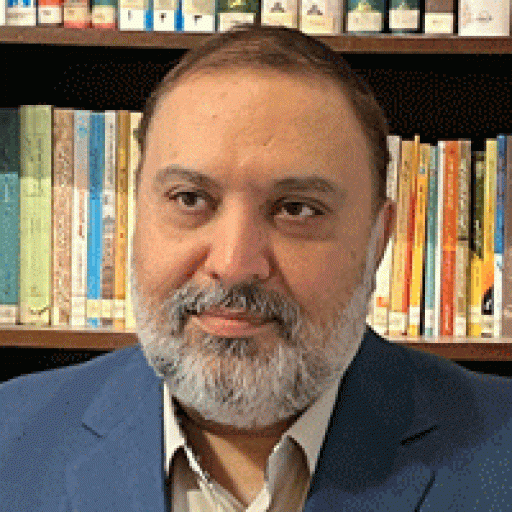
Reza Gholami, Faculty Member, Institute for Humanities and Cultural Studies
Introduction
This essay is not written to advocate for any specific theory but from a place of pure inquiry. My goal is neither to defend science against philosophy nor philosophy against science. Instead, I aim to briefly explore fundamental questions about human survival and consciousness and examine the answers provided by science and philosophy. This exploration serves as a foundation for advancing theories, identifying conflicts and convergences between different approaches, and paving the way for deeper research. I am not here to prove or disprove any claim but to keep the space for questioning open and show how the same questions can lead to varied, sometimes contradictory, answers. These contradictions are not an endpoint but a starting point for further thought and investigation.
Chapter 1: The Fundamental Question and the Clash of Perspectives
Since the dawn of human thought, one question has persisted: Does anything of us remain beyond memories and stories? This question stems not from a specific belief system but from innate human curiosity. Modern science, through the language of physics and biology, suggests that sound waves dissipate in the air, reflected light scatters in Earth’s atmosphere, and the brain shuts down upon death. Philosophy and mysticism, however, offer a different narrative: our actions leave a lasting imprint on existence, consciousness exists independently of matter, and humanity endures in deeper layers of reality. This clear conflict between the two perspectives is itself a question that demands exploration, not judgment.
Perhaps the answer lies not in choosing one perspective over the other but in understanding what “enduring” truly means. Is survival necessarily physical or metaphysical continuity, or could it be found in the invisible impacts and ripple effects we leave on others and the world? From this view, humans are not isolated beings that fade away but nodes in a network of relationships and meanings that continue to influence existence even after death.
Chapter 2: The Cosmic Archive Hypothesis and Inspiration from Starlight
One intriguing hypothesis is the idea of a “cosmic archive of human information,” where the universe itself becomes a repository for our data. This idea starts with a simple scientific observation: we see light from stars that died millions of years ago. Their light travels through the vacuum of space and persists to this day. This shows that the universe can preserve information for vast periods. But why can’t human sounds or images do the same?
The scientific answer is straightforward: sound waves require a material medium and quickly dissipate on Earth. Human light reflections also scatter and fade in the atmosphere. But this answer is based on what we know today. The history of science shows that “not discovered” does not mean “nonexistent.” We didn’t know about DNA for centuries, yet it existed. Radio waves were invisible, yet they filled the world. So, could there be structures or mechanisms in the human body that store information beyond genetic code?
Chapter 3: Beyond DNA and the Possibility of Unknown Structures
DNA can encode physical traits, and with advanced tools, we can reconstruct a person’s appearance or even their voice. Recent studies in vocal genetics suggest that certain voice traits are linked to specific genes, though this field is still in its infancy. However, DNA does not preserve memories, speech, or lived experiences. If we accept that science has not yet discovered all cellular or biological energy structures, we can hypothesize that unknown structures might store deeper information.
This hypothesis raises another question: If such structures exist, what happens to them after death? The human body decomposes into its elements, scattering atoms into soil, water, and air. Biogeochemical studies show that these elements re-enter natural cycles and redistribute across ecosystems. If these atoms or finer structures carry information beyond mere matter, then death may not be an end but a dispersal of our information into a cosmic archive.
In this view, the universe becomes an infinite archive of human information, where every scattered particle might carry a code of our existence. This is, of course, a speculative idea, not a scientific finding, but it poses a question that could guide future research. If such a possibility exists, future scientific tools—perhaps based on quantum physics or yet-unknown technologies—might one day detect and reconstruct these traces.
Chapter 4: Consciousness, Matter, and Conflicting Perspectives
A deeper question arises: Could human consciousness also have a place in such an archive? Today’s neuroscience asserts that consciousness is a product of brain activity and ceases when the brain dies. Extensive research in cognitive neuroscience links consciousness to specific electrochemical activities in the brain. In this view, matter precedes consciousness, and consciousness depends on it. However, philosophy and mysticism propose a different story: consciousness precedes matter, matter is a manifestation of consciousness, and human consciousness is a reflection of a universal consciousness.
Quantum physics offers a middle ground, showing that the boundary between observer and observed blurs at the quantum level. Studies on interpretations of quantum mechanics, such as the Copenhagen interpretation and quantum consciousness theories, suggest that the observer’s role in determining quantum states remains a debated topic. Consciousness might be tied to the fundamental structure of space-time. These three perspectives—scientific, philosophical, and quantum—clash not over truth but over the angle from which they view the same phenomenon.
Chapter 5: The Relationship Between Human Consciousness and a Creator’s Consciousness
Another question emerges: If the universe has a creator, what is the relationship between human consciousness and the creator’s consciousness? If a creator exists, creation requires knowledge and awareness. The creator’s consciousness must precede matter, and the material world is a manifestation of that consciousness. Islamic mysticism articulates this relationship, stating that human consciousness is a droplet from the ocean of absolute consciousness. In the works of great Islamic mystics like Rumi and Ibn Arabi, it is repeatedly said that humans are a reflection of divine attributes, and their consciousness mirrors absolute consciousness. We are not separate from that ocean but part of it.
This philosophical-mystical perspective clearly conflicts with the scientific view, yet both attempt to answer the same fundamental question: What is consciousness, and how does it arise?
Chapter 6: Waves, Entanglement, and the Interconnected Universe
Physics raises fascinating questions here. Quantum entanglement shows that particles can influence each other across infinite distances. Confirmed by experiments like those testing Bell’s inequalities, this phenomenon reveals that the universe is fundamentally interconnected. If a particle on one side of the universe can affect another on the opposite side, and if starlight can persist for millions of years, why couldn’t human consciousness information be preserved in another dimension of existence? This is a speculative question, but one that science has not definitively ruled out.
Physical waves tell an interesting story too. Sound waves dissipate in a medium, but electromagnetic waves like light and radio can travel millions of years through a vacuum. The physics of electromagnetic waves shows they move at a constant speed in a vacuum, with their weakening due only to geometric dispersion, not energy loss. The difference lies in their nature: sound waves depend on molecules, while radio waves are independent. This physical distinction can inspire philosophical thought: perhaps the moral and spiritual impact of human actions flows in a subtler dimension of existence, one we lack the tools to measure.
Chapter 7: Implications of Accepting the Hypothesis
If we take these hypotheses seriously, our views on death, identity, and history transform. Death is no longer destruction but a transition of information from a concentrated to a dispersed form. History is no longer just narratives and writings but a replayable event. If every action, word, and thought is recorded in the universe, our ethical responsibility becomes eternal. This perspective offers hope for a form of survival and continuity—not as physical return but as an informational and spiritual presence in the fabric of reality.
Chapter 8: Research Outlook and the Need for an Interdisciplinary Approach
This hypothesis demands an interdisciplinary research program. In biology, we must search for unknown cellular structures and explore information storage beyond DNA. Recent epigenetic studies show that information beyond DNA sequences can be stored and transmitted through chemical changes on DNA and histones, opening new horizons for understanding biological information storage.
In physics, we should investigate the preservation of information at the quantum level and the role of entanglement in information transfer. Theories in quantum information and computing show that information at the quantum level has unique properties distinct from classical concepts.
In technology, we need tools to detect informational traces in nature and algorithms to reconstruct scattered data. Recent advances in machine learning and AI demonstrate that reconstructing information from incomplete data is possible, though on a much smaller scale than this hypothesis suggests.
In philosophy, we must revisit the relationship between consciousness and matter and study the ethical and existential implications of this perspective. Contemporary philosophy of mind still grapples with the “hard problem” of consciousness, with theories ranging from eliminative materialism to panpsychism, each attempting to address this fundamental question.
Conclusion
The “cosmic archive of human information” hypothesis currently sits at the boundary of science and imagination. Its purpose is not to prove a claim but to open a space for questioning. The conflict between philosophers’ and scientists’ answers should not halt the pursuit of truth but inspire more precise questions, better experiments, and deeper thinking. The questions remain, and only through the continued collaboration of philosophers and scientists can we approach answers.
Perhaps one day we’ll discover that the universe is the greatest library of human history—a library that holds not just the written word but the living voices, true images, and perhaps even the consciousness of those who came before. Or maybe we’ll find that no such thing exists, and today’s scientific view is correct. Both possibilities are worth exploring, because questioning is the essence of being human.
Ultimately, this essay is an invitation to reflect on the limits of human knowledge and humbly accept that many questions remain unanswered. Science and philosophy are both valuable tools for exploring these questions, and their apparent conflicts should not prevent constructive dialogue. Perhaps in the future, with scientific progress and deeper philosophical insight, we can build stronger bridges between these approaches and gain a fuller understanding of eternity and humanity’s place in existence.
_________________________________________________________________________________
Sources and Further Reading:
A. Quantum Physics and Information:
- Bell, J. S. (1964). On the Einstein Podolsky Rosen Paradox, Physics.
- Nielsen, M. A., & Chuang, I. L. (2010). Quantum Computation and Quantum Information, Cambridge University Press.
B. Neuroscience and Consciousness:
- Chalmers, D. J. (1995). Facing Up to the Problem of Consciousness, Journal of Consciousness Studies.
- Koch, C. (2012). Consciousness: Confessions of a Romantic Reductionist, MIT Press.
- Tononi, G. (2008). Consciousness as Integrated Information: A Provisional Manifesto, The Biological Bulletin.
C. Biology and Genetics:
- Allis, C. D., & Jenuwein, T. (2016). The Molecular Hallmarks of Epigenetic Control, Nature Reviews Genetics.
- Watson, J. D., et al. (2014). Molecular Biology of the Gene, Pearson.
D. Philosophy of Mind:
- Dennett, D. C. (1991). Consciousness Explained, Little, Brown and Company.
- Searle, J. R. (2004). Mind: A Brief Introduction, Oxford University Press.
- Nagel, T. (1974). What Is It Like to Be a Bat?, The Philosophical Review.
E. Islamic Mysticism and Philosophy:
- Ibn Arabi (13th century). Fusus al-Hikam.
- Rumi, Jalaluddin (13th century). Masnavi-ye Ma’navi.
- Corbin, H. (2001). History of Islamic Philosophy, translated by J. Tabatabaei, Kavir.
F. Physics and Cosmology:
- Hawking, S. (1988). A Brief History of Time, Bantam Books.
- Penrose, R. (1989). The Emperor’s New Mind, Oxford University Press.