A Comparative Study of Christianity and Islam
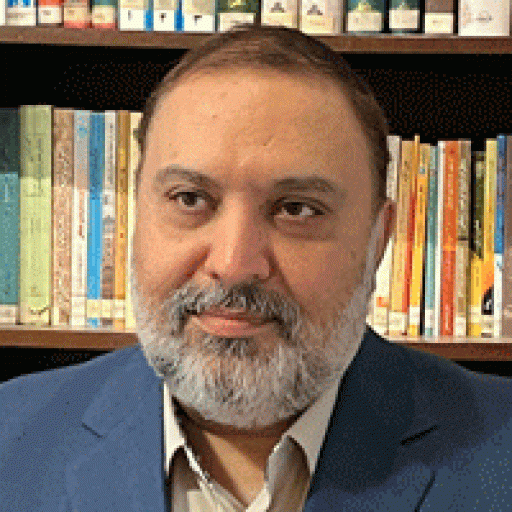
Full Text of Dr. Reza Gholami’s Speech at the Meeting on “Imamate and Leadership in Islamic Political Thought”, House of Iranian Wisdom, Vienna – April 24, 2026
Introduction: The Core Questions
Every religious community with a clear vision must eventually face this question: Where does leadership come from, what makes it legitimate, and how is it passed from one generation to the next?
In the Abrahamic religions – especially Christianity and Islam – this question has received different but deeply thoughtful answers. The main question of this lecture is:
What are the theological foundations of leadership theories in Christianity and Islam, and what paths have they taken through history?
Alongside this main question, several secondary questions arise: How did succession take shape in Christianity, and what are the differences between its branches? Why did Islam arrive at two different theories – Caliphate (Khilafat) and Imamate (Imamat) – after the Prophet, and what are the theological roots of each? And how did these two theories develop over time?
Before we begin, one important point must be acknowledged: none of these religious traditions are uniform or speak with one voice. Christianity is divided into Catholic, Orthodox, and Protestant branches – each with its own internal variety. Islam spans Sunni Islam with its four legal schools and various theological traditions, and Shia Islam with its Twelver, Ismaili, and Zaydi branches. What follows traces the main currents of these traditions, and does not claim to cover all of their rich diversity.
Part One: Succession in Christianity
After Jesus Christ, leadership of the Christian community was handed to the Apostles. They spread his message across the world and built an institutional foundation that still stands centuries later.
In the Catholic tradition, the highest proof of leadership authority goes back to the “Rock and Keys” covenant in the Gospel of Matthew. In this text, Jesus changed Simon’s name to “Peter” – meaning rock – and declared him the foundation of his Church. By giving him the “keys of the Kingdom of Heaven,” he established a divine link between the rulings of earth and heaven:
“You are Peter, and on this rock I will build my Church… and I will give you the keys of the Kingdom of Heaven.” (Matthew 16:18)
This passage presents Peter not merely as a preacher, but as the authorized representative of Christ in his physical absence -and it forms the cornerstone of the Pope-centered Catholic system.
From Peter, a chain of successors developed known as “Apostolic Succession” – a line of bishops and priests through whom the trust of leadership has been passed down each generation. In this tradition, the Pope is Peter’s successor and the spiritual center of the Church, with special authority to interpret matters of faith.
But this model was not accepted across all branches of Christianity. In the Orthodox tradition, leadership was distributed in a conciliar way among local churches – Constantinople, Alexandria, Antioch, and Jerusalem each kept their independence, and no single authority holds universal power. The Protestants rejected centralized leadership altogether, making the Bible the sole authority – every believer can connect with God directly, without any intermediary. This principle, known as the “priesthood of all believers,” was a revolution in the concept of religious leadership.
What all branches of Christianity share is that leadership is essentially spiritual – focused on teaching, guidance, and direction. Succession in Christianity is more institutional and collective, rather than resting on a single person with divine appointment in the strict theological sense.
Part Two: Two Theories, Two Theological Horizons
After the passing of the Prophet Muhammad(PBUH), the question of leadership became one of the most fundamental issues in Islamic history. Two great theories emerged from this question, each resting on different theological foundations.
The Theory of the Caliphate
The theory of the Caliphate, which took shape among Sunni Muslims, begins from an important theological premise: the Prophet Muhammad is the Seal of the Prophets, and with his passing, divine revelation came to an end. The Holy Quran states:
«مَا کَانَ مُحَمَّدٌ أَبَا أَحَدٍ مِّن رِّجَالِکُمْ وَلَٰکِن رَّسُولَ اللَّهِ وَخَاتَمَ النَّبِیِّینَ»
“Muhammad is not the father of any of your men, but he is the Messenger of God and the Seal of the Prophets.” (Al-Ahzab: 40)
Therefore, no successor can inherit the Prophet’s religious authority and infallibility. What remains is the community’s need for political leadership to maintain order, implement divine law, and protect the religion. Sunni scholars draw on verses such as:
«وَأَمْرُهُمْ شُورَىٰ بَیْنَهُمْ»
“and their affairs are conducted by mutual consultation among themselves” (Ash-Shura: 38)
«وَشَاوِرْهُمْ فِی الْأَمْرِ»
“and consult them in the matter” (Aal-Imran: 159)
On this basis, the Caliph is chosen through the community’s pledge of allegiance and consultation – as began with Abu Bakr al-Siddiq. The Caliph is neither divinely appointed nor infallible; he is a person the community has deemed worthy of this responsibility, and his authority flows from the consent and pledge of the people.
This foundation, however, has never been without its critics. Some voices within the tradition have argued that the legitimacy of a consultative caliphate depends entirely on the quality and inclusiveness of the consultation itself. A council that lacks clear standards, broad representation, and an accepted process can lose its legitimacy and become the tool of a particular elite. This critique — raised repeatedly throughout Islamic history — shows that even within the caliphate tradition, serious questions about how leaders are chosen have always existed.
In this framework, religious scholars play an independent and important role. Juristic reasoning (ijtihad) in Sunni Islam – deriving rulings from the Quran, the Prophetic tradition, scholarly consensus, and analogical reasoning – operated in a relatively open and dynamic way in the early centuries, giving rise to the four legal schools: Maliki, Shafi’i, Hanafi, and Hanbali. However, from around the fourth Islamic century onward, a dominant view emerged among many Sunni scholars that “the gate of ijtihad is closed” – that the great Imams of the four schools had already derived what needed to be derived. From that point, scholars were expected to follow (taqlid) these Imams and apply their rulings to new situations, rather than reasoning independently from primary sources. This approach, known as the “closure of the gate of ijtihad,” had a deep impact on the dynamism of Sunni legal thought in the medieval period -though in modern times, a number of Sunni thinkers have sought to revive independent reasoning.
The Theory of the Imamate
The theory of the Imamate, on which Twelver Shia Islam is founded, approaches the question from a different theological direction. In this view, the leadership of the community after the Prophet cannot be merely a political matter – because the Islamic community, in order to continue receiving divine guidance, needs an authority that can interpret religion with depth and prevent deviation.
For this reason, in the theory of the Imamate, leadership after the Prophet was handed not through collective election, but through explicit designation (nass) – a clear appointment by the Prophet himself – to Ali ibn Abi Talib (AS) and then to eleven Imams after him.
The Key Quranic Verses of the Imamate
The Verse of Guardianship (Ayat-e Velayat) (Al-Ma’idah: 55) – the strongest Quranic evidence for the designation of the Imam:
«إِنَّمَا وَلِیُّکُمُ اللَّهُ وَرَسُولُهُ وَالَّذِینَ آمَنُوا الَّذِینَ یُقِیمُونَ الصَّلَاةَ وَیُؤْتُونَ الزَّکَاةَ وَهُمْ رَاکِعُونَ»
“Your guardian is only God, and His Messenger, and those who believe — those who establish prayer and give charity while bowing in worship.”
Shia commentators – and many Sunni scholars regarding the occasion of revelation – hold that this verse was revealed in praise of Ali ibn Abi Talib, who gave his ring to a person in need while bowing in prayer. The word “innama” in Arabic is a particle of restriction, limiting guardianship to only these three sources. It should be noted that many Sunni commentators interpret “waliy” (vali) in this verse as “friend and supporter” rather than “ruler and guardian.”
The Verse of Proclamation (Ayat-e Eblagh) (Al-Ma’idah: 67) – linked to the event of Ghadir Khumm:
«یَا أَیُّهَا الرَّسُولُ بَلِّغْ مَا أُنزِلَ إِلَیْکَ مِن رَّبِّکَ وَإِن لَّمْ تَفْعَلْ فَمَا بَلَّغْتَ رِسَالَتَهُ»
“O Messenger, deliver what has been revealed to you from your Lord; and if you do not, you will not have conveyed His message.”
Shia Muslims conclude from the decisive tone of this verse that proclaiming the Imamate was so significant that it was treated as equivalent to the entire prophetic mission.
The Verse of Completion (Ayat-e Ekmal) (Al-Ma’idah: 3) – revealed immediately after the event of Ghadir:
«الْیَوْمَ أَکْمَلْتُ لَکُمْ دِینَکُمْ وَأَتْمَمْتُ عَلَیْکُمْ نِعْمَتِی وَرَضِیتُ لَکُمُ الْإِسْلَامَ دِینًا»
“Today I have perfected your religion for you, completed My blessing upon you, and chosen Islam as your way of life.”
In Shia theological reasoning, the “perfection of religion” without designating a leader after the Prophet would be incomplete.
The Verse of Authority (Ayat-e Olil-Amr) (An-Nisa: 59) – placing obedience to the Imam alongside obedience to God and the Prophet:
«یَا أَیُّهَا الَّذِینَ آمَنُوا أَطِیعُوا اللَّهَ وَأَطِیعُوا الرَّسُولَ وَأُولِی الْأَمْرِ مِنکُمْ»
“O you who believe, obey God and obey the Messenger and those in authority among you.”
Shia Muslims argue that since obedience to those in authority is commanded without any qualification, alongside obedience to God and the Prophet, those in authority must be infallible – otherwise God would not command absolute obedience to fallible people.
The Verse of Purification (Ayat-e Tathir) (Al-Ahzab: 33) – declaring the divine purification of the Ahl al-Bayt (Ahl-e Bayt):
«إِنَّمَا یُرِیدُ اللَّهُ لِیُذْهِبَ عَنکُمُ الرِّجْسَ أَهْلَ الْبَیْتِ وَیُطَهِّرَکُمْ تَطْهِیرًا»
“God only wishes to remove impurity from you, O People of the Household, and to purify you completely.”
Alongside these verses, Shia Muslims cite the Hadith of Ghadir Khumm, in which the Prophet said: “Whoever I am his master (mawla), this Ali is his master” – and the verse:
«وَلِکُلِّ قَوْمٍ هَادٍ»
“and for every people there is a guide” (Ar-Ra’d: 7)
– interpreted as pointing to the continuous presence of an Imam in every age.
The Defining Qualities of the Infallible Imam in Twelver Shia Islam
First, being from the Ahl al-Bayt: The line of Imamate descends from the Prophet’s family through Fatimah al-Zahra – the Prophet’s daughter and Ali’s wife. Being from the Ahl al-Bayt is not merely a matter of family lineage, but a sign of divine selection and purification, as indicated by the Verse of Purification.
Second, the station of infallibility (esmat): The Imam is protected from error and sin in interpreting religion, in conduct, and in guiding the community. This infallibility is not a claim of prophethood, nor does it mean receiving new divine revelation – the Prophet is the Seal, and the Quran is complete – but rather a form of inner connection to the divine source of knowledge, which in Shia literature is called “divinely granted knowledge” (elm-e ladoni).
Third, connection to the source of revelation: The Imam does not bring a new book or new law, but possesses a knowledge rooted in the same source from which revelation came. This connection is described in the beautiful Hadith of Nearness through Supererogatory Acts (Hadith-e Qorb-e Navafal) – found in both Sahih al-Bukhari and Al-Kafi:
“…My servant continues to draw near to Me through voluntary acts of worship until I love him. When I love him, I become the ear with which he hears, the eye with which he sees, and the hand with which he acts…”
This hadith describes a human being who has become, as Rumi (Molana) calls it, “annihilated in God” (fana) – one whose perception and action are a direct expression of divine will.
Fourth, the station of the Perfect Human (Ensan-e Kamel): In Shia teachings, the Infallible Imam is the clearest example of the “Perfect Human” – one in whom all human capacities have been brought to their highest fulfillment, and who is God’s proof (hojjat) on earth and the channel of divine grace between the unseen world and creation. Rumi describes this station beautifully:
“Aalam-e notqi o kolli bar zamin / Mazhar-e haqqi o jani dar kamin”
(You are the universal word and absolute truth walking on earth; you are the manifestation of God, a soul lying in wait within a human form.)
Part Three: Continuation and Development — From Theory to Practice
The Caliphate Through History
The theory of the Caliphate went through many rises and falls across history. The Rightly-Guided Caliphs (Kholafa-ye Rashedin), the Umayyad Caliphate, the Abbasid Caliphate, and finally the Ottoman Caliphate each represented a different interpretation and lived experience of this theory. With the collapse of the Ottoman Caliphate in 1924, the Sunni world found itself practically without a single unified political authority.
In the modern era, after the formation of nation-states, Sunni-majority countries took different paths. Religious leadership continued through institutions such as Al-Azhar, fatwa councils, and local scholars – but a single centralized religious authority never took shape at the level of the entire Sunni world. This diversity is both a strength of this tradition and one of its structural challenges.
The Imamate and the Theory of Deputyship
In the Shia tradition, when the occultation (gheybat) of the Twelfth Imam began in the third Islamic century, a new question arose: in the absence of the Imam, how should the leadership of the community be organized? The Shia answer was the “Theory of Deputyship” (Niyabat) – qualified religious scholars, as general deputies of the Imam, take on the responsibility of guiding the community in religious matters. This theory developed over the centuries and in the modern era took the form of the “Guardianship of the Jurist” (Velayat-e Faqih), a political-religious system that found expression in the Islamic Republic of Iran.
What distinguishes the theory of deputyship from a mere transfer of power is its deep connection with living juristic reasoning. Unlike the Sunni tradition, which effectively closed the gate of ijtihad in the fourth Islamic century, in Shia jurisprudence ijtihad has always remained open and active. One of the foundational principles of Shia law is that following a deceased jurist is not permitted – every believer must follow a living, qualified jurist. This principle, known as the “requirement of the jurist being alive”, means that juristic reasoning in every age must remain alive and active. A jurist cannot rely solely on the rulings of those who came before; he must reason independently from primary sources – the Quran, the Prophetic tradition, and the narrations of the Ahl al-Bayt.
The fruit of this structure is that Islamic law preserves its vitality in every era, and the work of guidance is always grounded in a living, contemporary jurisprudence – not dependent on rulings derived centuries ago. For this reason, the jurist who is qualified for deputyship in the age of occultation draws his legitimacy not from the legacy of deceased predecessors, but from his own living and independent reasoning from primary sources – and this is precisely the link that makes the theory of deputyship an organic outgrowth of Shia jurisprudence.
Also, in the theory of deputyship, infallibility is no longer required. But one important condition remains: personal justice. The deputy must be a just person. This condition can shape the character of the leader and largely prevent misuse of this position.
Part Four: The Idea of Trans-Denominational Leadership
Alongside these two main theories, contemporary experience has shown an interesting phenomenon that can be called “trans-denominational leadership”. In practice, this idea has taken two distinct directions.
The first direction is the movement that has chosen “Islam without schools of law” – an approach that sets aside the classical legal schools and returns directly to the Quran and Prophetic tradition. While this trend has its supporters in certain circles, it has not been broadly welcomed by the Muslim world as a whole, since it tends to disregard the rich jurisprudential and theological heritage of Islam and, in the view of many, oversimplifies the interpretive complexities of the religion.
The second direction takes a functionalist approach to leadership – evaluating leadership not on the basis of denominational affiliation, but on effectiveness, coherence, and the ability to protect the interests of the Muslim world. In this approach, the question is not which school of law a leader belongs to, but whether he can guide the Muslim world in the face of shared challenges. For this reason, even among some Sunni communities, one can observe groups that – in political matters, though not in theological or jurisprudential ones – recognized the leadership of Imam Khomeini and after him Martyrs Ayatollah Sayed Ali Khamenei as carrying significant influence on key strategic issues facing the Muslim world. This phenomenon arose not from accepting Shia theological beliefs, but from recognizing a coherent and independent leadership standing against external domination. The distinction of Ayatollah Khamenei’s leadership, compared to Imam Khomeini, lies in its greater focus on consolidating, managing, and developing the system under complex domestic and international conditions.
Conclusion
What this comparative journey shows is that the question of leadership in the Abrahamic religions is not merely a historical question – it is a living question, one that still beats at the heart of many of the world’s political and social transformations today.
Christianity institutionalized leadership within the Church and organized succession through apostolic continuity – drawing on the Rock and Keys covenant – but divided internally into Catholic, Orthodox, and Protestant branches, each with a different understanding of authority and leadership.
Islam also took two different paths: the theory of the Caliphate draws authority from below, from the community’s pledge of allegiance, but its enduring historical challenge has been determining what standards and composition a council must have to produce genuine legitimacy. The theory of the Imamate draws authority from above, from divine appointment, sees the Imam as the perfect human and God’s proof on earth, and through the principle of living ijtihad keeps jurisprudence vital and responsive in every age.
These two theories are not merely a political disagreement – they are two different theological answers to a shared question: after the Prophet, how is the guidance of the community guaranteed? One seeks the answer in the collective wisdom and choice of the community; the other in a continuity of authority rooted in divine appointment and infallibility. In the modern era, the idea of trans-denominational leadership has shown that these boundaries are more flexible in the political arena than they might appear – and a functionalist understanding of leadership can, beyond theological distinctions, provide a point of convergence for the Muslim world.
Both traditions spring from a shared concern – protecting religion and guiding the community – and it is this shared concern that, despite all differences, can serve as a foundation for dialogue and understanding. Perhaps the deepest lesson of this comparative journey is that no theory of leadership, however rich and well-grounded, is immune to the questions of its time – and only that tradition endures which does not lose its ability to engage with those questions.
Sources and References
Sacred Texts
- The Holy Quran
- The Bible (New International Version) — Matthew 16:18
- Sahih al-Bukhari (Sahih-e Bokhari) — Hadith of Nearness through Supererogatory Acts
- Al-Kafi (Al-Kafi) by Sheikh al-Kulayni (Sheikh Kolayni) — Hadith of Nearness through Supererogatory Acts
Classical Islamic Theology and Jurisprudence
- Al-Mawardi (Al-Maverdi), Al-Ahkam al-Sultaniyya — on the theory of the Caliphate
- Sheikh al-Mufid (Sheikh Mofid), Al-Irshad — on the Imams of the Shia
- Allamah al-Hilli (Allameh Helli), Kashf al-Murad — on Shia theology and Imamate
- Ibn Khaldun (Ebn Khaldun), Muqaddimah — on political theory and the Caliphate
Modern and Contemporary Works
- Hamid Enayat (Hamid Enayat), Modern Islamic Political Thought — London: Macmillan, 1982
- Abdolkarim Soroush (Abdolkarim Soroush), Reason, Freedom and Democracy in Islam — Oxford University Press, 2000
- Vali Nasr (Vali Nasr), The Shia Revival — New York: Norton, 2006
- Wilfred Madelung (Vilfred Madelong), The Succession to Muhammad — Cambridge University Press, 1997
- Said Amir Arjomand (Sa’id Amir Arjomand), The Shadow of God and the Hidden Imam — University of Chicago Press, 1984
On the Perfect Human and Mystical Tradition
- Jalal al-Din Rumi (Jalalodin Molana Rumi), Masnavi-ye Ma’navi
- Ibn Arabi (Ebn Arabi), Fusus al-Hikam (Fosus al-Hekam) — on the concept of the Perfect Human