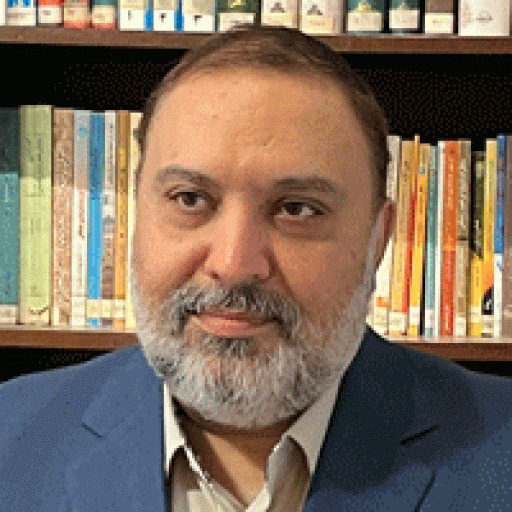
Speech by Dr. Reza Gholami at the Third Iranian Studies Symposium, titled “An Evening with Professor Rudiger Lohlker,” October 30, 2025, Vienna, Iranian Wisdom House in Vienna.
Good afternoon everyone.
Today we have gathered to honor a great professor and researcher who has devoted his life to expanding the boundaries of knowledge, written many valuable works, and trained dozens of talented students.
We are all proud of Professor Lohlker. He is one of the great treasures of Islamic and Iranian studies.
I would like to present a talk on Islamic studies today in his honor.
The topic of my speech is the eighth distinct readings of Islam.
The reading of Islam means looking at Islam through a particular lens; looking at Islam in different epistemic worlds and also looking at religion through diverse expectations.
First, the theological reading.
The theological reading focuses on religious faith.
The theological reading struggles to present a persuasive argument for Islam.
For some, Reliable references from the Qur’an and Hadith are convincing, while for others, reasoned arguments carry weight.
Theology utilizes both separately or together.
Theological assumption holds the absolute truth of religious beliefs.
In fact, for theology, preserving faith and defending Islamic beliefs against doubts and objections is its primary aim.
Second, the jurisprudential reading, which concentrates only on obligations.
It also pays little attention to ethics, reason, and the flow of history.
Almost perfect — just a few small corrections for clarity and accuracy:
Within the jurisprudential view of religion, there are two approaches:
minimal and maximal.
According to the maximal approach, one should try to find a religious rule even for the smallest details of a Muslim’s behavior.
Some consider jurisprudential rulings arising from collective reason as part of the achievements of jurisprudence; however, such rulings are rarely fully integrated into traditional jurisprudence.
At times, it also sacrifices the essence of religion for its outward forms.
It is crucial that If Islamic jurisprudence cannot adapt itself to the conditions and needs of the time, and if it cannot recognize the legitimate role of collective reason and science in certain areas, it may become isolated among believers in the future, while religiosity without jurisprudence spreads.
Meanwhile, this reading of jurisprudence often results in legalistic rigidity.
The third reading is the ethical, or moralistic, reading.
According to this reading, religion is fundamentally ethical. Thus, it must be morally justified everywhere and foster moral development in people.
This reading respects religion and does not concern itself with theological issues or legal rules that go beyond ethics.
The fourth reading is the philosophical reading, which involves a rational approach to Islam.
Maybe ask me what the difference is between the theological and philosophical readings.
Theological thought does not doubt religion and tries to defend it rationally at all costs, while philosophy allows for doubt and may show that some religious teachings cannot be proven by reason.
One of the features of a philosophical view of religion is looking at religion: free, from outside, from above, and at the whole of religion, systematically.
The philosophical reading is useful for two groups: independent researchers and those who are drawn to religion only through free and independent rational reasoning.
Of course, the philosophical reading has another meaning as well: it focuses on the ontological interpretation of Islam with two goals—rational assessment and spiritual inspiration.
Religions have a tendency to attract superstitions, like a magnet pulls iron, so philosophical reading plays an important role in exposing superstitions and unfounded beliefs attached to religion.
Because of this reason, most religious intellectuals follow the philosophical reading.
The fifth reading is the mystical reading. In this approach, the goal is to interpret the mystical perspectives of religion or to attain direct, experiential knowledge of existence through religion.
This reading of mysticism is deeply oriented toward the inner, spiritual essence of religion.
Also, At times, the mystical reading sacrifices the outward forms of religion for its inner essence.
The sixth reading is the historical reading of religion.
In this approach, the focus is on interpreting the overall course of Islam and deriving general principles from it.
Historical reading can support the jurisprudential reading, and it can also be considered a branch of the philosophical reading, namely the philosophy of history.
Historical reading may be considered an introduction to the formation of religious sociology.
At the same time, this reading can pose the risk of historicism or being stuck in the past.
Of course, religions cannot be separated from their past, but we can imagine a religion that stands with one foot in its past and one foot in the present.
As a seventh approach, we can also refer to the psychological view of religion. This reading regards religion as a source of comfort that helps reduce fear and sorrow. It expects religion to bring peace of mind by giving meaning and purpose to life-both in this world and in the hereafter-and thus saving human beings from the feeling of emptiness.
The eighth reading is the scientific reading of religion.
In this approach, efforts are made to justify religion scientifically.
In this reading, any part of religion that cannot be proven using scientific methodology is ultimately set aside.
This reading seeks to resolve the conflict between science and religion.
Meanwhile, One of the goals of the scientific view of religion is to make religion modern.
But this reading makes religion relative, similar to scientific theories.
One view believes that the world of religion is separate from the world of science, and it is better if the two do not enter each other’s domain.
I would have liked to talk about the political interpretation of religion as well, but it’s a broad topic and can be discussed in another session.
Each of these readings has its advantages and limitations.
The theological reading preserves faith but may resist critical inquiry.
The jurisprudential reading provides clear guidance but risks legalism.
The philosophical reading enables rational analysis but may distance itself from lived faith.
Some believe these readings can be integrated.
However, they often operate from incompatible assumptions and pursue different goals.
The question is not which reading is correct, but rather: which reading serves our scholarly purpose?
Here lies the crucial point: Ignoring this diversity of interpretations seriously reduces the credibility of Islamic studies.
We cannot pretend there is only one way to approach Islam.
Therefore, as scholars, we must be transparent.
We must clearly identify our chosen reading and its appropriate methodology. This honesty strengthens our field rather than weakens it.
Professor Lohlker has exemplified this intellectual integrity throughout his career—approaching Islamic studies with both depth and openness.
As we honor him today, let us commit to continuing this tradition: rigorous scholarship that acknowledges its own perspective while respecting others.
This is how Islamic studies remains vibrant, credible, and relevant.
Thank you for your attention.”