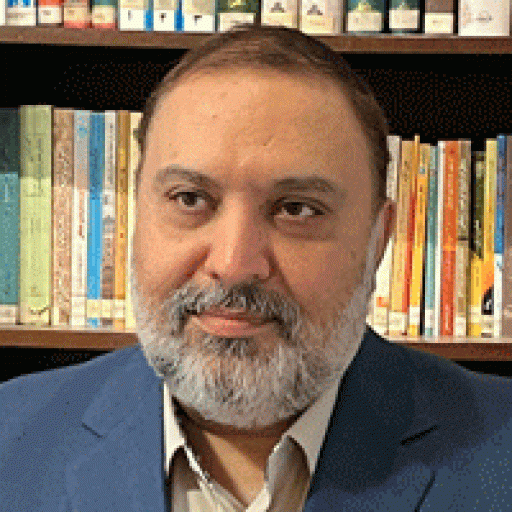
Full Text of Dr. Reza Gholami’s Speech at the Event “An Evening with Iranian Cultural Heritage”, Iranian Wisdom House,Vienna – April 17, 2026
Good evening
To start, I would like to thank all of you for participating in this event.
Also, I would like to express my appreciation to the speakers.
As you know, Iran, with over seven thousand years of civilization, has a rich cultural heritage—both tangible and intangible.
We used to think the Taliban’s destruction of Afghanistan’s heritage showed a lack of civilization, but the United States and its offspring Israel were destroying Iran’s cultural heritage. Despite claiming to be a modern civilization, this was barbaric behavior.
Iranian cultural heritage reflects the golden moments of human civilization.
It can be said that Iran’s cultural heritage is a gateway to the world of self-awareness.
Therefore, they are part of the heritage of humanity, not just Iran’s heritage.
Thus, any harm to cultural heritage in Iran means harm to the cultural heritage of all nations.
In other words, our problem is a global problem, and I am deeply shocked when I see that some relevant figures remain silent.
As far as I know, Even in Austria, the majority of Iranian studies scholars and Iranian studies centers remain silent.
You cannot be an Iranian Studies scholar and remain indifferent to the destruction of Iran’s cultural heritage.
Being indifferent to the destruction of Iran’s cultural heritage means accepting the destruction of cultural heritage everywhere in the world including your countries in the east and the west.
As our speakers said, Some people think destroyed cultural heritage can be rebuilt with money, but it’s not true.
Rebuilt cultural heritage is not the same as the original cultural heritage because It does not have the original existence or spirit.
Allow me to explain this a bit philosophically.
***
Cultural Epistemicide”: When Missiles Kill Time
Destroying cultural heritage in war is not just a legal problem or material loss.
At its core, it is a form of epistemicide – the killing of knowledge itself.
According to Heidegger, human existence is fundamentally historical: we live in a meaningful world whose layers of time reach us through objects, spaces, and buildings. When the Golestan Palace in Tehran is severely damaged, what disappears is not stone and tile – it is a horizon of meaning, a way of being in the world that can never be rebuilt.
Paul Ricoeur called this process an “injury to narrative identity”: every people exists through the story it tells about itself across time, and physical heritage is the anchor of that story. Destroying it does not only demolish buildings – it severs the human connection between past and future. It is a kind of “murder of time,” and in some ways more terrifying than the killing of people, because its victims have not yet been born.
***
So, I hope no one stays indifferent and silent.
It is also expected that UNESCO will take this issue more seriously.
UNESCO’s response to this tragedy is much less than expected.
For the future, we need strong guarantees to prevent attacks on countries’ cultural heritage.
Thank you for your attention.