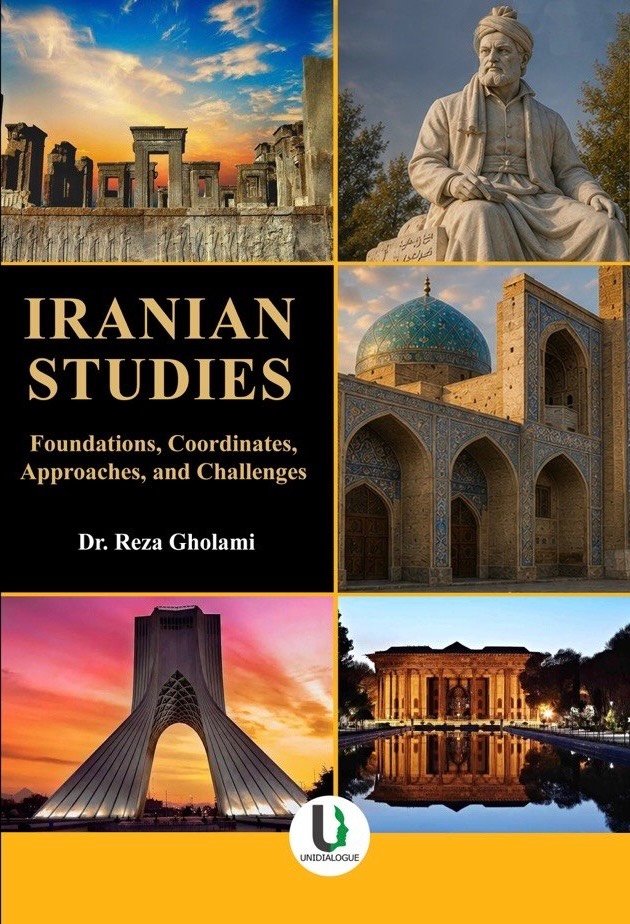
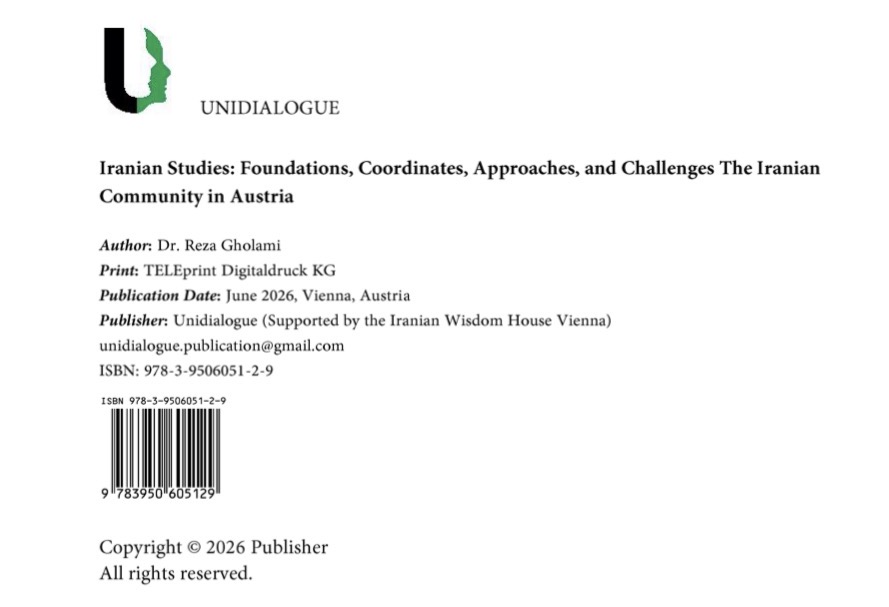
Authored by Reza Gholami, this 104-page duodecimo (pocket-size) book has been published in English by Unidialogue in Vienna.
In recent years, Iranian Studies has faced conceptual fragmentation and a methodological crisis more than ever before. A significant portion of the literature in this field has either remained confined to historical and linguistic descriptions or drowned in fragmented, isolated case studies. While these works possess inherent academic value, they rarely offer a cohesive, theoretical picture of “Iran” as a civilizational reality. Against this backdrop, *Iranian Studies: Foundations, Coordinates, Approaches, and Challenges* stands out as a distinct and thought-provoking endeavor.
The most defining feature of this book is its attempt to transcend purely descriptive Iranian Studies and move toward “theorizing the discipline.” The author seeks to redefine Iranian Studies not merely as a collection of historical, anthropological, or linguistic analyses, but as an independent epistemic field with its own theoretical foundations. This approach lends the book an ambitious yet rigorous identity.
The book’s narrative arc begins at this very juncture. The author initially defines Iranian Studies and addresses the necessity of rethinking its theoretical foundations. He then gradually guides the reader into deeper discussions, such as the epistemological crisis within the field, the relationship between Iran and identity, the status of the Persian language, and the concept of “Iran as a civilizational formation.” Moving forward, the book constructs a methodological framework for Iranian Studies, demonstrating that without a theoretical and civilizational horizon, the discipline risks degenerating into a series of scattered, incoherent research projects.
The chapter structure further reveals that the author has proceeded with a clear intellectual roadmap. Chapters covering the definition of Iranian Studies, the field’s epistemological crises, the necessity of theoretical foundations, the Persian language as an epistemic infrastructure, and paradigmatic methodology collectively establish a conceptual cohesion rarely found in similar works. The book is not merely a compilation of disjointed essays; rather, it attempts to provide a distinct intellectual architecture for understanding Iran.
Another strength of this work lies in its civilizational perspective. While mainstream trends of Iranian Studies in the West often reduce Iran to geography, ethnicity, linguistics, or political history, this book underscores “Iran as a civilizational tradition.” Consequently, the author endeavors to move beyond mere historiography, explaining Iran as a living cultural and epistemic system—a system wherein the Persian language, historical memory, and civilizational continuity play foundational roles.
The book’s critical approach toward the current state of Iranian Studies is also noteworthy. By pointing out the fragmentation of studies, the lack of a shared academic language, extreme descriptivism, and weak theoretical underpinnings, the author articulates critiques that largely align with the contemporary realities of the field. These critiques distance the book from a purely laudatory or ideological text, imbuing it with an analytical edge.
Naturally, the book is not without its shortcomings. At times, the level of abstraction and theorizing is so elevated that it may appear overly abstract to certain academic audiences, particularly researchers inclined toward field studies and data-driven research. Furthermore, to maximize its impact within international academic circles, the text requires a more direct dialogue with major intellectual currents in civilizational studies, postcolonial theory, and contemporary Iranian Studies.
Nevertheless, *Iranian Studies: Foundations, Coordinates, Approaches, and Challenges* can be regarded as a serious attempt to rethink the “philosophy of Iranian Studies.” It is an effort that aims to elevate the discipline above a collection of scattered research and transform it into a field characterized by theoretical grounding, conceptual cohesion, and a civilizational horizon. Even if some of the book’s ideas still require further elaboration and precise operational formulation, the very entry into this domain and the raising of such questions remain highly valuable and significant for the academic community of Iranian Studies.