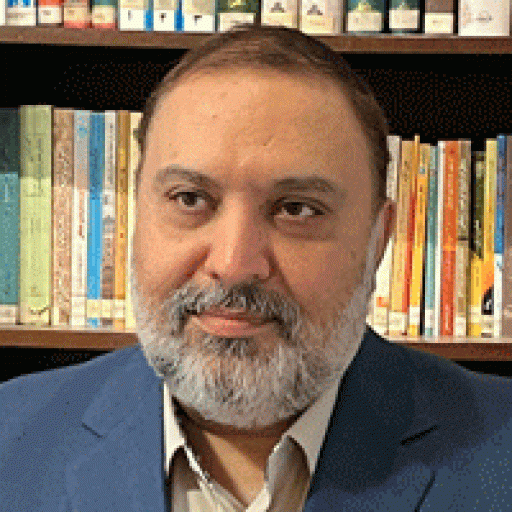
Reza Gholami
Faculty Member, Institute for Humanities and Cultural Studies
Throughout history, power has never been limited to hard military or economic tools. The deepest and most lasting forms of power have been those that succeeded in monopolizing the definition of truth.
From the ideological apparatuses of 20th-century totalitarian states – which Hannah Arendt, in her foundational work The Origins of Totalitarianism (1951), describes as the organization of masses and the destruction of reality – where regimes like Nazism and Stalinism not only controlled external reality but, through the re-engineering of language and the rewriting of history, even stripped people of the ability to imagine alternative realities – to the complex media networks of the contemporary world, where Michel Foucault, in works such as Discipline and Punish (1975) and The Will to Knowledge (1976), introduces the key concept of “regimes of truth” and analyzes it as a structural link between power and knowledge – a point where truth is not a neutral epistemological discovery but a product of power mechanisms that produce, distribute, and legitimize reality – the central conflict of our epistemological-political era has always revolved around one question: Who has the authority to define the nature of truth?
Arendt stresses that totalitarianism operates by replacing objective reality with coherent ideological structures. She writes that what prepares the masses for totalitarian rule is not belief in propaganda theories or membership in party organizations, but a reality in which the structure of reality is no longer comprehensible.[1]
In contrast, Foucault shows that truth is tied to the world through multiple power relations that produce and sustain it.[2] These discourses are meaning-generating systems that define the boundaries of what is possible and impossible, rational and mad, legitimate and illegitimate.
Today, with the rise of artificial intelligence and algorithmic systems, this ancient question has entered a new phase of transformation. The danger is no longer simply the “totalitarian use of technology” as a tool, but the inherently totalitarian nature of the algorithmic structure itself.
An algorithm, which on the surface appears to be a neutral computational-formal process, carries within its deep existence a kind of “machine metaphysics” – a metaphysics that redefines truth not as a historical-dialectical process (as Hegel described in Phenomenology of Spirit, 1807), but as a predictable, controllable, and optimizable algorithmic output.
This algorithmic totalitarianism corresponds directly to Arendt’s analysis – where she describes totalitarianism as a “permanent movement” that presents itself as the law of motion of history or nature,[3] keeping reality dynamic yet controlled – and to Foucault, who sees power not as something someone possesses, but as a “network of relations” that comes from everywhere.[4] In this framework, the algorithm becomes a digital regime of truth that manipulates truth not through vertical, centralized authority, but through hidden and distributed layers – a regime that spreads power across infinite small points in the network and shields it from critical epistemological view.
- From Political Totalitarianism to Algorithmic Totalitarianism: The Structural Transformation of Power
Classical totalitarianism, in Arendt’s analysis and that of other theorists, was defined by three structural features that fundamentally redefined the relationship between power and truth.
First, monopoly on truth: Totalitarian regimes, as Arendt describes, restricted truth to the official ideology of the party and systematically eliminated and invalidated any opposing narrative, turning reality into a single, unquestionable “official story.” She writes that totalitarianism tries to change reality itself by creating lies that do not necessarily correspond to actual realities but are only consistent with the party’s goals.[5]
Second, elimination of plurality: Diversity of viewpoints was not only suppressed but their very ontological possibility was denied – what Arendt calls “organized loneliness,” a state based on disconnection and the feeling of not belonging to the world, where the individual is placed in structural isolation and plurality is reduced to ideological unity.[6]
Third, engineering of public consciousness: Through tools such as propaganda and ideological education, collective consciousness was systematically reconstructed – what Foucault regards as part of “bio-power”, a power that intervenes in life and uses regulatory mechanisms to control populations,[7] internalizing norms and producing obedient subjects.
Although AI algorithms appear on the surface as neutral computational tools, at a deep structural level they can reproduce all three features in a newer and more complex form. This reproduction is inherent to the nature of algorithms because every algorithm is built on three fundamental elements, each carrying possibilities for structural manipulation.
First, selected data: Data are not random or neutral; they are chosen and collected through social, economic, and political filters. For example, AI models are trained on internet data largely produced and collected by major Western tech companies, pushing non-Western perspectives, languages, and knowledges to the margins. This epistemological monopoly is similar to Arendt’s ideological monopoly but far more hidden and harder to observe.
Second, hidden conceptual model: Algorithmic models are built on specific philosophical-epistemological assumptions that are often overlooked. For instance, deep neural networks operate on “deep learning,” which is inherently reductionist – reducing the existential complexity of the world to statistical-probabilistic patterns. This reduction echoes Foucault’s critique of “knowledge-power,” where knowledge and power presuppose each other directly: no power relation exists without a corresponding domain of knowledge.[8] Truth thus becomes statistical and quantitative norms, stripping away qualitative and interpretive dimensions.
Third, predefined objective: Algorithm goals – often commercial or political – steer truth toward what is “engaging,” “profitable,” or “aligned with desired norms.” This goal-oriented engineering fully aligns with Arendt’s analysis of propaganda and the Frankfurt School’s (especially Horkheimer and Adorno in Dialectic of Enlightenment, 1944) critique of instrumental reason.
As a result, what is presented as the “correct answer” or “reliable information” is not necessarily truth in the classical epistemological sense, but engineered truth – a truth hidden in layers of code and data, insulated from human critical dialectic. The sophistication of this manipulation lies in the fact that, unlike classical totalitarianism, the algorithm manipulates truth not through open violence and direct suppression, but through hidden layers and automated processes that filter data, bias models, and keep objectives ambiguous – turning truth into a simulacrum (Baudrillard, Simulacra and Simulation, 1981), an image without an original, yet with Foucauldian depth: a power that produces truth without revealing itself.
- The Moment of Danger: When the Algorithm Becomes the Self-Evident Epistemological Authority
The most fundamental threat emerges when algorithmic outputs are accepted not as one possible interpretation of reality, but as self-evident, certain, and unquestionable. This moment – which we might call the “Kantian moment of the algorithm” – replaces human aesthetic, ethical, and epistemological judgment with machine-computational judgment and shakes the foundations of the Western philosophical tradition. Kant, in Critique of Pure Reason (1781), emphasized that the independence in the use of reason and the “daring to know” (sapere aude) form the basis of Enlightenment.[9]
In this situation, three fundamental shifts occur, each posing an existential threat to free thought:
First, philosophical doubt is replaced by machine trust: Cartesian methodological doubt – which laid the foundation of modern knowledge in Meditations on First Philosophy (1641) – is replaced by blind trust in algorithmic output, an output that contains systematic errors, structural biases, and conceptual limitations, yet these flaws remain hidden in the computational “black box” and beyond public critical reach.
Second, dialogue is reduced to consumption of ready-made answers: Gadamer’s hermeneutic dialogue – based in Truth and Method (1960) on the “fusion of horizons” and mutual understanding through conversation[10] – becomes a one-sided, consumptive process where humans are no longer interpreting subjects but consumers of pre-produced meanings.
Third, truth is removed from lived experience and human critical thinking: Truth is handed over to abstract, statistical, non-experiential data that have no direct connection to the lifeworld (Lebenswelt) – a concept Husserl introduced in The Crisis of European Sciences (1936) [11] – and are detached from historical-social dialectics.
The complexity of truth manipulation reaches its peak here: the algorithm can make engineered opinions appear so self-evident that anything slightly conflicting with them is not seen as an alternative view but as false, ignorant, or even barbaric. This echoes Arendt’s analysis of the “banality of evil” (Eichmann in Jerusalem, 1963) – where evil lies not in overt violence but in unquestioning, automatic acceptance of non-critical norms.[12]
By presenting engineered truth as “self-evident” and “rational,” the algorithm frames dissent not merely as an epistemological mistake but as “irrational” or even “savage” – just as Foucault shows in History of Madness (1961) and The Order of Things (1966) how regimes of truth define and reproduce the boundaries between “reason” and “madness,” “civilization” and “barbarism.”[13] Here the algorithm goes beyond being a “tool of power” and becomes a totalitarian structure that determines reality – a structure that not only constructs reality but eliminates even the possibility of epistemological doubt as “barbarism” or “ignorance.”
- Invisible Engineering of Consciousness: From Bio-Power to Algo-Power
Classical totalitarianism, for all its terrifying aspects, had one feature: it was visible. Algorithmic totalitarianism, however, can appear invisible, soft, satisfying, and even desirable because it is built on “optimizing user experience,” “personalized services,” and “informational efficiency” – concepts that seem neutral and positive on the surface.
This new system operates not through direct suppression or naked violence but through four much more complex and subtle mechanisms that form the architecture of invisible control:
First, personalization of perceived reality: Algorithms tailor reality to each individual’s history, preferences, and behavioral patterns – an engineering of consciousness that fragments shared reality and locks each person inside a bubble of customized information.
Second, hidden prioritization of information: Content aligned with existing patterns receives higher visibility and access, while misaligned information is gradually eliminated – a digital version of what Foucault analyzed as selection mechanisms in modern control systems.
Third, silent removal of dissenting views: Undesirable or “disruptive” content is quietly deprioritized or removed from access cycles without official announcement or clear explanation – a soft censorship, unlike classical censorship, that cannot be easily identified, protested, or resisted.
Fourth, illusion of choice within a pre-designed framework: Users believe they choose freely, while available options have already been filtered and limited – what Herbert Marcuse called the “one-dimensional man”: freedom of choice among a wide range of goods and services does not preserve freedom if those goods and that freedom maintain social control over a burdensome and fearful life.[14]
The sophistication and danger of this manipulation lie precisely in its invisibility: using hidden layers (data biases, black-box models), the algorithm manipulates truth so that users see it as natural and obvious – and regard any opposition or doubt as “ignorance,” “lack of awareness,” or even “barbarism.” This fully aligns with what Foucault calls “pastoral power” – a power that addresses the individual and constantly guides him without him feeling dominated or controlled.[15]
In such a world, people believe they think freely and decide autonomously, while their horizon of thought and epistemological possibilities has already been limited and engineered. Moreover, opposition to algorithmic truth is interpreted and rejected not as a legitimate philosophical stance but as a sign of “uncivilized” behavior or “incompatibility with rationality.”
- Consequences for the Future Horizon of Free Thought: Four Crisis Scenarios
If this structural trend is not checked and reformed, four fundamental epistemological-political crises are likely, each threatening the future of free thought in its own way:
- a) Decline of the thinking subject: Humans shift from being questioning, self-aware thinkers to passive consumers of pre-packaged information – a transformation Habermas calls the “colonization of the lifeworld” by systemic-instrumental logic in The Theory of Communicative Action (1981).[16]
- b) Collapse of epistemological plurality: Diversity of knowledge and multiplicity of perspectives are reduced to statistical averages, and truth becomes an “algorithmic consensus” that no longer recognizes plurality.
- c) End of critical dialogue: Questioning, doubt, and critical inquiry are seen as meaningless, inefficient, or even destructive because the algorithm has already determined the “optimal answer.”
- d) Establishment of invisible authority: An faceless, unaccountable, and irresistible authority is installed, hidden in the structures of code, data, and algorithms.
- The Possibility of Liberation: Return to Responsible Rationality and Epistemological Courage
Nevertheless, the future horizon is not necessarily dark and closed. Artificial intelligence can become a tool for expanding rationality, strengthening analytical power, and broadening epistemological horizons – provided three fundamental principles are preserved, each requiring institutional and cultural commitment.
First, algorithmic transparency: Algorithms must be observable, interpretable, and criticizable, with their internal logic open to public scrutiny. This requires tech companies to be accountable and make algorithmic decision-making transparent.
Second, preservation of epistemological plurality: Diversity of perspectives, languages, cultures, and knowledges must be actively represented in data and models. This demands deliberate policies to include marginalized and non-Western voices.
Third, primacy of human ethical-epistemological judgment: Fundamental decisions – especially in ethical, political, and epistemological domains – must always remain under human authority, with algorithms serving only as auxiliary tools and advisors.
In this horizon, the central issue is humanity’s relationship with truth and epistemological responsibility. If humans revive the responsibility to think, question, and doubt, algorithms can serve freedom and the expansion of rationality.
Conclusion: At the Threshold of Choice and the Necessity of Returning Philosophy to Everyday Life
The totalitarianism of the future may emerge not with military boots and ideological shouts, but with silent code and invisible algorithms. Its main danger is that truth becomes frozen in hidden layers of computation and detached from historical dialectic – a threat that endangers not only political freedom but the very possibility of free thinking.
At this critical historical juncture, defending free thought requires reviving epistemological courage – the same Kantian sapere aude, the daring to know and independence in the use of reason. But this courage cannot remain confined to academia or specialized fields; it must return to the everyday life and lived experience of every person.
Philosophy – reduced in the modern world to a specialized and abstract discipline – must once again be revived as the “art of living” and the “culture of questioning.” What Socrates did in the marketplaces of Athens – questioning, doubting, dialoguing, and examining knowledge – must be reclaimed in a new form in the digital age. This means:
- Critical education must begin in childhood: children should not merely memorize ready answers but learn to ask fundamental questions, evaluate sources, and deal with ambiguity and complexity.
- Public spaces for philosophical dialogue must expand – not as one-way lectures but as open, pluralistic conversations where no voice is pre-excluded. These can be philosophical cafés, civic associations, non-algorithmic online platforms, or any format that facilitates collective critical thinking.
- A culture of “constructive doubt” must replace “algorithmic certainty.” AI responses should be accepted not as final truth but as “criticable proposals.” We must learn to ask algorithms: “Why this answer? On what basis? What other perspectives are possible?”
- Philosophy must become a tool of resistance against uniformity and one-dimensionality. In an era when algorithms push toward homogenization of thought, philosophy must embrace plurality, difference, and diversity not only as acceptable but as vital conditions for truth-seeking.
- Special attention must be given to teaching “algorithmic literacy” – understanding how algorithms work, their limitations, and their systematic blind spots – as part of civic education. Modern humans need to know what an algorithm is, how it functions, and what biases it carries.
Ultimately, the choice before us is this: either become passive subjects who receive truth from algorithms, or remain thinking subjects who construct truth through dialectical dialogue, constant questioning, and critical thought. In this fundamental choice, philosophy is not an academic luxury but the condition for the survival of human freedom.
As Arendt warned, totalitarianism triumphs when humans lose the ability to think. In the age of the algorithm, this warning has never been more urgent and vital. Reviving philosophy in everyday life, returning to Socratic questioning, and preserving Kantian courage in the use of reason — these are not romantic wishes but existential necessities for preserving humanity in the digital era.
References
[1]: Arendt, Hannah. The Origins of Totalitarianism. New York: Harcourt, 1951, p. 474.
[2]: Foucault, Michel. Power/Knowledge: Selected Interviews and Other Writings 1972–1977. Edited by Colin Gordon. New York: Pantheon, 1980, pp. 131–132.
[3]: Arendt, Origins, p. 463.
[4]: Foucault, Michel. The History of Sexuality, Volume 1: An Introduction. Translated by Robert Hurley. New York: Vintage, 1978, p. 93.
[5]: Arendt, Origins, p. 350.
[6]: Arendt, Hannah. The Human Condition. Chicago: University of Chicago Press, 1958, pp. 58–59; see also Origins, p. 478.
[7]: Foucault, History of Sexuality, pp. 140–141.
[8]: Foucault, Michel. Discipline and Punish: The Birth of the Prison. Translated by Alan Sheridan. New York: Vintage, 1977, p. 27.
[9]: Kant, Immanuel. “An Answer to the Question: What is Enlightenment?” (1784). In Practical Philosophy. Translated by Mary J. Gregor. Cambridge: Cambridge University Press, 1996, p. 17.
[10]: Gadamer, Hans-Georg. Truth and Method. Translated by Joel Weinsheimer and Donald G. Marshall. London: Continuum, 2004 (orig. 1960), pp. 305–307.
[11]: Husserl, Edmund. The Crisis of European Sciences and Transcendental Phenomenology. Translated by David Carr. Evanston: Northwestern University Press, 1970 (orig. 1936), pp. 48–49.
[12]: Arendt, Hannah. Eichmann in Jerusalem: A Report on the Banality of Evil. New York: Viking Press, 1963, pp. 287–288.
[13]: Foucault, Michel. Madness and Civilization: A History of Insanity in the Age of Reason. Translated by Richard Howard. New York: Vintage, 1988 (orig. 1961); and The Order of Things: An Archaeology of the Human Sciences. New York: Vintage, 1970 (orig. 1966).
[14]: Marcuse, Herbert. One-Dimensional Man: Studies in the Ideology of Advanced Industrial Society. Boston: Beacon Press, 1964, pp. 7–8.
[15]: Foucault, Michel. “The Subject and Power.” In Michel Foucault: Beyond Structuralism and Hermeneutics. Edited by Hubert Dreyfus and Paul Rabinow. Chicago: University of Chicago Press, 1982, p. 214.
[16]: Habermas, Jürgen. The Theory of Communicative Action, Volume 2: Lifeworld and System. Translated by Thomas McCarthy. Boston: Beacon Press, 1987, pp. 318–331.