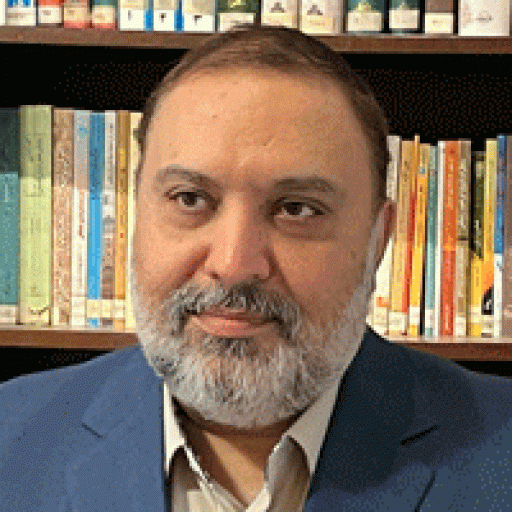
(A Deeper Look at Dr. Mehdi Golshani’s Perspective)
Speech by Dr. Reza Gholami, Faculty Member of the Institute for Humanities and Cultural Studies, at the academic symposium on the book Science and Religion in the Horizon of a Monotheistic Worldview, August 14, 2025, Vienna, House of Iranian Wisdom in Vienna.
In the name of God, and good afternoon to Distinguished guests, respected professors, esteemed researchers, and especially Professor Dr. Mehdi Golshani,
It is an honor to speak today about the book Science and Religion in the Horizon of a Monotheistic Worldview, a work that can serve as a “guiding light” in Iranian and global studies of science and religion.
This field, developed as an interdisciplinary discipline since the 1960s by scholars like Ian Barbour, has gained a strong position in universities worldwide. Dr. Golshani’s book, published and translated by Uni-Dialogue and Al-Mustafa International University, has the potential to become a reference work in this global literature.
Allow me to explore the seven main themes of this book in more detail:
- Dual Expertise: A Bridge Between Two Worlds
Professor Golshani, with his mastery of modern physics and Quranic teachings, offers a “unique” perspective. As a distinguished physicist, he is well-versed in the complexities of quantum mechanics and relativity. As a religious scholar, he understands the spiritual wisdom of divine revelation. This “dual expertise” allows him to explore the relationship between science and religion in a unique way.
In fact, this rare combination addresses a common problem. Often, religious scholars lack deep scientific knowledge, or scientists lack a full understanding of religion. This imbalance leads to serious misunderstandings.
- God and Scientists: A Historical Perspective
Many believe science leads to a “godless worldview,” but Professor Golshani provides evidence that history shows otherwise. The book highlights that scientists like Newton and Maxwell believed in God. However, there is a key difference between the “common belief” that sees God in a human-like form and the “deep understanding” of intellectuals who view God philosophically and abstractly.
This distinction matters because people’s thinking differs. Ordinary people, influenced by sensory experiences, imagine God simply. Scientists, through complex reasoning, develop a deeper understanding of God that may seem unfamiliar to non-experts. The book invites us to appreciate this nuanced perspective.
- Islam and Christianity: Different Approaches to Science
The book shows that Islam views science as a “sacred duty” to be pursued freely, while historical Christianity sometimes saw it as a threat, struggling with conflicts between church teachings and scientific discoveries.
The idea that science and religion are always in conflict often comes from generalizing Christianity’s experiences, like the Galileo affair, to all religions.
In truth, Islam’s approach is rooted in its structure. The book lists five reasons for the harmony between science and religion in Islam:
- Science has intrinsic value, not just practical use.
- Islamic history lacks systematic persecution of scientists.
- Islamic teachings are based on reason and logic.
- Science and religion have “separate domains” but complement each other.
- Islam encourages improving the world, which comes from the free growth of science.
These principles create a “fertile ground” for science and religion to coexist, unlike societies lacking these foundations.
- The Limits of Science and the Power of Revelation
It’s important to emphasize that conflicts between science and religion often arise from misunderstandings about their respective domains.
Science focuses on discovering natural laws and explaining the physical world, while religion addresses spiritual, ethical, and metaphysical questions. When science makes metaphysical claims or religion tries to offer scientific theories, unintended overlap occurs, leading to misunderstandings.
The Quran, in verses like “And He teaches you what you did not know,” emphasizes that it provides unique knowledge that science alone cannot reach. This refers to comprehensive knowledge meant to guide humanity toward true happiness.
This perspective challenges the mindset that “science knows everything” and warns science against entering areas it cannot observe. It promotes a “diverse knowledge” approach, where revelation and science each have their strengths. Science excels at explaining the physical world but must remain humble before metaphysical questions like the purpose of life or the nature of the soul.
- Islam’s Balanced Path
The Quran, in verse 61 of Surah Hud, which states, “He created you from the earth and settled you in it,” offers a “middle way” that neither rejects the world and its ethical benefits nor glorifies it like secular materialism.
Unlike the Renaissance, which embraced a human-centered view and saw nature as a resource to exploit, Islam balances progress with ethical responsibility.
This balance supports “sustainable science” that advances technology while staying true to ethical values. It avoids extremes, such as ignoring material progress or pursuing it without considering consequences.
- Philosophy as a Bridge
Professor Golshani deepens his analysis by using the philosophy of science. By exploring questions like the nature of knowledge or scientific truth, the book appeals to religious scholars, scientists, and philosophers alike.
This philosophical approach turns the book into a “common space” for dialogue. It is valuable not only for religious scholars but also for those studying the foundations of science, fostering richer conversations.
- A New Vision for Science
The book calls for a “transformative” approach to science that includes:
- Moving beyond observation-based science.
- Including ethical values in science.
- Accepting complex realities beyond mechanical materialism.
- Using diverse methods to explore truth.
- Addressing “big questions” about the meaning and purpose of life.
This “holistic” view sees science as interconnected, not as separate disciplines. It makes science more aligned with higher human values, offering hope in a world where technology can seem cold and impersonal.
In a world facing existential crises like the ethics of artificial intelligence or environmental destruction, this perspective acts as a “compass” for science to navigate challenges while preserving human values.
Conclusion
Professor Dr. Mehdi Golshani’s Science and Religion in the Horizon of a Monotheistic Worldview is more than a book; it is a “roadmap” for harmoniously integrating science and religion. It does not merely combine them or revive old ideas but creates a “creative synthesis” that preserves the strengths of both.
This book is a gift to the academic communities of Iran and the world, offering a new path to connect science and religion. In an era where technology seems like an “uncontrolled train,” this book shows how science can be made more “humane” by rooting it in higher values.
I congratulate the academic community on the publication of this valuable work in German by Uni-Dialogue and hope it guides curious minds toward integrated wisdom.
I would also like to specially thank Professor Mohammad Waldman, whose experience and skills enabled him to undertake and excellently complete the translation of this book.
Thank you for your attention.