“and a new interpretation of the advent of Imam Mahdi (the awaited Savior) in in Shia Islam”
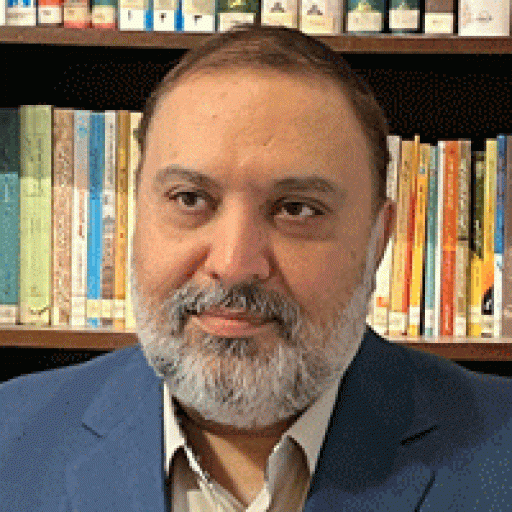
By Reza Gholami
Professor of Political Philosophy, Cultural and Civilizational Studies, and Faculty Member at the Institute for Humanities and Cultural Studies
Introduction
The theology of war refers to a set of religious teachings, principles, and rational or scriptural arguments that explain, justify, or legitimize war in all or specific circumstances. This branch of theology, explored across various religions by religious scholars, seeks to answer the key question: under what conditions can war be theologically justified?
Beyond this, the theology of war often addresses topics such as just and legitimate warfare, the ethics of war, the afterlife fate of those killed on both sides, and the ultimate purpose of war. In other words, it not only examines the reasons for permitting war in different situations but also pays serious attention to the ethical and humanitarian principles of conduct during war and its short- and long-term consequences.
It is worth noting that the study of theology’s role in wars has always been a central topic in religious studies, history, and political science. From ancient times to the present, theology has played two contrasting roles: as a tool to legitimize wars and as an inspiration for peace and resistance against wars and violence in general.
For example, during the Crusades, Christian religious beliefs were used to mobilize people and justify prolonged military campaigns against Muslims. Similarly, Muslims leveraged the unique power of religion to inspire, encourage, and mobilize their forces in defense during the Crusades. In modern times, theology has remained influential in major conflicts, such as World Wars I and II and other wars. For instance, over the past seventy years, the Israeli apartheid regime has relied on sacred ideals to justify the occupation of Palestine and acts of genocide. Conversely, the resistance of the Palestinian people and the broader Islamic world against Israel owes more to Islam and the sense of responsibility among Muslims toward one another and human societies than to nationalism or racism.
This article, focusing on Islam, explores the dual role of theology in war and peace. It aims to achieve a balanced and realistic understanding by analyzing sacred texts, ethical teachings, and historical experiences. Along this path, concepts such as just war, legitimate defense, realism in warfare, ethics in war, peacemaking, and non-military interpretations of the era of humanity’s savior in the end times are examined.
Islam and Three Major Perspectives on the Theology of War
In Islam, the theology of war is characterized by three main perspectives:
- War-Centric Perspective: This view considers war the primary means to achieve sacred goals and has no hesitation in initiating or participating in wars in the name of religion and God.
- Peace-Centric Perspective: This perspective holds that war should be the last resort, used only to achieve peace and justice, not as a tool for spiritual or religious goals, let alone expanding power. This perspective is divided into two branches:
- The first branch considers only defensive wars as legitimate, asserting that initiating wars is entirely impermissible in religion.
- The second branch views initiating wars as a last resort to achieve religious goals, including establishing legitimate religious authority.
- Absolute Peace Perspective: This view deems war, especially for religious purposes, inherently illegitimate. It argues that religious people should strictly avoid all forms of war—defensive or offensive—for religious goals and embrace absolute pacifism, also referred to as “total peace.”
In the following sections, I will explain these three perspectives—war-centric, peace-centric, and total peace—while emphasizing that this discussion is entirely academic and open to critique.
Religious War-Centrism
Religious war-centrism, which uses religion and divine will to justify war, has complex and multifaceted roots that can be examined in several dimensions. These roots are often a combination of theological, political, economic, cultural, and psychological factors. Some of the most significant roots of religious war-centrism include:
- Religious Texts and War-Centric Interpretations: Many verses and narrations in religious sources, assuming their authenticity, can be interpreted in isolation or collectively to derive war-centric doctrines by ignoring their historical context and nuances. Some argue that changing interpretive methodologies can avoid war-centric conclusions, but the explicit nature of these texts makes such reinterpretation challenging, though not impossible.
- Charismatic Religious Leadership and Ideological Interpretations: At times, the statements of charismatic religious leaders and their subjective or situational interpretations of the need for war take precedence over sacred texts. Criticizing these leaders is often met with harsher condemnation than criticizing the texts themselves.
- Religious Identity and “Othering”: In certain periods, religious communities define their identity through enmity, polarization, and constant military confrontation. In such contexts, ending conflict feels like a loss of religious identity.
- Defending Moral Values and Divine Order: Many war-centrists view fighting evil or falsehood and spreading good or truth as an inevitable divine mission. Avoiding this struggle is believed to bring divine punishment upon the religious community.
- Hidden Political and Economic Motives: In some historical instances, wars fought in the name of religion or divine symbols were later revealed to be covers for political and economic agendas. Such suspicions have been raised about certain aspects of the prolonged Crusades.
- Sense of Oppression and Social Pressure: In situations of severe oppression, religious communities may view war as a means of resisting injustice. In some cases, war reduces pressure and oppression, leaving a positive historical impact.
- Eschatological Aspirations and Salvation: War has often been seen as a precursor to the arrival of a savior or the realization of salvation in the end times, considered part of the divine plan by many religious adherents throughout history. This topic will be explored further at the end of this article.
- Historical Experiences and Past Models: The reproduction of religious war-centrism is often inspired by past successes achieved through war, a common practice in some religious societies.
- Ethical and Spiritual Justifications, Jihad, and Martyrdom: Jihad, in this context, refers to beliefs that portray war as a means of spiritual purification or self-improvement. More significantly, martyrdom in the way of God is described as the surest path to eternal salvation, creating strong motivation for engaging in war and enduring its hardships in religious communities.
Religious Peacemaking
Religious peacemaking is built on several key foundations, which are outlined below:
- Teachings of Sacred Texts and Theology of Peace: These teachings, especially universal ones, are abundant and prominent in some sacred texts and are supported by credible historical evidence.
- Ethical and Spiritual Principles: Ethical and spiritual principles in religions often create an obligation for religious communities to avoid war and pursue peace.
- Religious Leadership and Peacemaking Models: Charismatic religious leaders play a unique role in promoting the logic of peace in religious communities.
- Concept of Brotherhood and Global Unity: If a religion emphasizes human brotherhood and its sacred texts advocate for global unity based on this principle, the inclination toward peace in religious communities is more easily realized. For example, the Persian poet Saadi wrote, “Human beings are members of one body, created from the same essence.”
- Peaceful Eschatological Teachings: These teachings promise ultimate peace and tranquility during the savior’s era, achieved not through war and violence but through the triumph of thought, culture, and dialogue. This perspective can transform war-centric eschatological doctrines into peace-centric ones.
- Historical Experiences of Peaceful Coexistence: Successful and enriching historical experiences of peaceful coexistence, common in most religions, are considered.
- Role of Moderate Religious Institutions: Both local and global religious institutions promote interfaith dialogue, unity, tolerance, cooperation, and counter extremism.
- Rationality and Realism: Realism and wisdom, supported by significant religious texts, are key factors in fostering peace in religious communities. Realism views war-centrism as fundamentally impractical and adopts innovative approaches even in defensive wars by assessing objective conditions and capabilities.
- Reluctance of Religious People Toward War: War decisions lacking majority support from religious communities often face practical, ethical, and religious challenges. Social pressure to find alternatives can shift strategies from war to peace, preventing ideological misuse of religion.
Moderate and Enlightened Islam and the Inclination Toward Peace
A natural question arises: does a rational interpretation of Islam lean more toward war or peace?
It is evident that Islam does not inherently view war as a positive phenomenon and pursues its goals in conditions of peace and tranquility. To understand this reality, the following key points are insightful:
- The Value of Human Life in Islam According to the Quran and Narrations:
- The Quran states: “Whoever kills a soul—unless for a soul or corruption in the land—it is as if he has killed all mankind, and whoever saves a soul, it is as if he has saved all mankind” (Quran, Al-Ma’ida, 5:32). This verse clearly highlights the immense value of human life in Islam, equating the killing of one innocent person to the killing of all humanity. This principle applies to non-Muslims as well and underscores the necessity of preserving human life in all circumstances, including war.
- A narration from the Prophet Muhammad (PBUH) states: “The destruction of the entire world is easier for God than the unjust killing of a Muslim” (Al-Targhib wal-Tarhib, Vol. 3, p. 293, Hadith 6). This emphasizes the high value placed on human life in Islam.
- Imam Ali (AS), upon hearing of the killing of his companions in the Battle of Siffin, said: “I disliked war for you as a mother dislikes it for her child” (Nahj al-Balagha, Sermon 200). This shows Imam Ali’s deep concern for preserving lives and his reluctance to engage in war unless absolutely necessary for defense.
- Avoidance of Mass Killing and the Actions of Imams to Preserve Lives:
- Preventing War Before Engaging in It: Quran, Al-Anfal, 8:60 advises Muslims to prepare for confrontation with enemies, but this preparation aims to deter war and intimidate adversaries, not to engage in mass killing. This indicates Islam’s emphasis on preventing war even when military readiness is required. In other words, the strategy of minimal damage and maximum success is a key doctrine in Islamic defensive wars.
- The Peace Treaty of Imam Hassan (AS) with Muawiya: In Islamic history, Imam Hassan’s peace treaty is a prominent example of avoiding mass bloodshed to preserve Muslim lives. Despite pressures, Imam Hassan chose peace over war, saving many Muslims from certain death. This shows that an infallible Imam prioritized the preservation of lives over war, even at the cost of bitter consequences.
- Imam Hussein’s Efforts to Avoid Bloodshed in Karbala:
- Multiple Proposals to Avoid War: Historical sources confirm that Imam Hussein (AS) made several proposals to Umar ibn Sa’d to prevent war, including returning to Medina or, according to some weaker narrations, migrating to Islamic borders or remote areas. These efforts show Imam Hussein’s aversion to bloodshed, resorting to battle only when all options were exhausted and defense was the only choice. Notably, Imam Hussein employed all military strategies and tactics, not allowing the certainty of martyrdom to override careful planning.
- Imam Hussein’s Conduct on the Night of Ashura: It is narrated that Imam Hussein spoke with his companions on the night of Ashura, allowing those unwilling to stay to leave under the cover of darkness to avoid death. This act reflects his concern for their lives and his reluctance for mass casualties, though most companions chose to remain. This advice reveals Imam Hussein’s realism.
- The Philosophy of Taqiyya and Related Narrations:
- Imam Sadiq (AS) said: “Taqiyya is the believer’s shield and heritage” (Wasail al-Shia, Vol. 16, p. 205). Taqiyya in Shia jurisprudence aims to protect lives and property in dangerous situations, preventing unnecessary harm or death. This principle emphasizes that Islam does not permit reckless self-destruction or harm.
- Another narration from Imam Sadiq (AS) states: “Taqiyya is my religion and the religion of my fathers” (Al-Sirat al-Mustaqim, Vol. 3, p. 71). This highlights the importance of taqiyya in preserving lives and property, prioritizing survival over confrontation.
- Prohibition of Self-Destruction in the Quran:
- The Quran states: “Do not throw yourselves into destruction” (Al-Baqara, 2:195). This verse forms the basis for many jurisprudential rulings that prohibit reckless or dangerous actions. Scholars deem operations leading to unnecessary deaths impermissible, urging Muslims to avoid situations leading to their destruction without clear justification.
- The famous saying, “The ink of scholars is superior to the blood of martyrs” (Al-Amali al-Tusi, Vol. 1, p. 521), underscores the priority of rationality, knowledge, and awareness in Islam’s intellectual system. Scholars’ guidance through knowledge and ethics can prevent wars and bloodshed, playing a fundamental role in fostering peace and stability.
- Martyrdom Operations and Jurisprudential Disagreements:
- Some Shia scholars consider martyrdom operations permissible in specific conditions, while others, citing the above verses and narrations, deem them forbidden. Ayatollah Javadi Amoli and others allow such operations only when no other means of defending religion or society exists and lives are in imminent danger. This disagreement highlights the need for careful scrutiny, avoiding reckless mass casualties.
- The Concept of Truth and the Danger of Dogmatism:
- Imam Ali (AS) said: “Truth is not known by men; know the truth, and you will know its people” (Nahj al-Balagha, Sermon 50). This emphasizes the difficulty of discerning truth and advises Muslims to rely on rational, ethical, and religious criteria rather than individuals or social positions. Claiming absolute truth can lead to unjust wars.
- Imam Baqir (AS) said: “God will hold people accountable on the Day of Judgment based on the intellect He granted them in this world” (Usul al-Kafi, Vol. 7, p. 11, Hadith 1). This highlights that recognizing truth varies with human understanding, and responsibility is proportional to one’s intellectual capacity.
- Doubts About the Legitimacy of Some Wars in the Era of Occultation:
- Many Shia scholars, due to the absence of an infallible Imam and the difficulty of determining absolute truth, question the legitimacy of certain wars during the era of occultation. In Shia jurisprudence, initiating jihad requires the permission of an infallible Imam, making it impermissible in this era. This cautious approach avoids endangering innocent lives unnecessarily.
- Imam Sadiq (AS) said: “Whoever claims certainty has lied, and whoever speaks with absolute certainty has disbelieved” (source unclear, commonly cited in Sunni works). This advises against dogmatic judgments in complex matters, including war.
Conclusion on Peacemaking in Islam
In Shia Islam, preserving human lives and preventing bloodshed and war as much as possible is a priority. The following reasons support this conclusion:
- The High Value of Human Life: Quranic verses and narrations emphasize the immense value of human life, even that of enemies, requiring cautious consideration in any threat to life.
- Imams’ Preference for Peace: Examples like Imam Hassan’s peace treaty and Imam Hussein’s efforts to avoid war demonstrate a strong inclination toward peace in the teachings of the Ahl al-Bayt.
- Philosophy of Taqiyya: Taqiyya prioritizes preserving lives over direct confrontation, reflecting a preventive approach to violence.
- Prohibition of Reckless Actions: Quranic verses and narrations forbid reckless actions leading to harm, advocating rational and calculated responses to conflict.
- Cautious Approach to Jihad: Jurisprudential disagreements and hesitancy about certain types of jihad in the era of occultation reflect a restrained approach to aggressive actions.
- Uncertainty in Defining Absolute Truth: The difficulty of determining absolute truth encourages caution, preventing unnecessary wars.
Moderate Islam and the Rejection of Initiating Wars
Despite discussions in historical, theological, and jurisprudential texts about initiating wars, it is challenging to find reliable scriptural or rational evidence to justify them in Islam. Even wars during the Prophet’s era labeled as initiatory can, upon deeper historical analysis, be interpreted as defensive or preemptive actions to neutralize imminent threats. However, this interpretation does not extend to the conquests of later caliphs.
Legitimate Defense: A Defensible Religious and Rational Principle
Alongside Islamic peacemaking, legitimate defense is recognized as both a right and a duty, supported by religious and rational arguments. This principle applies when individuals or Islamic societies face threats to life, property, or dignity, requiring defense of themselves and their values.
Religious Foundations of Legitimate Defense:
- The Quran states: “Fight in the way of Allah those who fight you, but do not transgress. Indeed, Allah does not like transgressors” (Al-Baqara, 2:190). This permits defense against aggression while prohibiting excessive force.
- A narration from the Prophet (PBUH) states: “Whoever is killed defending their property is a martyr.” This underscores the legitimacy and obligation of defense in Islam.
Rational Foundations of Legitimate Defense:
Beyond religious arguments, legitimate defense is a natural and necessary right for any human society. Failing to defend against aggression leads to atrocities, depriving people of life and peace, and can destroy societies physically and spiritually. Defense is both instinctual and rational.
Limits and Conditions of Legitimate Defense in Islam:
While legitimate defense is endorsed, it does not permit unrestricted actions. The principle of proportionality must be observed, and excessive force is forbidden. Harming innocent civilians during war is strictly prohibited.
Rational Decision-Making in Crises
In critical situations where war is an option, a rational and realistic approach, grounded in ethical and religious principles, is essential for sound decision-making. This requires evaluating the costs and consequences of war while prioritizing human values and justice. Religious communities committed to peaceful principles can play a key role in preventing unnecessary wars and promoting peaceful solutions.
Key Factors in Rational Decision-Making Regarding War:
- Public Support: Wars without public consent are doomed to fail. Leaders must transparently justify war and gain public support to avoid social collapse and distrust.
- Economic Capacity: War decisions must consider financial resources. Without adequate support, economic crises may overshadow war outcomes.
- Clear and Achievable Goals: War objectives must be defined and attainable to avoid heavy losses and unintended consequences.
- Time for Reforms: In internal crises, diplomacy and engagement can provide time to strengthen society, enhancing future resilience.
- Justice as a Goal: War is justifiable only if it leads to global justice or reduces oppression, ensuring it does not become a source of injustice itself.
- War Is Not the Only Solution: History shows that wars often escalate violence. Cultural, economic, and diplomatic alternatives must be seriously considered.
Lessons from the Conduct of Shia Imams in Realistic Decision-Making:
Imams like Imam Sajjad, Imam Sadiq, and Imam Reza avoided armed uprisings against oppressive rulers due to their deep understanding of political, social, and cultural conditions. Their wisdom included:
- Protecting Shia Lives: In conditions of weakness, war could have led to the destruction of the Shia community. Peaceful approaches preserved their intellectual and cultural continuity.
- Unfavorable Conditions for Victory: The Imams recognized that uprisings without strong organization and support would fail, as seen in cases like Zaid ibn Ali’s rebellion.
- Prioritizing Intellectual and Cultural Struggles: Instead of military action, the Imams strengthened the intellectual and ethical foundations of society.
- Focus on the Future of Shia and Islam: By enduring hardships, the Imams ensured the survival and growth of true Islam and Shia thought.
Conclusion: Rational decision-making in crises, especially regarding war, requires thorough analysis of various factors and their short- and long-term consequences. The Imams’ conduct shows that true victory lies in understanding conditions, leveraging peaceful opportunities, and prioritizing peace and societal strength. This approach guides modern societies to avoid unnecessary wars and pursue justice realistically.
The Need for a Rational and Realistic Interpretation of the Era of the Savior:
Teachings about the end times and the savior’s emergence hold a special place in many religions, including Islam, Christianity, and Judaism, promising global justice, the eradication of oppression, and lasting peace. However, traditional interpretations, particularly in some Shia texts, associate the savior’s era with widespread wars and vengeance, using terms like “revenge against disbelievers” or “military supremacy.”
Revisiting Traditional Interpretations:
A more rational and realistic view of the texts suggests that war is not necessary and contradicts the core messages of divine religions, which emphasize peace, guidance, and cultural invitation. Instead of focusing on war, the cultural, ethical, and human dimensions of the savior’s movement should be highlighted.
The assumption that the world is entirely corrupt, with only a select few on the moral path, may apply to certain political systems but not to most people. Many individuals, despite differences, are committed to ethical principles and can support a movement for justice and peace without resorting to global wars.
Key reinterpretations include:
- Global Guidance Over Destruction: The Quran and narrations emphasize guidance as the primary mission of prophets and Imams. The savior’s era continues this mission, aiming to restore humanity’s divine nature, not to destroy or punish.
- Cultural Engagement Over Military Conflict: Prophetic missions often used wisdom and reasoned dialogue. The savior’s revolution can rely on cultural and ethical discourse rather than war.
- Redefining Vengeance: Concepts like “revenge against enemies” can be reinterpreted as the triumph of truth over falsehood, dismantling oppressive systems rather than physical destruction.
- Justice in the Savior’s Era: Justice, the core of the savior’s revolution, requires peaceful coexistence and respect for human rights, achievable through persuasion rather than war.
- Embracing Cultural and Religious Diversity: The savior’s era can view diversity as an opportunity for constructive dialogue, presenting the savior as a cultural and ethical leader rather than a military commander.
Conclusion: Rational interpretations of end-time texts show that the savior’s revolution can be defined as a cultural and ethical movement, aligning with the peaceful and guiding messages of divine religions. This approach can attract global support for justice and spirituality, establishing lasting peace.
Total Peace and Its Lack of Realism
While peacemaking aligns with Islamic logic, the concept of total peace—where Muslims avoid even legitimate defense, leaving themselves vulnerable to attacks on life, property, or dignity—lacks sufficient scriptural or rational support. This extreme approach, sometimes driven by fear, cowardice, or betrayal, has caused significant issues in Islamic and other societies.
Reasons Total Peace Is Illogical:
- Fear of the Enemy: Weakness or fear may lead some to avoid defense, emboldening aggressors.
- Betrayal of Collective Interests: Total peace can stem from prioritizing personal or factional interests over the common good.
- Lack of Realism: Accepting total peace in the face of clear threats reflects a failure to assess reality accurately.
Islamic Teachings Against Total Peace:
Islam does not endorse total peace in this sense but emphasizes legitimate defense and strategic deterrence. The Quran advises: “Prepare for them whatever force you can” (Al-Anfal, 8:60), and Imam Ali (AS) said: “Whoever sleeps while facing an enemy will be awakened by calamity” (Ghurar al-Hikam, 8672).
Final Conclusion: Total peace, by ignoring legitimate defense and deterrence, is an extreme approach that contradicts Islamic and rational logic. It risks enabling aggression and societal collapse. Islam advocates a balanced path of just peace and empowered defense, prioritizing peace but allowing defense when necessary to ensure security and justice.
References:
- Key works on the theology of war include The City of God by Saint Augustine and Ihya Ulum al-Din by Imam Ghazali, which address war ethics. Shia jurisprudence also details conditions for war in the chapter on jihad.
- Quran, Al-Ma’ida, 5:32
- Al-Targhib wal-Tarhib, Vol. 3, p. 293, Hadith 6
- Nahj al-Balagha, Sermon 200
- Wasail al-Shia, Vol. 16, p. 205
- Al-Sirat al-Mustaqim, Vol. 3, p. 71
- Quran, Al-Baqara, 2:195
- Al-Amali al-Tusi, Vol. 1, p. 521
- Wasail al-Shia, Vol. 14, p. 26
- Fatwas of Ayatollah Javadi Amoli
- Nahj al-Balagha, Sermon 50
- Usul al-Kafi, Vol. 7, p. 11, Hadith 1
- Commonly cited in Sunni sources, exact reference unclear
- Quran, Al-Baqara, 2:190
- Quran, Al-Baqara, 2:256
- Quran, Al-Anfal, 8:60
- Ghurar al-Hikam, 8672
Publication: Journal of Critical Thought (Iran, Tehran), Issues 4 and 5, Summer and Autumn 2025