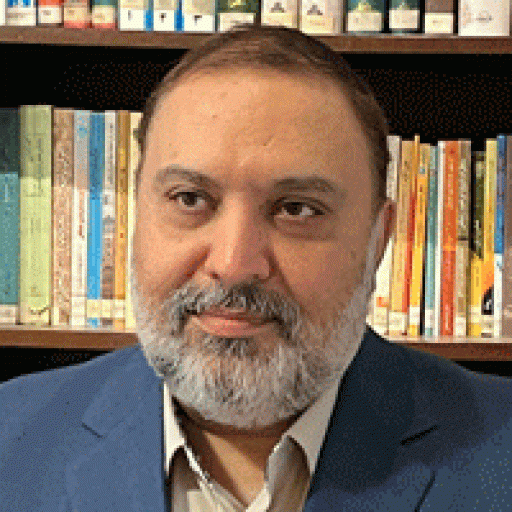
The text of Speech by Dr. Reza Gholami at the Academic Seminar “Islam and Iran: A Reciprocal Relationship” Reflections on Morteza Motahhari’s Book the Reciprocal Services of Islam and Iran
Good afternoon, everyone. Thank you to all the participants.
I especially thank the kind professors who accepted our invitation to speak.
As an introduction, let me briefly introduce the book Mutual Services of Islam and Iran by the late Professor Morteza Motahari:
Mutual Services of Islam and Iran is one of Motahari’s key works, exploring the mutual relationship and influences between Islam and Iranian culture and civilization. Published in 1971, this book is widely regarded for its analytical and insightful approach to Iranian and Islamic identity, making it one of the most influential works in recent decades. I consider Motahari a great religious intellectual who played a unique role in presenting a rational and accurate image of Islam. In this book, he aims to prove that Islam and Iran have not been in conflict but have historically served and elevated each other.
Motahari argues that Islam rescued Iran from the political and class-based corruption of the Sassanid era, while Iranians, with their knowledge, culture, and art, greatly contributed to the growth and flourishing of Islamic civilization. He critiques both extreme nationalist views that portray Islam as destructive to Iranian identity and Islamist perspectives that overlook the role of Iranian culture in Islam’s progress. Using historical evidence, he offers a balanced narrative of the relationship between these two key elements of identity.
In this conference, we aim to discuss other dimensions of this book, including its critiques, in light of new questions.
You may ask why it is necessary today to rethink the relationship between Iran and Islam. Let me briefly address this:
- The relationship between Iran and Islam is central to Iran’s cultural and social identity.
- This bond has shaped Iran’s historical and civilizational roots and will play a decisive role in the country’s future.
- In recent years, we have seen a revival of cultural and civilizational Iran-centrism.
- Unlike past extreme nationalism, today’s Iran-centrism seeks to revive national identity in harmony with Islam.
- Moderate Iran-centrism can act as a unifying factor for the nation.
- It fosters social cohesion and boosts national confidence.
- Moderate Iran-centrism can significantly contribute to Iran’s sustainable growth and development.
- The discussion of Iran and Islam is no longer just a historical matter but a strategic necessity.
- Properly understanding this relationship can pave the way for achieving a new Islamic civilization.
- This reexamination can strengthen Iran’s cultural standing in the world.
You know that, over the past 55 years, Mutual Services of Islam and Iran has faced various critiques. Here are some of them:
First, motahari overemphasizes Islam’s positive role in saving Iran from the Sassanid class system while paying little attention to the positive aspects of pre-Islamic Iranian culture and ethics.
Second, he portrays the relationship between Islam and Iran as entirely positive and synergistic, ignoring historical conflicts and challenges between Iranian identity and Islamic governance.
Third, the role of the Persian language, national literature, and Iranian myths in preserving Iran’s independent identity after Islam is downplayed, with insufficient focus on Iranian resistance to Arabization.
Fourth, Motahari’s historical analysis is seen as ideological, reducing the complexity of Iran’s history to a contrast between Sassanid oppression and Islamic justice.
Fifth. the book overlooks the roles of geography, economy, politics, and historical contingencies in the Iran-Islam relationship, relying heavily on religious concepts.
In response to these critiques, Motahari’s students and aligned thinkers have offered the following defenses:
- Motahari did not aim to rewrite history but to counter the distortions of anti-religious intellectuals and defend historical truth from a civilizational perspective.
Also, he believed that Iran’s identity after Islam is an Islamic-Iranian identity, and Iran’s cultural independence exists within this framework, not in opposition to it.
in addition, Iran’s history, especially after Islam, revolves around religion, and Motahari provides a philosophical and civilizational analysis, not a detailed event-based narrative.
It is important that Motahari did not deny challenges or resistance but analyzed them as part of the formation of a shared Islamic-Iranian identity, viewing historical challenges as dynamic factors in the Islamic-Iranian civilization.
- He saw religion as a driver of Iran’s human and cultural growth, approaching it from a civilizational and ethical perspective, not merely an ideological or political one.
In conclusion, I would like to emphasize a few points:
First, our historical knowledge about Iran before Islam is limited, and many judgments lack solid evidence. Hundreds of independent studies are needed to gradually enable reliable assessments.
Second, the long and gradual process of Islam’s entry into Iran cannot be wholly affirmed or denied. I cannot claim that Islam’s arrival was entirely peaceful or free of suppression. Iran was a vast land, and violence or suppression in some areas cannot be ruled out. Iran’s response to Islam was diverse, varying across regions, and Islam’s spread was a prolonged process. However, the most important fact is that if Islam had not been the conscious choice of most Iranians, they had many opportunities to abandon it. Instead, Islam became an inseparable part of Iranian identity.
Third, the events following the Prophet’s passing regarding Islam’s entry into Iran should not be entirely seen as a continuation of his mission. The actions of the Rashidun Caliphs, at least in their methods, should be attributed to them, though they largely adhered to Islamic principles.
Fourth, Iranian civilization absorbed Islam and adapted it to its own culture and civilization. This means that Iran is not just a body but also a sprit.
Thus, the reality of “Iranian Islam” is undeniable. In essence, Iranian Islam significantly separated Islam from the pre-Islamic Arab behaviors that persisted after the Prophet’s time. The deep affection of Iranians for Imam Ali and his noble descendants stems from this, as Iranians have always seen Imam Ali as a symbol of pure, prophetic Islam.
fifth, Sociologically, pitting Iran against Islam benefits neither. Motahari clearly explained this with compelling reasons. Even today, Iran without Islam would not remain Iran, and Islam without Iran would not have reached such civilizational heights.
sixth. Discussions about Iran and Islam must avoid ideological biases to approach reality and practically contribute to the growth of both Iran and Islam.
seventh, the unity of Iran and Islam means that the progress of Islam and Iran must go forward side by side. Especially, Islam must not fall behind the time.
If Islam fells behinds the time, it is possible that the new Iran will move beyond Islam. Therefore, it is imperative for Iranian Muslim scholars to revitalize the system of Ijtihad through a renewed emphasis on reason and rationality.
Thank you for your attention.