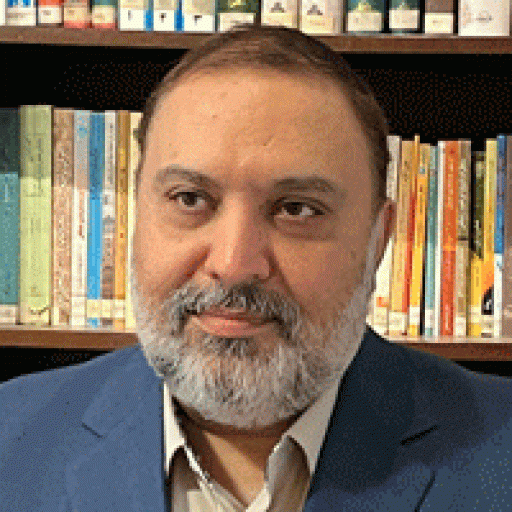
Dr. Reza Gholami, Member of faculty at Institute of Humanities and Cultural Studies
The Distorted Dream
Modernity began with a promise that remains captivating: the liberation of humanity from the chains of superstition, tyranny, and ignorance. This promise is not only valuable today but perhaps more essential than ever. However, what we witness today is not modernity—it is its profound and systematic distortion by political and economic powers that have turned tools of liberation into instruments of domination.
When Adorno and Horkheimer speak of the “Dialectic of Enlightenment” (Adorno & Horkheimer, 1944/2002), they refer precisely to this distortion. Reason, meant to free humanity, has been transformed in the hands of power systems into “instrumental reason”—not a reason that seeks truth, but one that pursues efficiency and control. This transformation was not an inevitable outcome of modernity but the result of its deviation from its original path.
Bertrand Russell, in his analysis of power, points to the same issue (Russell, 1938). He shows that the most effective form of domination is one that disguises itself as freedom. In pre-modern societies, power was overt—kings, nobles, and priests ruled openly. In the modern era, however, power has learned to hide behind the mask of democracy, freedom of choice, and individual rights. This new complexity is not a weakness of modernity but the result of the cunning misuse of its achievements.
The Transparent Cage and Mechanisms of Control
“Freedom without freedom” is both a linguistic paradox and the most accurate description of our current condition. We live in a transparent cage—one whose walls are invisible yet solid and all-encompassing. What is this cage made of? The very tools that were supposed to liberate us: technology, education, media, and economic systems.
Herbert Marcuse, in One-Dimensional Man, demonstrates how advanced industrial societies have managed to absorb even opposition and criticism into their framework (Marcuse, 1964/1991). He speaks of “repressive tolerance”—a state where people believe they are resisting while, in reality, they participate in reproducing the very system they claim to oppose. A worker who protests but continues to buy products from the same company they criticize is an example of this condition.
This situation was not inevitable. The “culture industry,” as Adorno describes—the commodification of culture, art, and thought—was not a natural outcome of modernity but the result of its appropriation by market forces and power (Adorno, 1991). Technology, which could have been a tool for liberation, has become, in the hands of capital, a means of surveillance and control. Education, meant to foster critical thinking, has turned into a factory for producing labor.
Hannah Arendt’s Critique and the Collapse of the Human Condition
Hannah Arendt, in The Human Condition, provides a precise analysis of this distortion (Arendt, 1958/1998). She introduces the concept of vita activa—the active life—consisting of three dimensions: labor, work, and action. For Arendt, true freedom lies in “action”—participation in public affairs, creating something new, and interacting as equals in a public space. However, distorted modernity has preserved only “labor” and “work” while destroying “action.”
Arendt argues that the main problem is “thoughtlessness”—not deliberate malice, but a lack of reflection on our actions (Arendt, 1963/2006). In her analysis of Eichmann, a Nazi officer who claimed he was merely following orders, she illustrates this point. Thoughtlessness is more dangerous than evil because it allows ordinary people to participate in oppressive systems without feeling responsible. This is precisely what happens today—we participate in daily routines, laws, and norms that may deprive us of true freedom without reflecting on them.
The public sphere, which Arendt considers essential for freedom, has been replaced by the “social sphere” (Arendt, 1958/1998). In the public sphere, people engage as equal citizens in discussion and debate. In the social sphere, they are defined merely as members of various groups—economic, class-based, or cultural. As a result, humans have been transformed from “citizens” into “consumers.”
The Subtlety of Control in the Digital Age
Social media is a clear example of “freedom without freedom.” Users feel they are freely creating content, connecting with others, and accessing diverse information. In reality, sophisticated algorithms shape their behavior, filter the information they receive, and even influence their emotions and opinions (Zuboff, 2019). They “choose” what to see, but these choices are guided by predictive and manipulative systems. Artificial intelligence technology has made this process far more complex and perilous than before.
This situation is not an inherent outcome of technology. Technology could have been a powerful tool for democratizing information, communication, and power. However, in the hands of large tech companies and power systems, it has become a tool for control and manipulation. This is the distortion of modernity, not modernity itself.
The Education System and the Production of Obedient Subjects
The contemporary education system is another example of this distortion. Education, meant to free the human mind and foster critical thinking, has become a factory for producing labor. Students learn to answer pre-determined questions, not to ask the right ones. They are trained to adapt to the needs of the labor market, not to transform society (Freire, 1970/2000).
Even at higher levels, education has been reduced to “skill training” rather than “cultivating thought.” Students learn how to succeed within the existing system, not how to question it. Yet, true modernity was supposed to empower humans with the ability to critique and analyze.
Limited Democracy and the Illusion of Choice
Even Western democracies, which claim to champion freedom, exemplify “freedom without freedom.” Citizens feel they have a choice, but the available options all operate within the same economic-political framework. Fundamental changes are excluded from the range of choices. Elections have become competitions between different brands of the same product (Brown, 2015).
This situation does not indicate the failure of modernity but rather the success of conservative powers in distorting and limiting it. True democracy was meant to go beyond periodic elections—it was supposed to involve continuous citizen participation in decisions affecting their lives.
Resistance and Reclaiming Modernity
This situation is not final. Recognizing the mechanisms of distortion is the first step toward resisting them. Reclaiming modernity is possible not by returning to the past but by reviving its critical and freedom-seeking spirit.
Resistance can take place at various levels. At the individual level, it involves reclaiming critical thinking and questioning what seems “natural.” Why is this situation considered normal? Who benefits from it? Are there other ways to live?
At the collective level, it involves reviving the public sphere and creating spaces for genuine discussion and dialogue. Participating in collective affairs outside the market framework and fostering human relationships based on trust and mutual respect.
At the cultural level, resistance against the culture industry involves supporting independent art, creating local and participatory culture, and avoiding blind consumption of mass cultural products.
Conclusion: Modernity as an Unfinished Project
Modernity is an unfinished project, not a failed one (Habermas, 1981/1987). It has both strengths and weaknesses, and viewing it in black-and-white terms is misguided. Many of modernity’s promises—freedom, equality, justice, and critical thinking—remain valuable and achievable. However, their realization requires resistance against their distortion by existing powers.
“Freedom without freedom” is not a diagnosis of modernity’s failure but of its deviation. This deviation was neither inevitable nor irreversible. Restoring modernity to its original path requires awareness, resistance, and collective will.
The greatest danger is that future generations may lose even the memory of true freedom. When “freedom without freedom” becomes the norm, the possibility of returning to real freedom diminishes. Thus, resisting this condition is not only a right but a duty for anyone who believes in true freedom—not for their own sake, but to preserve the possibility of freedom for future generations.
References
Adorno, T. W. (1991). The Culture Industry: Selected Essays on Mass Culture (J. M. Bernstein, Ed.). London: Routledge. (Original work published 1944)
Adorno, T. W., & Horkheimer, M. (2002). Dialectic of Enlightenment: Philosophical Fragments (J. Cumming, Trans.). Stanford: Stanford University Press. (Original work published 1944)
Arendt, H. (1998). The Human Condition (2nd ed.). Chicago: University of Chicago Press. (Original work published 1958)
Arendt, H. (2006). Eichmann in Jerusalem: A Report on the Banality of Evil. New York: Penguin Classics. (Original work published 1963)
Brown, W. (2015). Undoing the Demos: Neoliberalism’s Stealth Revolution. New York: Zone Books.
Freire, P. (2000). Pedagogy of the Oppressed (M. B. Ramos, Trans.). New York: Continuum. (Original work published 1970)
Habermas, J. (1987). The Theory of Communicative Action (T. McCarthy, Trans.). Boston: Beacon Press. (Original work published 1981)
Marcuse, H. (1991). One-Dimensional Man: Studies in the Ideology of Advanced Industrial Society. Boston: Beacon Press. (Original work published 1964)
Russell, B. (1938). Power: A New Social Analysis. London: George Allen and Unwin.
Zuboff, S. (2019). The Age of Surveillance Capitalism: The Fight for a Human Future at the New Frontier of Power. New York: PublicAffairs.