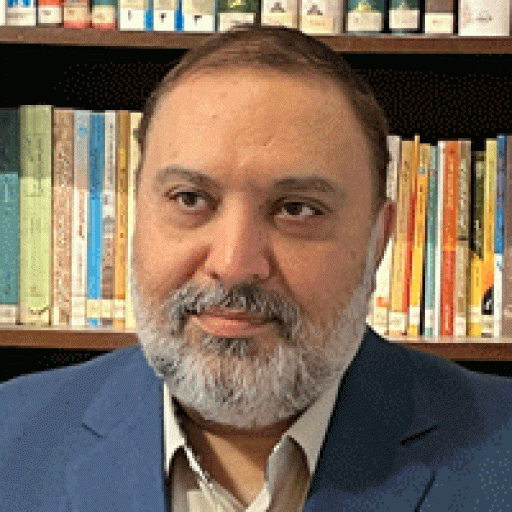
Reza Gholami
Jul 30, 2025
The killing of over 60,000 people in Gaza—most of them women and children—under the pretext of Israel’s right to self-defense, followed by months of deliberate starvation of the civilian population, is not something that history will quietly forget or forgive.
These are not isolated political incidents; they are human catastrophes on a scale that tests the moral conscience of the world.
In the face of such atrocities, Europe and the United States must be held accountable—not only for their silence or selective empathy, but for their active complicity. Behind-the-scenes support for Israel, justification of disproportionate violence, and systematic disregard for international law and human rights have exposed a deep ethical fracture in the so-called liberal democratic world. History will demand an answer from those who chose diplomacy over dignity, interests over innocence.
But the betrayal goes deeper. It reaches into the very heart of the intellectual world.
Philosophers and public intellectuals—those who claim to be the custodians of human dignity, reason, and universal ethics—have, in large part, failed the moral test of our time. In the months of horror and suffering in Gaza, many of the world’s most prominent thinkers chose to remain silent. Others, disturbingly, spoke only to rationalize or legitimize the actions of the aggressor under the guise of “the right to self-defense.” Even figures such as Jürgen Habermas, a towering name in contemporary philosophy and critical theory, voiced support for Israel while overlooking the scale and nature of the violence inflicted on a trapped and starved population.
Such positions are not merely political misjudgments—they represent a collapse of philosophical integrity. A philosophy that does not take a stand for human dignity, that does not cry out against injustice, that remains neutral in the face of massacres, is a philosophy in decay. If philosophy cannot defend the oppressed, if it watches in silence while bombs fall on children and entire families vanish beneath rubble, then it is no longer a living, breathing pursuit of truth. It becomes a dead doctrine—a corpse of reason over which the world should mourn.
What is the worth of philosophy if it cannot distinguish between victim and executioner? If, in the name of neutrality or geopolitical realism, it equates mass murder with legitimate defense? If it watches as hospitals, schools, and refugee camps are destroyed and says nothing? In such silence, there is no wisdom—only cowardice dressed in academic restraint.
This is a moment of reckoning—not only for politicians and diplomats but for the entire intellectual tradition of the West. The question is not whether we agree or disagree on policy. The question is whether conscience still lives in the heart of philosophy.
Let it be known: those philosophers and intellectuals who betrayed the cause of human rights through silence or selective solidarity, have not only failed Gaza—they have failed philosophy itself.
The True Measure of Philosophy
The true value of philosophy is not proven in quiet classrooms or abstract theorizing—it is revealed in the critical junctures of human history. Philosophy proves its worth when it stands beside the oppressed, when it becomes a voice for justice in the face of cruelty. A philosophy that does not respond to the suffering of humanity is empty, and a philosopher who feels no pain for the wounds of the world is merely a technician of thought, not a lover of wisdom.
Philosophy is philosophy only when it carries the burden of human dignity, when it dares to speak truth to power, even at great cost. A true philosopher is one who, like Socrates, is willing to drink the hemlock for the sake of truth, but never to abandon it. Without this courage—without this existential commitment to justice—philosophy becomes an ornament of privilege, not a guide for humanity.