
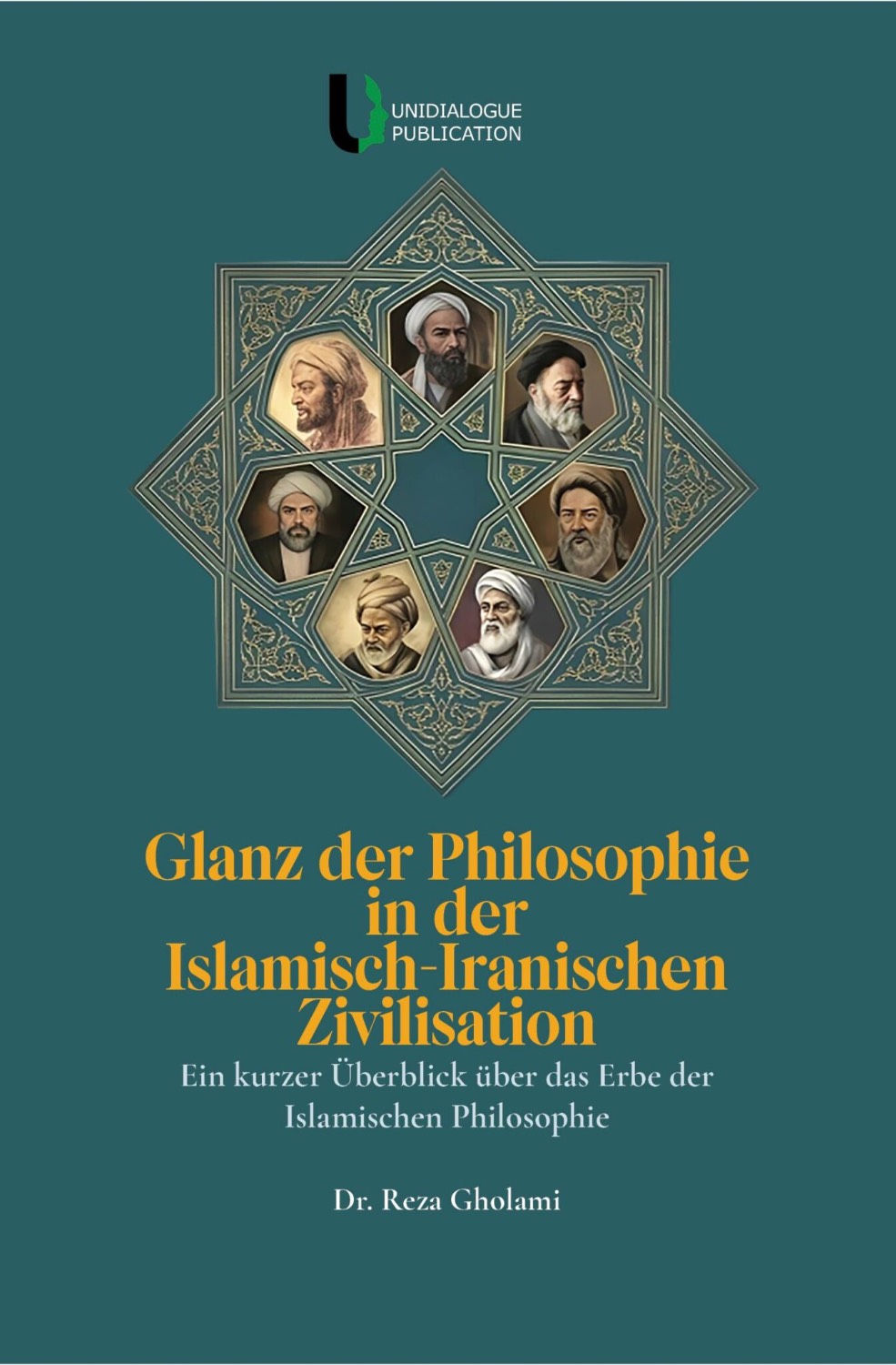
Book Review and Introduction: “The Splendor of Philosophy in Islamic-Iranian Civilization: A Brief Overview of the Heritage of Islamic Philosophy” (Second Edition)The Splendor of Philosophy in Islamic-Iranian Civilization: A Brief Overview of the Heritage of Islamic Philosophy (Glanz der Philosophie in der Islamisch-Iranischen Zivilisation), authored and scientifically supervised by Dr. Reza Gholami of the Institute for Humanities and Cultural Studies and published by UNIDIALOGUE Publications in Vienna (2nd edition, June 2026), is a German-language volume intended for philosophy students and academic audiences in Austria and the wider German-speaking world.
ApproachThis treatise provides a rigorous, dialogue-oriented reconstruction of Eastern rationality designed for Western academia. Deviating from standard doxographical accounts, the work adopts an analytical-critical methodology to trace the epistemological evolution, systemic schools, and socio-political challenges of philosophical inquiry within the Islamic world.
Structural and Content Innovations in the Second EditionCompared to its previous version, the second edition of this book has undergone a comprehensive qualitative upgrade, distinguished by three fundamental additions:
1. Epistemological Autonomy (The New Introduction): The author posits a strict demarcation between philosophical inquiry and theological dogmatism (*Kalam*). It argues that authentic philosophical discourse must remain unconstrained by doctrinal boundaries, subjecting even foundational theological and ontological tenets to the scrutiny of critical rationalism.
2. Integration of Averroism: A newly appended chapter evaluates the intellectual legacy of Averroes (Ibn Rushd). It examines his rigorous Andalusian Aristotelianism, his rejection of Neoplatonic synthesis, the “double truth” paradigm, and his subsequent foundational impact on Latin Scholasticism and the European Renaissance.
3. Concise Prolegomena to Key Thinkers: Avoiding encyclopedic dilution, the text offers a compact, highly integrated overview of the historical context, life, and core doctrines of seminal figures, ensuring a structural balance between Peripateticism (Avicenna), Illuminationism (Suhrawardi), and Transcendent Wisdom (Mulla Sadra).
The Analytical Anchor: An Essay Beyond a Mere Appendix (Anhang)The definitive feature of this edition is a profound, independent analytical essay by Dr. Reza Gholami titled “Reflections on Islamic and Iranian Philosophy: An Exploration into Nature, Origins, and Implications.” Given its theoretical depth, this extensive treatise stands as the most critical portion of the volume, moving far beyond a conventional appendix to serve as a manifest-like intellectual anchor.Rather than offering a mere historical report on the genesis of these traditions, the essay systematically addresses foundational questions: What is the essence of Islamic philosophy? How should its relationship with Greek philosophy and Islamic theology be understood? Is “Islamic philosophy” a more precise term than “the philosophy of Muslims”? What elements grant Islamic philosophy its independent identity, and does this intellectual tradition still possess the generative capacity to address the dilemmas of contemporary humanity?The author demonstrates that these traditions were not merely reproductions of Greek philosophy, but creative systems endowed with methodological and epistemological innovations. He emphasizes that despite extensive interaction with theology, Islamic philosophy was never reduced to Kalam and maintained its relative independence. Furthermore, its fidelity to the “spirit of philosophy”—characterized by rationality, questioning, and the free pursuit of truth—remains a vital factor in its endurance.
Crucially, a significant portion of the essay delineates the concept of Iranian wisdom and its evolution. By tracing the roots of Iranian wisdom from ancient traditions through to Illuminationism and Transcendent Wisdom, the author illustrates how Iran’s intellectual heritage, interacting with
Islamic culture, generated a distinct and creative tradition that remains vibrant and alive today. Ultimately, the essay calls for a “creative rereading” of these traditions—not as a nostalgic return to the past, but as a deliberate effort to establish a meaning-oriented system tailored to contemporary human needs.
Target AudienceRefined through precise academic editing, this second edition serves as an authoritative reference for researchers in comparative philosophy, Islamic studies, and Western scholars seeking a non-dogmatic, analytically rigorous understanding of the essence of Eastern intellectual history.
Target AudienceRefined through precise academic editing, this second edition serves as an authoritative reference for researchers in comparative philosophy, Islamic studies, and Western scholars seeking a non-dogmatic, analytically rigorous understanding of the essence of Eastern intellectual history.
_______________________________________________________
Dr. Reza Gholami, Glanz der Philosophie in der Islamisch-Iranischen Zivilisation: Ein kurzer Überblick über das Erbe der Islamischen Philosophie (Second Edition), published by UNIDIALOGUE, Vienna, June 2026, 152 pages, ISBN 978-3-9506051-3-6.