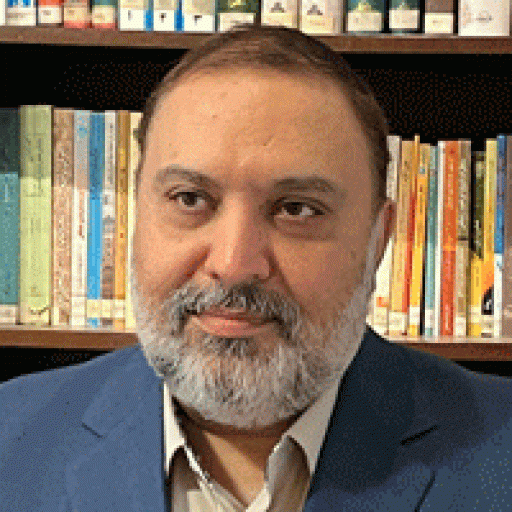
Reza Gholami July 5, 2026
This is how people like me understand Islam — a broad, honest view that I’ve tried to reach by thinking deeply about the heart of the religion, not a cartoonish one. I don’t close the door to criticism of my own interpretation. Anyone is free to question what I say, just as I, as a Muslim and a scholar of religion, am free to share my own reading of Islam. Today Islam is presented to the world in many different, and sometimes opposite, ways by different groups. Staying silent about these differences means quietly going along with a picture of the religion that fits neither reason nor human dignity. That is why I think it’s important to be clear about where I stand, and to say plainly which version of Islam I reject.
The Islam I believe in and accept is not just any version that happens to appear. I reject an Islam that is not born from careful, clear-eyed faith, but instead comes from blind imitation, emotional impulse, or fear. I reject an Islam that limits questioning and self-examination, and that replaces reason and open thinking with rigidity and blind bias — such an Islam cannot bring us closer to the truth. I reject an Islam that pushes its followers toward absolutist, black-and-white thinking, and an Islam that turns its great figures into idols, putting worship in their place instead of honest criticism and reflection. I reject an Islam whose rulings get inflated or downplayed to suit the wishes of its own leading figures, and an Islam whose legal rulings are not compatible with human dignity. I also reject an Islam that chooses extremism over moderation, and that puts the outer shell of religious law above its inner spirit and meaning. And I reject an Islam that cannot strike a fair balance between this world and the next — between worldly happiness and spiritual salvation.
I reject an Islam that stays frozen in its early history and does not move forward with time. I reject an Islam that is not dynamic, that fails to keep pace with the changing world. I reject an Islam that does not take living ethically seriously in practice, and one that, instead of living peacefully alongside people of other faiths and beliefs, pursues the practice of branding others as infidels. I reject an Islam that spreads hatred and misery instead of spreading love and joy in society. I reject an Islam that stays indifferent as superstitions and false beliefs grow up around the religion and come to dominate people’s lives. I reject an Islam that cannot tolerate cultural and intellectual diversity, and that fails to respect individual freedoms. I reject an Islam that gives its blessing to political tyranny.
I also reject an Islam that turns women into tools — for reproduction, for serving their husbands, or for men’s pleasure — and that denies women their rights and freedoms. I reject an Islam that forces girls and women into wearing the hijab against their will. I reject an Islam that, instead of inviting others freely and through reasoned persuasion to its culture, tries to spread that culture by force. And I reject an Islam that puts outward religious rituals and ceremonies ahead of building justice. I reject an Islam that is indifferent to injustice against human beings. I reject an Islam that stays indifferent to the real problems facing societies and to people’s poverty and hardship, or that becomes a tool for those seeking power. Finally, I reject an Islam that does not believe in connection, dialogue, engagement, and the exchange of ideas across cultures and civilizations.
This is the Islam I believe in and the Islam I am proud to follow.