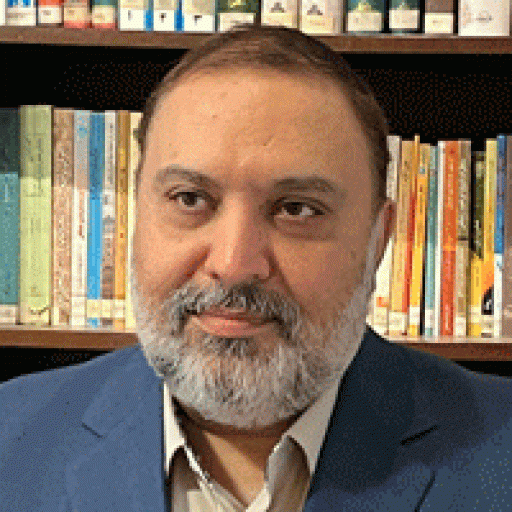
Lecturer: Prof. Reza Gholami
Event: The first scientific meeting of the series “Pleasure of Philosophy” entitled “Mulla Sadra’s Philosophy Privileges”
Date: 2024-05-21
Venue: Cultural Consultation of the Islamic Republic of Iran, Vienna.
Introduction
In the name of Allah, the Compassionate, the Merciful.
I am happy that we have the opportunity to speak about Mulla Sadra’s philosophy in the first program of our series of scientific programs in Vienna. It’s necessary to thank Professor Sharif Lakzaee, a member of the academic staff of the Research Institute of Islamic Sciences and Culture in Iran, who agreed to give a speech at this scientific meeting.
Mulla Sadra is one of the prominent figures of Islamic philosophy. He lived in the 17th century during the Safavid dynasty. His philosophy played an important role in the contemporary Islamic philosophy of Iran. In recent decades, some contemporary Muslim philosophers in Iran have tried to develop Mulla Sadra’s philosophy by creating a new philosophy, which is called Neo-Sadra’s philosophy. There is also a thought stream in Iran that believes a progressive political thought can be achieved based on Mulla Sadra’s philosophy. Professor Sharif Lakzaee and his older brother, Najaf Lakzaee, are among the leaders of this current.
Mulla Sadra has several key points in his philosophy. Although when we want to compare his philosophy with other Islamic philosophies, Mulla Sadra has clearer literature; his discussions are deep and multidimensional. Therefore, I can acknowledge that talking about his philosophy is very complicated. We also know there is no perfect philosopher and every philosopher, such as Mulla Sadra, has weaknesses along with their strengths.
Mulla Sadra’s main creativity, in my opinion, is challenging famous philosophical theories and trying to innovate and reconstruct Islamic philosophy. Here, I would like to point out seven key advantages of Mulla Sadra’s philosophy. Although I will explain all briefly, I will focus more on two of them (the fifth and sixth key advantages).
1. Unity of Existence
Mulla Sadra’s philosophy emphasizes the unity of existence (wahdat al-wujud), positing that all things are manifestations of an ultimate reality. This worldview promotes harmony and interconnectedness among all aspects of reality. Perhaps Spinoza’s approach to existence can be seen as similar to Mulla Sadra’s, but Mulla Sadra’s approach is deeper, and I emphasize that there are differences between them.
In fact, Mulla Sadra opened a way for understanding the beings of the world by proposing the originality of existence, and said there is nothing except from God’s side, and all things are rays of true light and the truth of existence[i]. What is original and unique is the existence and essence of God.
What Mulla Sadra posits in the unity of existence theory is akin to a hierarchy of knowledge[ii]. If we consider “existence” as a spectrum, at one end there is a very weak order of existence, and at the other end there is the source and origin of existence (i.e., God). In his theory, perfection means moving from the weak side to the source of existence, and as the source of existence is infinite, perfection is infinite too.
2. Transcendental Wisdom
Mulla Sadra’s philosophy explores the nature of knowledge and reality beyond empirical observation, delving into deeper metaphysical and spiritual realms. This allows for a more holistic understanding of existence. While Mulla Sadra does not reject the use of empirical experience as a source of knowledge, he considers it within a certain scope in his premises of philosophical arguments.
Undoubtedly, Mulla Sadra developed the philosophy of Ishraqi (enlightened philosophy) and investigated mysticism through a rational lens. To put it another way: mystical insights, as long as they cannot be translated into the language of reason, cannot be criticized, and as long as they don’t defend themselves against criticisms, they don’t have the authority to enter the realm of philosophy.
In Mulla Sadra’s philosophy, we cannot ignore the key role of refining the soul. In fact, a person without self-refinement will not be able to understand the higher levels of truth.
I do not agree with the view that Mulla Sadra’s philosophy is opposed to the philosophy of Mashaei. While it is true that Sadra’s philosophy is closer to theology due to its effective use of the Qur’an and Sunnah, thus earning the title of transcendental wisdom, it is also true that it maintains a higher degree of philosophical purity than enlightened philosophy. In other words, although transcendental wisdom does not have the same level of philosophical purity as Mashaei philosophy, it still retains more philosophical rigor than the enlightened philosophy.
Mulla Sadra states: “The rulings of the real Shari’ah are not in conflict with rational, certain, and necessary knowledge. It is not a philosophy whose laws are in accordance with the book and tradition[iii].” This statement should not mislead us into thinking that he accepts everything in the Qur’an and Sunnah according to any interpretation. No, Mulla Sadra, as a commentator, tries to present a rational interpretation of the Qur’an and the Sunnah.
From this perspective, there is no conflict between religion and reason. More precisely, this means that there is no conflict between his interpretation of the Qur’an and the Sunnah and reason.
I don’t want to criticize Mulla Sadra’s point of view, but I believe that every philosopher must put aside their faith during their philosophical activity. Indeed, if a philosopher has certain beliefs, there is no problem; however, they must set aside these beliefs when engaging in philosophical activities. This is a fundamental principle in philosophy.
3. Spiritual Journey
Mulla Sadra’s philosophy offers a framework for individuals to embark on a spiritual journey towards self-realization and inner perfection. By cultivating self-awareness and deep reflection, one can develop a deeper connection to the source of existence.
The four journeys of Mulla Sadra include:
o Journey from people to the source of existence (God).
o Journey with God to God.
o Journey from God to people with God.
o Journey (living) among people before God.
Mahdi Haeri Yazdi, while explaining the four mystical journeys, considers these journeys inseparable from the four intellectual journeys (Haeri Yazdi, ????)
Placing Mulla Sadra’s philosophy within the framework of the four mystical journeys is one of his great innovations, linking mysticism and philosophy. According to his view, the entire universe is not outside of these four stages, and philosophy is a knowledge that discusses the universe as it is. Therefore, Mulla Sadra has planned his philosophy within the framework of these mystical and rational journeys.
4. Integration of Knowledge Sources
As I mentioned, Mulla Sadra’s philosophy integrates Islamic mysticism and the Quran with reason and proof, providing a comprehensive perspective that resonates with Islamic teachings. This synthesis allows for deeper thought and the resolution of some challenging philosophical problems.
However, using religious sources in philosophy does not necessarily mean exiting from the philosophical realm. It is crucial that a philosopher does not use religious sources in detail without critical and reasonable research. This is a great truth: religions and metaphysics can open some super important perspectives for philosophers. I think there is no philosophy in history (even modern philosophies) that has not borrowed from religions.
Compared to other religions, Islam is committed to rationality in its teachings, and Mulla Sadra cleverly used Islamic sources to solve philosophical dilemmas. It is interesting and useful to mention that the synergism of Islamic teachings and Sadra’s philosophy has made his philosophy more popular than previous philosophies, especially the Mashaei philosophy, in the Shiite Muslim society.
5. Al-Harkat al- Jowharī
Mulla Sadra introduced a significant philosophical concept known as “Substantial Motion” (Al-Harkat al-Jowharī). This idea is a foundation of his dynamic and innovative philosophical system called “Transcendent Theosophy” (al-Hikmat al-muta‘aliyah). Substantial Motion posits that all substances are in a constant state of transformation. Unlike the traditional Aristotelian view that only non-essential properties change while the essence of things remains static, Mulla Sadra demonstrated that substances themselves are in a continuous process of intrinsic movement and evolution.
He argued that this motion is not merely accidental but substantial, meaning that the essence of a substance is dynamic. This leads to his doctrine that existence is a single, continuous gradation of being, with more complex beings evolving from simpler ones over time. In this framework, all changes in the world are expressions of a unique reality undergoing substantial motion.
Mulla Sadra’s theory of movement is progressive and revolutionary because it integrates various philosophical traditions—including Islamic theology, mysticism, and the philosophies of predecessors like Avicenna and Suhrawardi—into a coherent metaphysical system that places movement and change at the very heart of reality. This concept has profound implications for understanding the nature of the universe, the process of becoming, and the dynamic relationship between God and creation. It suggests that the universe is not static but is constantly evolving, with each being participating in a grand cosmic movement towards perfection.
Additionally, the theory of Substantial Motion has a transformative role in two other areas: the quality of the emergence of the soul and its connection with the body, as well as the explanation of the relationship between perfection and resurrection (Ma’ad).
6. The Soul-Body Relationship
Mulla Sadra had profound views on the soul, believing it to be a substance that is essentially independent (spiritual survival) but requires matter for its action (physical occurrence). The soul, according to him, is attached to the body and governs it. In other words, Mulla Sadra posited that initially, humans are purely physical beings, and the soul forms in connection with the body through a process, ultimately surviving after the body’s death.
Mulla Sadra believed that the human soul is brought into being with the body, starting as prime matter full of potentiality. Through a process called substantial motion, it evolves from a vegetative soul to an animal soul and finally to a human soul. This theory led him to present a philosophical proof for physical resurrection (Ma’ad), a significant departure from the views of other philosophers and the dualism of Descartes.
Notably, even great philosophers like Avicenna struggled to rationally prove physical resurrection and eventually turned to faith for this proof. Mulla Sadra, however, argued that the faculties of intellect and imagination are incorruptible. He used this theory to explain divine rewards and punishments and the physical resurrection.
His philosophical perspective on the soul was deeply intertwined with his interpretations of the Holy Quran, theology, and the narrations of prophets and Imams. Mulla Sadra endeavored to show that it is possible to derive a progressive interpretation from the core of the Quran and Islamic narrations, illustrating deep truths about the soul and its journey.
7. Social Theory
Although Mulla Sadra, like some philosophers before him, such as Farabi, did not dedicate an important part of his thought system to practical wisdom, general principles in the social field can be derived from his theories. However, in my opinion, our use of Mulla Sadra in the social arena does not go beyond these general principles. While a realistic view about society and its complex problems is absent in Mulla Sadra’s philosophy, it is possible to build a social theory based on his philosophical framework.
Thank you for your attention.
[i] Original text: “as anything but rays and rays of true light, and the truth of existence” (Vague)
[ii] Original text: “the level of knowledge”
[iii] (Vague)