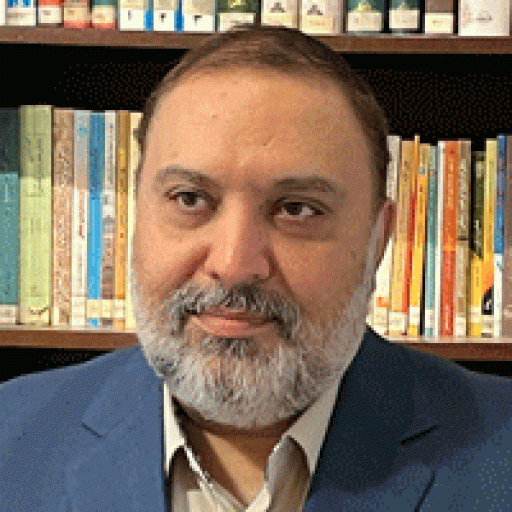
Dr. Reza Gholami’s note on International Mother Language Day.
In the name of God
Today, on International Mother Language Day, we have a valuable opportunity to talk about the role of language in shaping thought, identity, and civilization. Language is not just a tool for communication; it also defines the way we think and understand the world. As the great philosopher Ludwig Wittgenstein said: “The limits of my language mean the limits of my world.” This shows that language is not just about words—it shapes our horizon of knowledge and perception.
- Language, Thought, and the Labyrinth of Language
In his later works, Wittgenstein introduced the idea of the “labyrinth of language” (Sprachlabyrinth). He believed that language is like a complex maze, offering many paths for expressing and understanding ideas. This means that language is not a simple structure but a dynamic and multi-layered system that evolves through social and cultural interactions.
Each language creates its own network of meanings, influencing the way people think, analyze, and interpret the world. Societies that develop and enrich their language also expand their intellectual and cultural achievements. However, if a language weakens or remains stagnant, the ability of its speakers to think critically and creatively will also decline.
- The Importance of Mother Languages in Shaping Worldviews
Our mother tongue is the first gateway through which we experience the world. It carries the cultural values, deep beliefs, and historical identity of a nation. The way we think and view life is deeply connected to the language we first learn as children.
Forgetting or neglecting a mother language means losing a part of historical and cultural memory. Societies that preserve and strengthen their native languages also keep their intellectual and civilizational identity alive. Therefore, protecting and promoting mother languages is not just a cultural responsibility—it is essential for the survival of diverse ways of thinking and living.
- Persian: A Treasure of Iranian-Islamic Civilization
Among the world’s great languages, Persian is one of the oldest and richest. For more than two thousand years, it has preserved the legacy of a great civilization. Persian is not just a means of communication—it is also a language of philosophy, mysticism, poetry, and literature. Great works by poets and thinkers like Ferdowsi, Rumi, Saadi, and Hafez were written in Persian and have influenced cultures far beyond its borders.
- Persian: The Language of Ethics, Peace, and Spirituality
One of the unique aspects of the Persian language is its deep connection to spirituality, ethics, and peaceful coexistence. Persian literature is filled with moral lessons, calls for kindness, and messages of tolerance and love. Promoting the Persian language is not just about spreading a language—it is about sharing values that bring people closer to one another.
- Persian: One of the Living Classical Languages of the World
Persian is one of the oldest languages in the world, with a literary tradition spanning over a thousand years. It remains the official language of Iran, Afghanistan (as Dari), and Tajikistan (as Tajik). Historically, culturally, and literarily, Persian holds a unique place among the world’s languages. Therefore, preserving and promoting it is not only a national responsibility but also a step toward safeguarding an important part of humanity’s heritage.
- The Need for More Attention to Persian in Universities
Persian, spoken in Iran, Afghanistan, Tajikistan, parts of Uzbekistan, and India, has long been a cultural and intellectual bridge in the region. Learning Persian offers several key benefits:
- Rich literary and philosophical heritage – Great thinkers like Rumi, Hafez, Saadi, and Avicenna wrote in Persian, providing deep insights into Eastern wisdom.
- Academic and research opportunities – Persian is vital for philosophy, mysticism, history, and Islamic studies, with many texts still untranslated in the West.
- Cultural and diplomatic engagement – Many nations share historical ties with Persian-speaking regions, making the language valuable for researchers, diplomats, and businesses.
- Understanding Eastern civilizations – Persian offers access to centuries of ideas, cultural exchanges, and intellectual achievements across the Middle East and Central Asia.
Given these advantages, more universities should offer Persian programs, as learning Persian is not just about language—it is a gateway to knowledge, philosophy, poetry, and wisdom.
In conclusion, preserving and promoting mother languages is essential for maintaining culture, identity, and civilization. Every language that disappears takes away a unique way of understanding the world. Today, let us reaffirm our commitment to protecting and expanding our native languages, especially Persian, so that their rich heritage continues to thrive.
I would also like to express my sincere gratitude to the organizers of this important cultural event here at the United Nations office. A special thanks goes to the friendly and brotherly nation of Bangladesh, the host of this ceremony, for its dedication to celebrating linguistic and cultural diversity. Your efforts remind us all of the importance of honoring and safeguarding the world’s languages for future generations.