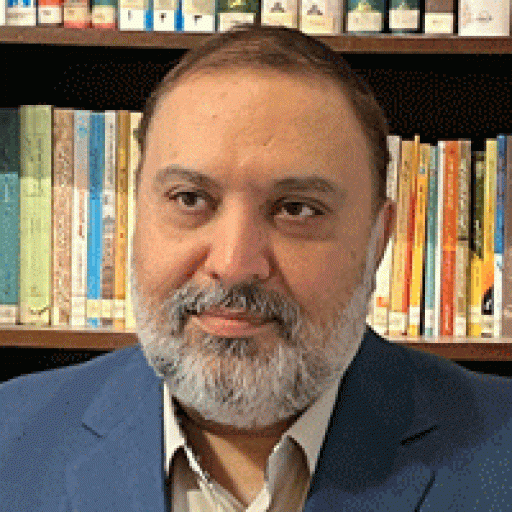
Dr. Reza Gholami’s Introductory Talk at the “Music and Spirituality” Seminar:
(November 5, 2024- Vienna, Iranian Wisdom House)
First, I would like to welcome you all and thank you for your presence at this gathering.
Although discussions on music and spirituality are very old, they remain relevant today. This topic is still alive and worthy of discussion and deep reflection from different perspectives.
The first question is: does music have a natural harmony with spirituality? And is harmony necessary for music and spirituality to interact?
The second question is: can music help people grow spiritually?
If we believe that music can help with spiritual growth, the main question then becomes: how does music help with spiritual growth?
Several answers have been suggested for these questions:
Firstly, music and spirituality have a deep, historic connection, but harmony between them is not always necessary. Music, by evoking emotions, can inspire focus, calmness, and even mystical states that are often linked to spiritual experiences. Many spiritual and religious traditions use music as a tool for reaching deeper spiritual states. For example, music is used in Sufi practices and religious chants in churches and temples to bring people closer to a spiritual experience.
Even reading sacred texts, like the Quran with its specific musical style, is emphasized in religions such as Islam. Currently, Quran reciters have beautifully recited the entire Quran using various melodic modes. Additionally, the recitation of prayers with specific vocal and musical tones is very common in Judaism, Christianity, and Islam.
But the interaction between music and spirituality does not always mean they are fully harmonious. Music in itself may not be spiritual, but when played or listened to in a spiritual setting or with spiritual intent, it can create a spiritual experience for the listener.
A more important answer comes from the perspective of the Muslim philosopher Farabi, who was one of the prominent Islamic thinkers about music.
In his famous book Kitab al-Musiqi al-Kabir (The Great Book of Music), Farabi explains that music can affect a person’s inner states and help develop moral virtues and spiritual growth.
Farabi divides music’s connection to the human spirit into four main goals:
-
- Influencing emotions and creating positive mental states
- Strengthening virtues and aiding moral development
Farabi saw music as a tool that, in certain conditions, could help to purify the soul and develop the spirit.
-
- Balancing reason and emotions
Farabi saw music as a way to harmonize reason and emotion, creating inner balance, which he considered fundamental for spiritual and moral growth.
-
- Offering relaxation and therapeutic benefits
Farabi also noted the healing effects of music, seeing it as a way to soothe the mind and help with certain unstable mental states, which often arise from a lack of spirituality.
My final point, as an introduction, is that music has provided unique contributions to spirituality, especially in recent centuries.
As a result, some modern musical pieces worldwide have become symbols of the relationship between music and spirituality due to their combination of spiritual and musical elements. These pieces often inspire a sense of contemplation, calm, and spiritual connection. Let me mention a few of these significant works.
-
- The album “Tabula Rasa” by Arvo Part is perhaps the most widely recognized example of music symbolizing spirituality. In this piece, Part uses silence and repetition to create a space of peace and spirituality, inviting listeners to self-reflection and spiritual contemplation.
- In traditional Iranian music, there are many works that symbolize music and spirituality. For example, the album “Bidad” by Mohammad Reza Shajarian and Parviz Meshkatian is one of the most significant pieces of traditional Iranian music. With verses by Hafez and the mystical mood of the Homayoun mode, this piece creates a deep spiritual experience.
Overall, these works act as bridges between music and spirituality in the modern world, creating deep, contemplative atmospheres. Each of these works helps people move closer to inner and spiritual experiences in a unique way.
In this seminar, we have the honor of hosting three experts in music:
Dr. Nasir Heydarian, a professor at the University of Graz in Austria, who is also a symphony conductor with a history of leading major orchestras.
Reinhard Gosch, an Austrian musician and producer of major musical works, who has significant familiarity with Eastern music, including Iranian music.
Milad Aghaei from Iran, a successful composer whose works often focus on spirituality, and who is also a respected voice in this field.
The advantage of this seminar is that all three speakers, in addition to their background in music studies, have extensive practical experience as well.
***
Also, at the end of the meeting, Dr. Reza Gholami said:
The lectures were very helpful. I found new points in the talks.
Thank you to all the professors and experts.
This meeting showed that here in Vienna, the center of music in the world, we have focused on a very important topic.
Music and spirituality are closely connected. When music is in its true place, it can greatly help people’s spiritual growth. (Music with poetry and vocals, and music without poetry and vocals.)
I even think that, unlike the Christian world and other religions, the Islamic world has not made good use of the opportunities music offers and has often viewed music as something suspicious.
I think there is room for more investment in developing theories and creating innovative pieces in this area.
I even suggest creating a Music and Spirituality Award in Vienna, which could be given each year to the best works. It specially needs to help of all of you.
we will continue this discussion in the future.
In this meeting, we touched less on mysticism and preferred to keep the discussion more general on the topic of spirituality. In the future, we could explore the relationship between music and mysticism in a more specialized way.
I won’t take up more of your time. Our time is up. I thank everyone
Again. And Good night to all.