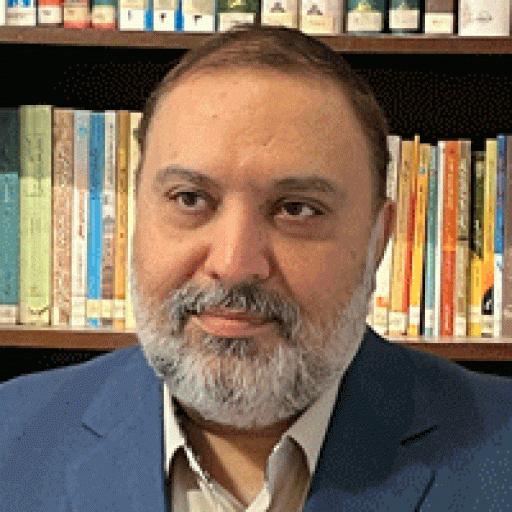
Full text of Dr. Reza Gholami’s speech at the Symposium on Artificial Intelligence, Ethics, and Democracy, July 10, 2026, Iranian Wisdom House, Vienna, Austria
Distinguished professors, dear colleagues, ladies and gentlemen,
It is a great honor to participate in this gathering celebrating the publication of Professor Mark Coeckelbergh’s important books in Persian, especially his remarkable book Artificial Intelligence and Democracy.
Allow me first to express my sincere appreciation for Professor Coeckelbergh. He is not only one of the world’s leading philosophers of technology, but also one of the few contemporary thinkers who consistently reminds us that the most important questions about artificial intelligence are not merely technical—they are philosophical, ethical, and political.
While many discussions about AI focus on innovation, efficiency, or economic growth, Professor Coeckelbergh invites us to ask deeper questions: What kind of society are we creating? What happens to human freedom when decisions are increasingly delegated to algorithms? What becomes of democracy when technological systems begin to shape public life?
These are not questions about machines alone. They are questions about humanity itself.
His book Artificial Intelligence and Democracy is therefore much more than a study of emerging technologies. It is an invitation to rethink democracy in the age of intelligent machines. By bringing together philosophy of technology, political philosophy, and ethics, the book demonstrates that the future of democracy depends not only on technological progress but also on our collective moral and political choices.
Inspired by this important work, I would like to reflect today on a central question:
Can democracy survive the age of artificial intelligence, or must democracy itself be reimagined?
For more than two thousand years, democracy has rested on one fundamental assumption: that citizens are capable of reasoning together.
From ancient Athens to modern constitutional democracies, political legitimacy has depended upon dialogue, public deliberation, critical thinking, and informed judgment. Democracy has never been simply a method of counting votes. It has always been a culture of shared reasoning.
Today, however, artificial intelligence is transforming not only our technologies but also the conditions under which democratic life exists.
The greatest question before us is therefore not whether machines will become more intelligent.
The deeper question is whether human beings will remain intellectually and morally capable of governing themselves.
Artificial intelligence did not create the current crisis of democracy.
Long before the emergence of generative AI, many democracies were already experiencing declining public trust, political polarization, institutional weakness, and growing social fragmentation.
But AI possesses an unprecedented ability to accelerate all these existing crises.
In this sense, artificial intelligence should not be understood as the origin of democratic decline; rather, it functions as a powerful amplifier of democratic vulnerabilities.
The first challenge concerns the crisis of truth.
Every democratic society requires what philosophers call a shared epistemic space—a common world in which citizens may disagree about values while agreeing on basic facts.
Artificial intelligence is fundamentally changing this condition.
Today, AI can generate persuasive texts, realistic images, convincing voices, and highly sophisticated videos that are almost impossible to distinguish from reality.
Deepfakes and AI-generated misinformation do more than spread falsehoods.
They undermine confidence in truth itself.
When citizens no longer know what is authentic, political debate gradually loses its foundation.
Democracy cannot function if every fact becomes negotiable and every piece of evidence becomes suspect.
Equally concerning is the ability of AI to personalize political influence.
Algorithms collect enormous quantities of behavioral data and construct detailed psychological profiles of citizens.
Political communication is therefore becoming increasingly individualized.
Different voters receive different political realities, different narratives, and different emotional appeals.
Public debate gradually disappears and is replaced by invisible behavioral engineering.
Democracy slowly moves from persuasion toward prediction and manipulation.
The second challenge concerns human agency.
This, I believe, is one of the most profound philosophical questions raised by Professor Coeckelbergh.
Artificial intelligence no longer simply assists our decisions.
Increasingly, it mediates our perception of reality.
Algorithms decide what news we read, what opinions we encounter, what products we buy, what routes we take, whom we meet online, and even what we believe deserves our attention.
Gradually, AI becomes an invisible architecture shaping human judgment.
Democracy presupposes autonomous citizens capable of independent reflection.
Yet algorithmic environments increasingly transform citizens into predictable patterns of behavior.
The danger is therefore not that machines replace governments.
The danger is that algorithmic systems slowly reshape the cognitive conditions upon which democratic citizenship depends.
The third challenge concerns political power.
Historically, democratic societies attempted to distribute power among elected institutions through constitutions, laws, and public accountability.
Artificial intelligence introduces a different architecture of power.
Today, immense political influence is increasingly concentrated within digital platforms, algorithmic infrastructures, and technology corporations.
These systems regulate public discourse without necessarily possessing democratic legitimacy.
Their algorithms influence elections, shape public opinion, determine the visibility of ideas, and increasingly regulate civic life.
Political authority is therefore shifting from visible democratic institutions toward invisible technological systems.
Perhaps algorithms are the new hard-line dictators.
This transformation deserves far greater philosophical attention than it has so far received.
If these are the challenges, what should be our response?
Technology alone cannot solve problems created by technology.
The first response must be philosophical.
One of the greatest needs of our time is the revival of philosophy—especially political philosophy and ethics.
Philosophy teaches us not what to think, but how to think.
It strengthens critical judgment, logical reasoning, intellectual humility, and moral responsibility.
Citizens trained in philosophical reflection are far less vulnerable to manipulation, propaganda, and algorithmic deception.
But this revival cannot stay locked inside universities and academic books. Philosophy must become public again. It must reach schools, media, and everyday conversation, not only expert rooms. Only when clear and simple philosophical thinking spreads through society can ordinary people build the rational judgment needed to resist manipulation. Without this, people may vote and choose together while still remaining unaware, guided by emotion and algorithm instead of reason. A society of unconscious citizens cannot build a conscious democracy.
In an age of intelligent machines, democratic societies require wiser citizens.
The second response is the restoration of intellectual life.
We live in an era of information abundance but intellectual scarcity.
Algorithms reward speed rather than reflection, emotion rather than argument, popularity rather than truth.
Of course, Sometimes they even drop the mask and openly tell lies. I experienced this many times during the Iran–U.S. war in 2026.
Independent scholars, philosophers, journalists, writers, and public intellectuals therefore have an indispensable democratic responsibility.
Their task is not merely to produce knowledge.
It is to preserve the depth of public reasoning.
Without thoughtful intellectual leadership, democratic debate gradually becomes superficial and reactive.
The third response concerns governance.
Artificial intelligence cannot remain outside democratic accountability.
High-risk applications of AI should be transparent, explainable, contestable, and subject to meaningful public oversight.
Citizens should possess the right to understand how important algorithmic decisions affecting their lives are made.
Opacity may be acceptable in commercial competition.
It is unacceptable in democratic governance.
The fourth response is technological responsibility.
Artificial intelligence itself should help combat AI-generated deception.
Reliable authentication systems, digital watermarking, and advanced verification technologies should become standard components of responsible AI development.
Innovation without responsibility ultimately weakens public trust.
Finally, no democratic future is possible without education.
Digital literacy is important.
But even more important is civic literacy.
Young people must learn not only how artificial intelligence works but also why democracy matters.
They must understand freedom, responsibility, justice, dialogue, and the ethical foundations of public life.
Democracy is sustained not only by institutions but by educated citizens.
Ladies and gentlemen,
Perhaps the greatest lesson we learn from Professor Coeckelbergh’s work is that the future of democracy will not be determined by artificial intelligence alone.
It will be determined by the values through which humanity chooses to govern artificial intelligence.
Technology always reflects the civilization that creates it.
If our civilization values only efficiency, optimization, and prediction, artificial intelligence will reinforce those priorities.
But if our civilization values freedom, dignity, justice, responsibility, and human flourishing, AI can become a powerful instrument for strengthening democracy rather than weakening it.
The greatest danger is therefore not that machines become more intelligent than humans.
The greater danger is that human beings gradually surrender the practices that have sustained democratic life for centuries: critical thinking, moral judgment, public dialogue, and shared responsibility.
Democracy is ultimately not a technological achievement.
It is a moral achievement.
Its future depends less on the intelligence of our machines than on the wisdom of our societies.
Thank you for your attention.