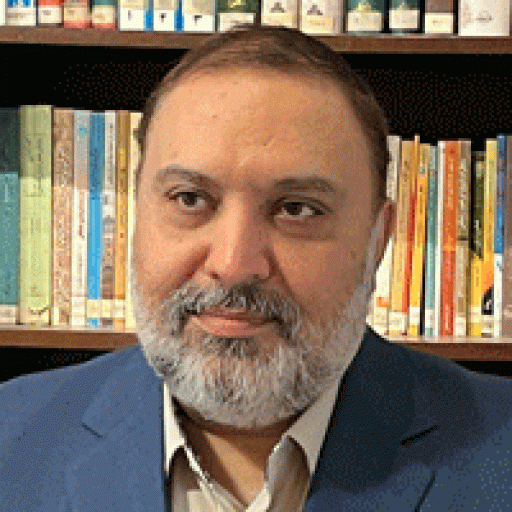
Full Text of the Speech by Dr. Reza Gholami at the Opening Meeting of the Specialized Iranian Studies Book Exhibition
Vienna, Iranian Wisdom House, 17 June 2026
Good afternoon, everyone,
Thank you very much for being here today.
I am delighted to have this opportunity to briefly introduce my book, Iranian Studies: Foundations, Coordinates, Approaches, and Challenges.
The idea of writing this book emerged from a question that accompanied me for many years:
What exactly is Iranian Studies?
At first glance, the answer seems simple. We usually say that Iranian Studies is the study of Iran’s history, language, literature, culture, religion, arts, society, and civilization.
However, as I continued my research and teaching, I increasingly felt that this answer was incomplete.
It tells us what Iranian Studies studies, but it does not fully explain what makes Iranian Studies a coherent field of knowledge.
If historians, linguists, sociologists, anthropologists, political scientists, and scholars of religion all study Iran, what connects their work?
What is the common subject of their inquiry?
What are the foundations of this field?
And what kind of knowledge should Iranian Studies produce?
This book is my attempt to reflect on these questions.
In the book, I define Iranian Studies as a systematic and interdisciplinary field of knowledge that seeks to understand Iran as a historical, cultural, social, and civilizational reality.
In my view, Iranian Studies should not be limited to gathering exact information about Iran. It should also help us understand the deeper structures, meanings, continuities, and transformations that have shaped Iranian civilization through time.
The book is organized into four main parts.
The first part discusses the Foundations of Iranian Studies. It examines the nature of the field, its subject matter, its goals, and its theoretical basis.
The second part focuses on the Coordinates of Iranian Studies. Here I discuss the major elements that define Iran and Iranian civilization and make them meaningful objects of academic inquiry.
The third part examines various Approaches and Methodologies in Iranian Studies. It looks at different ways of studying Iran and evaluates their strengths and limitations.
The fourth part addresses the Challenges of Iranian Studies, including conceptual, methodological, and institutional challenges facing the field today.
While writing this book, I became increasingly convinced that Iranian Studies, despite its rich achievements, still needs deeper theoretical reflection.
During the last century, an enormous amount of valuable research has been produced about Iran. We have excellent studies on Persian literature, Iranian history, archaeology, religion, politics, and many other fields.
However, much of this knowledge remains fragmented.
Different scholars often work within different disciplinary frameworks, using different assumptions and methods.
As a result, we know a great deal about many aspects of Iran, but we sometimes lack a broader framework that helps us understand how these different aspects relate to one another.
One of the main purposes of this book is therefore to encourage a discussion about the theoretical foundations of Iranian Studies.
A central argument of the book is the importance of a civilizational perspective.
This does not mean that political, social, economic, linguistic, or religious studies are unimportant. On the contrary, all of them are essential.
My argument is simply that Iran can be understood more adequately when these dimensions are viewed as parts of a larger civilizational whole.
A civilizational perspective allows us to examine long-term historical continuity, collective memory, cultural creativity, systems of meaning, and the interaction of different social and intellectual traditions.
It provides a wider framework within which many different dimensions of Iranian life can be studied together.
Another concept that I explore in the book is what I call the Civilizational Genome.
This concept emerged from a simple question:
How can a civilization remain recognizable across centuries while constantly changing?
Iran has experienced conquests, dynastic changes, religious transformations, social movements, and encounters with many different cultures.
Yet despite these changes, there remains a strong sense of historical continuity.
The concept of a civilizational genome is an attempt to understand the deeper structures that help preserve this continuity while still allowing adaptation, development, and renewal.
In developing this discussion, I also draw inspiration from Islamic philosophy, particularly the philosophy of Mulla Sadra.
His theory of substantial motion offers, in my opinion, an interesting philosophical framework for understanding continuity and change together.
According to this perspective, reality is not static. Change is not something external to existence. Rather, change is part of existence itself.
I found this idea helpful in thinking about civilizations and their historical development.
A civilization may change continuously while maintaining a deeper identity that gives coherence to its historical journey.
Another objective of the book is to contribute, even in a modest way, to the dialogue between different intellectual traditions.
Throughout the book, I engage with contemporary social sciences, civilizational studies, philosophy of science, and elements of the Islamic intellectual tradition.
My hope was not to privilege one tradition over another, but rather to create a space for dialogue among them.
I should also emphasize that this book does not claim to offer a final theory of Iran or Iranian civilization.
Many of the ideas presented in the book remain open to discussion, criticism, and further development.
Indeed, one of my hopes is that the book will encourage new debates and new research questions.
If it helps scholars think more deeply about the foundations, methods, and future directions of Iranian Studies, I will consider it successful.
In conclusion, I would say that this book is an invitation to reflect on a simple but important question:
How should we study Iran?
Not only as a country, not only as a society, and not only as a historical entity, but also as a civilization with a long and complex historical experience.
I hope this work contributes, even in a small way, to a richer understanding of Iran and to the continuing development of Iranian Studies as an academic field.
I look forward to your comments and critiques.
I am honored to share that I recently sent this book to prominent philosopher and scientist, Professor Seyyed Hossein Nasr in The George Washington University
for evaluation. After kindly reviewing the book, Dr. Nasr generously commented:
“This is an ambitious project, but it is missing significant engagement with traditional sources.”
I am grateful for his valuable scholarly feedback. In future editions, I will certainly seek to address this shortcoming more fully. However, it is important to note that this book is conceived as a philosophy of science study of Iranian Studies rather than a conventional work of Iranian studies scholarship.
Let me say a few simple sentences about the Iranian Studies specialized book exhibition. This exhibition aims to show the importance of sources in expanding and deepening Iranian Studies. In this way, it reveals to us both the weaknesses and limitations, as well as the strengths and advantages. One of the works done on the occasion of this exhibition is a review and analysis of the publications of the Austrian Academy of Sciences in the field of Iranian Studies. We hope that this will help to strengthen the Academy’s publications.
I would also like to ask Dr. Sibylle Wentker to kindly convey this academic review on our behalf to the President of the Academy.
Thank you very much for your attention.