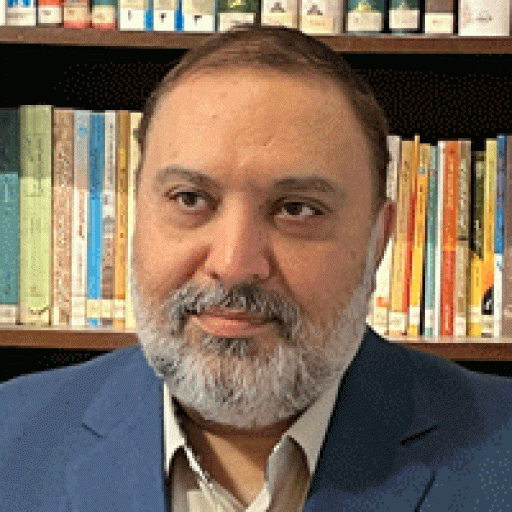
Reza Gholami
Habermas passed away today at the age of 96. Yet the intellectual edifice he built over his long life belongs to that rare category of legacies that do not die with their author.
Habermas was an heir to the Frankfurt School, but he charted his own course. The first generation of that tradition – Adorno and Horkheimer among them – had reached an impasse: they saw modern reason as an instrument of domination and could find no way out. Habermas asked: has every form of emancipatory rationality truly been exhausted? His answer was the Theory of Communicative Action – a fundamental distinction between instrumental reason, which seeks control, and communicative reason, which seeks understanding. He argued that within every sincere act of dialogue, a hidden ethics is at work: recognizing the other as an equal, committing to reason, and remaining open to changing one’s position in the face of a better argument.
His historical contribution to philosophy was that of a bridge-builder – between the European critical tradition and analytic philosophy of language, between theory and political practice, and above all, between intellectual despair and the possibility of change. He returned philosophy to the public sphere and demonstrated that democracy is not an electoral procedure but an ongoing communicative project.
Yet the most serious challenge to Habermas remains this: is the “free and equal dialogue” on which he builds his entire framework anything more than an abstract ideal? Critics such as Foucault and radical feminists argued that every conversation is already shaped by pre-existing relations of power. Those whose voices have been marginalized from the outset do not become equal simply by entering Habermas’s “communicative space.” This challenge remains unanswered – and it is precisely this that keeps his thought alive and contested.
***
Although I was upset about his stance on Gaza last year, I wrote to him with a request: to give his blessing to a symposium in Vienna – a critical reexamination of his ideas, delivered by Iranian thinkers. He replied that age had made attendance or participation impossible. That brief response was my last direct connection to him.
May his memory endure.