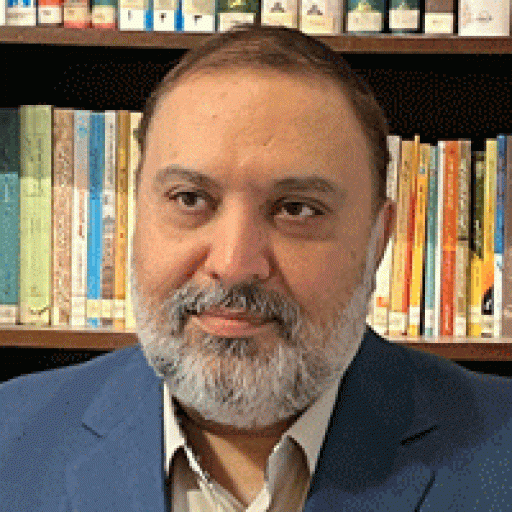
The full text of Dr. Reza Gholami’s lecture at the International Online Conference “The Future of the World and New Philosophical Problems,” held in cooperation with the University of Tabriz (Iran) and the Iranian Wisdom House in Vienna, November 20, 2025
Good afternoon, everyone.
I would like to take this moment to thank Professor Muhammad Asghari for his efforts in orchestrate the scientific part of conference. I also thank all the distinguished professors, researchers, and participants for their presence and contribution.
I hope this conference helps revive the role of philosophy in solving global problems.
Now, let me move straight to my topic.
Introduction: Humanity’s Position on the Threshold of the Future
We stand on the threshold of a future filled with opportunities and threats.
Technological advancements, especially artificial intelligence, could be the most important factor in creating change in the coming decades.
Parallel Challenges of the New Era
But the harsh reality is this: we talk about new technologies like artificial intelligence, while we have not yet overcome the challenges of climate change on Earth, and we may even fail in this path.
Crises in Political Philosophy
Even from the viewpoint of political philosophy, there are serious concerns: the weakness of democracy, the limits on freedom and justice, and most importantly, the growing fragility of human rights.
These political concerns have become more serious because globalization has turned from an idea or perspective into an objective reality, making humans inhabitants of a small village or a single ship.
This situation has brought major changes to governance and has confronted the political order of the modern era with serious shifts.
Part One: The Role of Philosophy in Human Transformations
However, the discussion is about transformations that can confront human life with changes beyond our imaginations.
In this midst, philosophy certainly cannot and should not be a mere spectator.
Philosophy as a Guide
By proactively confronting these transformations, philosophy can bring humanity closer to opportunities and keep it away from threats.
This means philosophy has a hidden but important role, which is to serve as a source of hope. Philosophy creates hope by elevating thought even in the hardest conditions.
Mutual Relationship Between Philosophy and Humans
Basically, philosophy for its own sake is meaningless.
History shows that philosophy is for humans and, in critical situations, helps people and societies respond to fundamental questions and approach truth.
This mutual help has also ensured the growth of philosophy itself and saved it from stagnation and standing still.
Part Two: Problem-Oriented Philosophy and Its Connection to Society
The Necessity of Philosophy’s Connection to Society
For philosophy to play such a role in critical moments, it must not distance itself from the context of societies.
It must hold the pulse of society, especially in the foundational layers of human minds.
Only in such a position can philosophy be problem-oriented.
Let me talk frankly. we speak of the need for philosophers to be active and engaged in the face of deep changes in the world, yet philosophy—by becoming an academic profession and falling prisoner to the industry of article-writing—has withdrawn from this role. This is the contradiction we face.
If in the past we witnessed the emergence of transformative philosophical ideas, these ideas did not appear only in universities. They emerged through serious conversations woven into the fabric of society itself—in public spaces, in dialogue with people’s real concerns. This is what we miss today.
Today, philosophy has become isolated. It speaks to itself in academic journals and conferences, while the world transforms without philosophical guidance. The great philosophical problems of our time—about technology, justice, meaning, and human existence—are being decided by economists and engineers, not philosophers. And this is a profound loss.
Philosophers must first put an end to this fragile condition that has brought philosophy to the brink of disappearance. They must step out of the universities and return to the marketplace of human concerns. This is not optional—it is the first task.
Of course, for philosophers to enter the public space, they need freedom. They need the ability to speak without red lines. They need to cross boundaries that others fear to cross.
Philosophers should not face pressure from governments or multinational companies when they speak their critical views openly. They should not be given political labels or attacked for their ideas. This freedom is not a luxury—it is necessary for philosophy to do its work.
Without this freedom, philosophers become servants of power, not voices of truth. And then philosophy dies, not just in universities, but in the hearts of people who need it most.
How a Problem is Born in the Philosopher’s Mind
A philosopher who is not problem-oriented is not a philosopher. A problem does not enter the philosopher’s mind from outside; rather, it is born in their mind through their engagement with humans and society, in a dynamic process.
Also, a problem is not fixed; the problem itself is constantly changing and evolving, and the philosopher’s art is to deeply understand the changing problem.
Part Three: Plurality of Philosophical Problems and Relativity
Plurality of Intellectual Habitats
Every philosopher encounters a problem in their own intellectual habitat, while in the world of philosophy, there is no single habitat.
On the other hand, every philosopher, in their own habitat, looks at humans and human societies through their own specific lens; therefore, problems, even if they have the same title, are not identical.
To the extent that there are multiple viewpoints on one point, the problem or problems related to that point are also multiple.
Philosophy does not try to create one single answer to problems. Each philosophical problem can have many different answers. But what matters is this: which answer helps keep the core of human being alive and strong?
This is the real measure. Not which answer is the most “correct,” but which answer supports what it means to be human. Different answers can all be true in their own way, but we choose the one that strengthens human existence itself.
The Challenge of Relativity and the Importance of Dialogue
Some believe that neither the birth of philosophical problems nor the recognition of a problem is open to dialogue, because it is an individual matter, and the dominance of relativity leaves no common points among people.
In this case, the importance of dialogue and even criticism comes into question.
Critique of the Postmodern View
However, this postmodern interpretation probably does not align much with the history of philosophy and its realities.
The fact that philosophers consider dialogue useful for themselves and highly effective is enough for us to turn to dialogue and use it in the process of becoming problem-oriented and then problem-recognition.
Common Concern of Philosophers
Of course, there is another historical reality: most philosophers, both in identifying and analyzing problems and in seeking answers, share a common concern, which is establishing free thought and preserving human freedom and will.
Part Four: The Nature of Philosophical Problems
Clarifying Expectations from Philosophy
However, expectations from philosophy must be clarified.
The question is: what kind of problems should philosophy pay attention to? More clearly, what problems are philosophical problems?
Four Characteristics of a Philosophical Problem
A philosophical problem must at least have these four characteristics:
- Being foundational
- Universality and global scope
- Connection to the existence and truth of human being
- Existential and practical importance
Distinction Between Philosophical Problems and Other Problems
Therefore, it must be acknowledged that a philosophical problem is neither a religious problem, nor a scientific problem, nor an economic problem, nor a political or social problem in the sense of detailed and everyday issues.
I would like, for example, to talk here about the difference between a scientific problem and a philosophical one.
Science cannot and should not replace philosophy, because science by its nature deals with details and functional laws of material things, not their essence, and therefore cannot both raise philosophical questions and answer them. In fact, the decline of philosophy is not only impossible—it is dangerous. This is because humanities and social sciences, when facing the challenges of the world’s future, cannot use science and technology without the guidance of philosophy and reflection on meaning and being.
Philosophy plays a role that cannot be replaced. Ontology—the philosophy of being—reveals things and objects for what they truly are. It shows us the relationships between things and objects. Through this work, philosophy naturally places before us a set of must-dos and must-nots. Humanities and social sciences without this philosophical understanding would become nothing more than empty tools. They would not be able to answer the deep questions about what we should do—not just what we can do.
Science tells us what is possible and what works. Philosophy of being reveals what things are and how they relate to each other. From this understanding naturally comes a set of principles for human action. Without this, human and social sciences cannot face the challenges ahead.
Part Five: Problem-Recognition and Its Importance
Two Sides of the Coin: Problem-Orientation and Problem-Recognition
But problem-orientation—meaning the ability to give birth to a problem from the intersection of the mind with objective realities—is only one side of the coin. The other side is problem-recognition.
The Role of Problem-Recognition in Discovering Solutions
For philosophers, correctly recognizing the problem is discovering half of the solution.
As Gaston Bachelard said: “No scientific truth is formed without posing a problem.”
Or as Paul Feyerabend said: “Intellectual progress is the result of engagement with problems, not following methods.”
Problem-understanding in philosophy requires an integrated approach: philosophy must use all available tools of rational thinking—whether formal logic, mathematical methods, historical analysis, or experimental methods—to explore the deep and fundamental roots of problems.
However, one of the main weaknesses in traditional and even modern problem-understanding methodology is the undervaluation of history. Both traditional and contemporary philosophers tend to underestimate the importance of history and historical linguistics—not that they deny it exists, but they simply do not give it sufficient weight. Many contemporary philosophers discover problems as if they were born yesterday, without paying attention to the history of how the problem has changed, to its past origins, and to how the problem has transformed from one historical form to another. These historical oversights are precisely where fundamental errors occur: we may end up not truly understanding the problem, but only recognizing one of its temporary appearances in the present moment. From this perspective, perhaps Continental philosophers have been more successful.
Well, after this long introduction, let me now focus on the new philosophical issues that will arise in the future of technology—especially artificial intelligence, which I believe will play a central role in the technological world.
The Weakening of Deep Thinking in the Age of Artificial Intelligence
The spread of artificial intelligence is seriously weakening people’s ability to think deeply. This is a real danger that can challenge what it truly means to be human. For many philosophers today, this has become a critical issue because it threatens our ability to reflect, think critically, and be creative.
The Crisis of Individuality and Human Agency
In the last few centuries, industrialization already started to reduce human individuality and the feeling of being in control of one’s own life. Now, with artificial intelligence, this danger can become much greater. In the AI era, people may be pushed aside not only as workers, but even as the main decision-makers and active agents of their own lives.
The Crisis of Work and the Loss of Life’s Core Meaning
Work has always been one of the most basic parts of human life. With the arrival of advanced AI and robots, work now faces an unprecedented threat. Machines will replace humans in a huge number of jobs. This is not just an economic problem – it is an existential and philosophical crisis.
Work is much more than just earning money. It is part of our identity, a source of meaning, and the reason many people feel valuable. Widespread unemployment caused by automation could take away one of the most important things that makes life feel meaningful. The big questions become:
- If humans no longer work, how should we live?
- What will give life meaning in a world without work?
- How can we keep human dignity when we no longer have agency through work?
The Collapse of Creative Culture and Cultural Diversity
On the other side, Culture and cultural diversity were already in danger because creative culture was increasingly turned into just another commercial product. Now, with AI algorithms taking over the creation of music, art, films, and books, this danger is even greater than ever. Cultural homogenization driven by AI can dramatically reduce the richness and variety of human culture.
The Threat to Logical Analysis and Philosophical Big-Picture Thinking
Meanwhile, In the future, people may gradually lose their ability to think logically in depth and to see the big philosophical picture. If we rely too much on AI to process information and make decisions for us, our own deep cognitive skills and capacity for philosophical reasoning will become weaker.
The Danger of AI Tyranny
In the future, humanity could fall under the control of artificial intelligence and lose its freedom and free will. This control could appear in the form of monitoring and shaping behavior, limiting real choices, and taking away personal autonomy. Such a situation would seriously threaten the ethical and political foundations of democratic societies.
New Emerging Issues: Genetic Engineering and Human-Machine Merging
Besides all the above, there are other developments that will fundamentally change the human future:
- Genetic engineering and the fate of humanity: Changing human genes can completely transform what a human being is, social justice, and the meaning of natural life, and it could even lead to the creation of evil beings.
- Directly connecting the human brain to microchips and Quantum computers: When the mind is linked directly to machines, the border between human and machine disappears. This raises deep questions about identity, consciousness, and what it means to be human. Some people even expect that connecting the brain to new generations of computers might help humans overcome death.
- Turning humans into half-robot (cyborg) beings: The possibility of becoming part-biological and part-artificial creatures brings enormous ethical, existential, and social challenges and it raises many philosophical questions.
Conclusion
In this talk, I explained the difference between problem-orientation and problem-analysis, and showed why both are necessary for serious philosophical work. My central point was the urgent need to revive the role of philosophy in the global community—a role that has been greatly weakened in recent decades. Philosophers must rediscover the transformative power of philosophy, and people everywhere must realize that without philosophical guidance, the core of human existence is at risk.
I also highlighted artificial intelligence as the main challenge we face today. Although I briefly mentioned genetic engineering and microchips, my focus was on the impact of AI on the future of human existence. I do not deny the positive aspects of new technologies, but the key task of philosophy is to understand how we can protect the essence of being human in an age shaped by AI.
All these points lead to one conclusion: we are facing profound philosophical questions that must be addressed with seriousness and clarity. The future of humanity—and even the meaning of being human—depends on the answers we give today.
Thank you for your attention