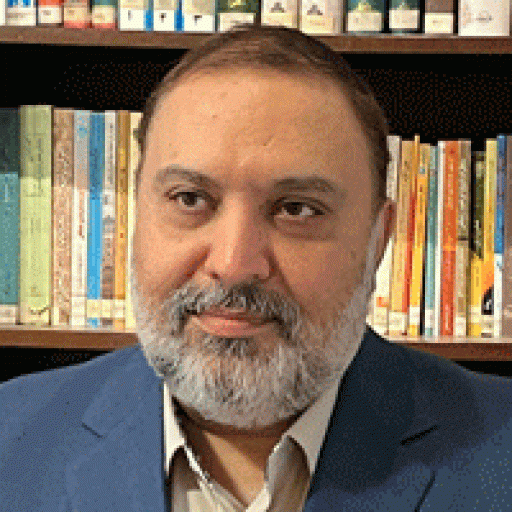
Speech by Dr. Reza Gholami, Senior Lecturer in Political Philosophy, Cultural and Civilizational Studies, and Iran’s Cultural Counselor in Austria, at the event “A Message of Empathy and Solidarity for the World: Majid Majidi’s Cinematic Portrayal of Muhammad, the Prophet of God,” September 11, 2025, House of Iranian Wisdom, Vienna.
In the Name of God
Good afternoon everybody.
Good to see all of you,
In these blessed moments, as we gather to celebrate the 1,500th anniversary of the birth of the noble Prophet Muhammad (peace be upon him), we have a unique opportunity to reflect on one of the brightest aspects of his divine mission: “Moderate Islam”.
You know that honoring Muhammad, the Prophet of Islam, means honoring all the Abrahamic religions, because they all followed the same path.
This essence can be summed up in one word—moderation—which shines through every part of the Prophet’s thoughts, actions, ethics, and way of life.
Art in Service of Truth
Today, we also celebrate the introduction of a remarkable film by the esteemed director Majid Majidi, which beautifully and artistically portrays the childhood of the Prophet of Islam.
This work of art not only captures touching and inspiring scenes of the Prophet’s humanity and moral greatness from his early years but also takes a significant step toward introducing his true character to the world.
We hope Mr. Majidi, with his deep and impactful vision, will create another film about the Prophet’s mission to reveal lesser-known aspects of his ethical and civilization-building life to global audiences.
I would also like to express my gratitude for Mr. Majidi’s heartfelt message to this gathering.
The Essence of His Mission: Perfecting Noble Ethics
The Prophet of Islam clearly stated, “I was sent to perfect noble ethics.”
This short sentence captures the entire purpose of his divine mission.
Noble ethics have two key dimensions, both of which were perfected in the Prophet’s character:
- The theoretical dimension refers to the values and principles of high human ideals, such as truth-seeking, justice, love, and human dignity. These form the intellectual and philosophical foundation of an advanced society.
- The practical dimension is about living these values in daily life through actions like honesty in speech, selflessness, respect for others, fairness in judgment, modesty in relationships, and forgiveness in interactions.
An Eternal Model of Humanity
The Prophet Muhammad (peace be upon him) was not only a preacher of these noble ethics but also their perfect embodiment.
In him, human virtues—such as honesty, trustworthiness, kindness, courage, patience, and justice—reached their highest levels.
He was a living example of morality, making him an eternal role model for all people, beyond the boundaries of time and place.
The remarkable secret behind the rapid and lasting spread of Islam lies in this truth: the Prophet practiced the same ethics he called others to follow.
His invitation to others was not through force or coercion but through the magnetic pull of his moral character and human virtues.
Mercy and Gentleness: The Key to Hearts
The Holy Quran beautifully describes this reality:
“By God’s mercy, you were gentle with them. If you had been harsh or hard-hearted, they would have turned away from you.” (Quran, Al-Imran, 3:159)
This verse shows that love for humanity is the foundation of perfecting noble ethics.
True morality cannot exist without a sincere, heartfelt connection with others.
The Depth of the Prophet’s Love for Humanity
The Prophet Muhammad (peace be upon him) truly loved people from the depths of his heart and dedicated his entire being to their happiness and salvation.
The Quran describes this profound love:
“Perhaps you will grieve yourself to death because they do not believe.” (Quran, Ash-Sharh, 26:3)
This verse highlights that the Prophet, out of his deep love for humanity, was willing to risk his own life to guide people toward spiritual and moral growth.
Human Dignity: The Basis of Equality
The Prophet’s boundless love stemmed from his firm belief in the inherent dignity of all human beings.
The Quran declares this fundamental truth:
Quran says:
“We have honored the children of Adam.” (Quran, Al-Isra, 17:70)
The Prophet saw all people—regardless of race, skin color, gender, ethnicity, or social status—as possessing inherent dignity.
In his view, the true measure of worth was not appearance, wealth, or social position but rather humanity and piety.
As the Quran states:
“The most noble of you in the sight of God is the most righteous.” (Quran, Al-Hujurat, 49:13)
This verse reminds us that while all humans are equal in their fundamental dignity, true virtue is measured by piety and morality—a standard that should never lead to discrimination or disrespect among people.
Moderate Islam: The Balanced Community
Moderation holds a central and foundational place among noble ethics.
The Quran describes Muslims as the “balanced community” (Quran, Al-Baqarah, 2:143),
meaning a community that is moderate, balanced, and avoids extremes in thought and action.
Thus, authentic Islam can be called Moderate Islam—an Islam that emphasizes moderation, rationality, wisdom, and ethics in contrast to extremism, rigidity, or deviation.
Ten Key Features of Moderate Islam
The characteristics of Moderate Islam are clearly outlined in the Quran and the Prophet’s teachings:
- Optimism, kindness, and love, which inspire hope and compassion in people’s lives and work toward a brighter future.
- Forgiveness and selflessness, even toward opponents, showing a readiness to forgive and sacrifice.
- Goodness and goodwill for all, transcending ethnic, religious, and geographic boundaries.
- Open-mindedness and tolerance, engaging patiently with different viewpoints and keeping the door open for dialogue and constructive criticism.
- Peaceful coexistence, living in harmony with followers of other religions and cultures.
- Support for the weak and needy, standing by the oppressed and helping those in need without hesitation.
- Knowledge, open-mindedness, and pluralism, valuing learning and embracing diverse perspectives.
- Peace and avoidance of violence, permitting resistance only in cases of just self-defense. (Of course, defense based on framework of ethics)
- Balance between this world and the hereafter, neither neglecting worldly responsibilities nor forgetting spiritual goals, but harmonizing the two.
- Social and global responsibility, extending ethics beyond the individual to society and international relations. Social justice, global peace, helping the poor, protecting the environment, and fostering dialogue among religions and civilizations are key aspects of Moderate Islam, offering a practical model for modern humanity.
The Path to a Bright Future
Moderate Islam is literally the authentic Islam of the Prophet—a faith built on the strong foundations of love, human dignity, moderation, and noble ethics.
If this radiant essence is properly understood and put into practice, it can lead not only to individual happiness but also to lasting peace and global justice.
Through his pure life and blessed example, the Prophet Muhammad (peace be upon him) showed forever that the true path to humanity’s salvation and happiness lies in ethics, moderation, and sincere love for all people.
Thank you for your attention.