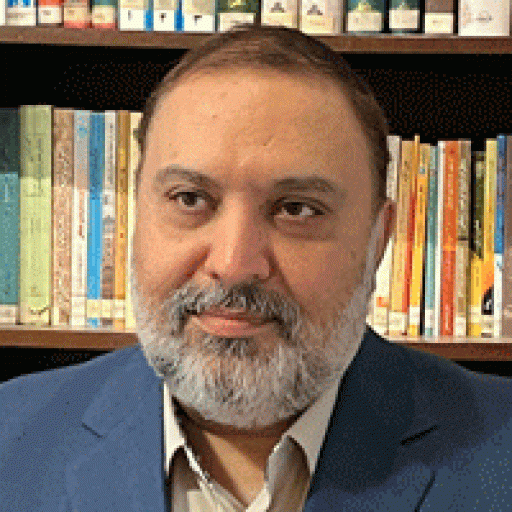
Full Text of Dr. Reza Gholami’s Speech at the Meeting: Global Transformations and New Issues in Interfaith Dialogue
May 28, 2025- Iranian Wisdom House, Vienna
We stand in an era where the rapid pace of technological transformations has profoundly reshaping the human experience-not only through advancements in technology but also in the foundations of thought, social relationships, and humanity’s understanding of itself and the world. In such a time, questions about the nature of humanity, the meaning of life, the boundaries of free will, and the limits of ethics are not only new but urgently pressing. Religions, which for centuries have provided meaning to existence and safeguarded human dignity, now face a heightened responsibility-not merely to recite tradition but to reinterpret and reimagine it to address the challenges of the modern world.
First, I extend my heartfelt gratitude to all of you, especially the esteemed speakers, and offer special thanks to Professor Petrus Bsteh for his kind message to this meeting. This gathering addresses a profoundly important and innovative topic, with the potential to open a new chapter in interfaith dialogue.
The purpose of this speech is to emphasize the role of interfaith dialogue in confronting emerging issues driven by technological transformations—not a dialogue confined to outdated clichés but a collaborative effort to protect ethics, the root of human life and the common ground for all religions. When the truth of ethics is at stake, differences in beliefs should not justify silence. Today, ethics is not merely an individual virtue but a collective responsibility, and interfaith dialogue offers a historic opportunity to fulfill this duty.
Ethics: The Core of Survival and the Foundation of Interfaith Dialogue
Without ethics, humanity risks limitless destruction; with ethics, it can become a bearer of peace, justice, and compassion. Despite differences in worldview, religions share a common call to ethics. What unites religions in times of crisis is not agreement in doctrine but consensus in ethics. However, this consensus is under threat. Emerging technologies, from artificial intelligence and human cloning to digital immortality, are crossing ethical boundaries that religions have upheld for centuries: dignity, free will, and the sanctity of creation. Moreover, we face global challenges such as climate change, destructive wars fueled by advanced weaponry from developed nations, and widespread human rights violations, even in so-called advanced countries. These are not issues that science or politics alone can resolve; they are tests of global ethics.
New technologies—tools, systems, or methods leveraging advanced sciences, particularly digital tools—offer immense opportunities to solve problems and enhance life. I am not opposed to technology; on the contrary, these advancements hold great potential for humanity. However, if they disregard human dignity, ethics, justice, individual freedom, and human individuality, they could lead to humanity’s destruction. While I am not pessimistic about the future, we must recognize both the opportunities and the threats these technologies bring.
From Formal Discussions to Active Engagement
For too long, interfaith dialogue has often been trapped in formal, repetitive discussions that have become less impactful. It is time to reflect critically on ourselves, open our eyes to the world, understand new issues, and recognize that we are all in the same boat. Active and pioneering interfaith dialogue must focus on the issues shaping humanity’s future, particularly those driven by technological advancements. To be effective, it must move beyond symbolic exchanges and lead to practical outcomes.
Let us emphasize pragmatism. Interfaith dialogue should generate new ideas and translate them into action through collaboration and clear objectives. For instance, religious communities, once they clarify their goals, can achieve them by pressuring governments and multinational corporations or mobilizing public support. Some political leaders and corporate executives value human dignity, ethics, justice, and freedom, and we must engage with them. The first step is for religious communities to deeply understand humanity’s future in the context of technological transformations and define their priorities accordingly. Realism is essential—some of us have become preoccupied with religious formalities, lacking a deep understanding of today’s challenges or what lies ahead.
Identifying and Prioritizing Issues
To make interfaith dialogue effective in addressing crises driven by technology, we need a clear framework to identify and prioritize issues based on their threat to human ethics. Criteria such as scope of impact, depth of threat to dignity, lasting effects, urgency, and potential for interfaith collaboration can guide us. We face three major fronts: global crises, emerging technologies, and social transformations.
Global Crises: A Call for Collective Ethics
Climate change, pandemics, technological arms races, wars fueled by advanced weaponry, and human rights violations, even in advanced nations, are not challenges that science or politics alone can solve. Environmental destruction, neglect of solidarity during pandemics, the use of technology as a tool for death, and disregard for human rights reflect a decline in collective ethics. Religions can reexamine humanity’s relationship with nature, others, and power, drafting ethical charters, acting as the voice of global conscience, and holding economic and political systems accountable.
Emerging Technologies: From Power to Wisdom
I emphasize that religions, drawing on their spiritual and divine understanding of humanity, must connect scientific development to wisdom—the science of goodness—to prevent science from becoming an unchecked force. Technologies like artificial intelligence, genetic engineering, brain chips, human cloning, and mind uploading offer unprecedented opportunities but risk reducing humans to engineered objects. Religions must engage, not as opponents of science but as guardians of values that ensure technology serves humanity rather than competes with it.
Social Transformations: Rebuilding Solidarity
Consumerism, individualism, and life in global cities have shifted us from a collective “we” to isolated “I’s.” Ethics that ignores others is not ethics but a justification for modern selfishness. With their traditions of cooperation, charity, and collective worship, religions can rebuild solidarity. By reinterpreting these traditions in a modern language, they can offer an alternative for ethical living in a diverse, tense world. Global cities, symbols of convergence and disconnection, can become spaces for realizing religious ethics if religions actively shape their cultural landscape.
A Transformative Future and the Role of Religions
We are on the cusp of a new world defined by transformative existence—a chain of changes redefining not just our environment but the essence of being human. Humanity is transitioning from natural to technological existence, and toward a hybrid existence where boundaries between human and machine, body and data, nature and design blur. This is not merely a technical shift but an existential challenge: the human of the future is not just a seeker of meaning but a designer of self. The question of “what it means to be human” is now critical to our destiny.
If religions are to remain relevant, they must evolve from guardians of tradition to guides of transformation—not for power, but to preserve human dignity. This requires moving beyond symbolic dialogues to collective action, such as forming interfaith ethical councils, mediating technology-driven crises, drafting global bioethics charters, pressuring governments and corporations, or engaging directly with scientists and multinational companies.
Twenty Critical Issues for Interfaith Dialogue
To make interfaith dialogue effective, we must identify shared, fundamental issues with clarity and priority. The following twenty questions can guide this effort:
- The Meaning of Life in a Mechanized World: As artificial intelligence redefines life, can religions articulate the authentic meaning of human existence?
- Ethical Boundaries in Genetic Engineering: Is humanity permitted to alter genetic structures? What are the ethical limits of “creation”?
- Human Dignity in Cloning: If humans can be cloned, what becomes of the soul, individuality, and dignity?
- Digital Immortality and the Soul: How does mind uploading align with beliefs about death, the afterlife, and the soul?
- Global Ethics and Climate Change: Is environmental destruction a violation of a sacred covenant? What is the role of religions in protecting nature?
- Religious Responses to Pandemics: Have solidarity, sacrifice, and compassion been redefined as global ethical imperatives during pandemics?
- Arms Races and Collective Conscience: How can religions revive ethical boundaries against weapons of mass destruction?
- AI and Human Divinity: Is humanity’s technological prowess replacing the divine? How should religions address this?
- Biotechnology and Redefining Humanity: Should the concept of humanity be redefined with advancements like nanomedicine?
- Media and the Ethics of Truth: In a world where truth is sacrificed for popularity, what is religions’ role in defending honesty?
- Individualism and Social Solidarity: Can religions rebuild the collective “we”?
- Consumerism and Contentment: Can religious teachings offer a path to balanced living in a world of endless consumption?
- Digital Loneliness: How can deep human connections be restored in an era of high-speed communication?
- Educational Justice: Are class divides preventing equal access to religious and ethical experiences?
- Interfaith Dialogue in Multiculturalism: How can ethical coexistence be achieved without relativism?
- Brain Chips and Human Sanctity: Do brain implants violate the sacred inner self?
- Free Will and Neural Interventions: If brain chips control decisions, what happens to free will and ethical responsibility?
- Human-Machine Identity: Will brain-machine integration create a new species, and are religions ready to recognize this?
- Electronic Weapons and War Ethics: How can war ethics be redefined when weapons operate without human decisions?
- Faceless Violence in Technological Warfare: How can compassion and responsibility be preserved when the enemy’s suffering is invisible?
These questions highlight modern crises and pave the way for strategic interfaith programs, fostering collaboration among religions.
Conclusion: Raising the Banner of Ethics
Religions have faced challenges and, in some ways, may have weakened, yet they retain significant influence and power in the world. Our destiny is not to surrender to circumstances—our future remains in our hands. In an era where the line between salvation and destruction is thin, ethics is our lifeline. If interfaith dialogue centers on this principle, it will not only preserve peace but guide the creation of an ethics-driven civilization.
Today, we must move from competition to companionship, from division to understanding, and from isolation to dialogue. Religions, as the awakened conscience of humanity, can lead this transformation—raising a banner not in the hands of power, but in the hands of truth.
Thank you for your attention.
Reminder: Due to time constraints, a summary of this text was presented by Reza Gholami during the meeting. This written version is more comprehensive than the oral presentation.