In the Thought of Ayatollah Khamenei
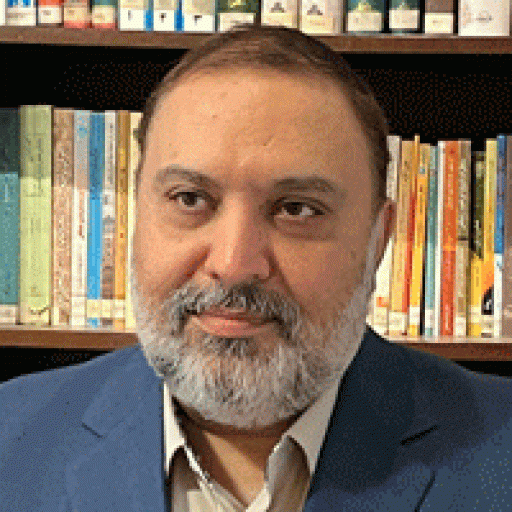
The full text of Dr. Reza Gholami’s speech at the academic meeting “Khamenei: Half a Century of Seeking Justice in the World,” March 17, 2026, Iranian House of Wisdom, Vienna.
Thank you all for being present and for your participation in this meeting.
I also appreciate your sympathy.
We are holding this meeting at a time when our beloved leader was martyred in a missile attack, and our nation is facing an imposed war, while its people are bravely defending their country.
With hope for victory and peace, I begin my remarks.
Introduction
In a large part of the dominant literature on international relations, the analysis of the global order is mainly based on concepts such as power, interests, and the balance of power.
Within these frameworks – both in the realist tradition and in various liberal narratives—justice usually occupies a marginal place and, at best, receives attention only after the stabilization of a power-based order.
In contrast, in the political thought of Ayatollah Sayed Ali Khamenei, justice holds the position of a fundamental principle that organizes political and social life.
Just as it is important in domestic politics, it is also decisive at the level of international relations.
From this perspective, many crises in the contemporary world- from wars and military interventions to widespread economic inequalities – have their roots in the unjust structure of the global order.
From this viewpoint, the main issue in global politics is not merely competition among powers, but rather the tension between the existing domination-centered order and the possibility of forming a more just order in relations among nations.
This perspective, despite its many advantages, like any other viewpoint, remains open to critique – particularly with regard to the practical challenges of its implementation, which can be the subject of further debate.
1. Epistemological Foundation: Justice as a Fundamental Principle
In the intellectual framework of Khamenei, justice is not merely an ethical or ideal concept.
Rather, it is considered the fundamental principle of the legitimacy of power and the main criterion for organizing social and political relations.
This understanding of justice is rooted in a monotheistic worldview in which the mission of the prophets is described as the establishment of justice in human society.
According to this view, just as the legitimacy of power within societies depends on justice, relations among states at the international level should also be based on justice, mutual respect, and the rejection of domination.
In the statement known as the Second Step of the Revolution which issued by Ayatollah Khamenei, justice is described as one of the essential goals of Islamic civilization.
He has written:
“Justice stands at the forefront of the primary goals of all divine missions… It will not be realized in its complete form except in the government of the Promised Eman Mahdi, but it can be achieved relatively in all eras and is a duty for everyone—especially rulers and those who hold power.”
This statement implies three important theoretical conclusions:
- Complete justice has an ideal and trans-historical horizon.
- The relative realization of justice is possible and necessary in every era.
- Those who possess power bear a special responsibility for the realization of justice.
2. Structural Critique of the Global Order: The Concept of the “System of Domination”
One of the central concepts in the analysis of international relations in the thought of Khamenei is the concept of the system of domination.
This concept refers to a structure of power relations in which a limited group of major powers attempt to impose their will and interests on other countries.
Within this framework, the existing global order is not merely a set of legal rules or international institutions.
Rather, it is a structure that in many cases reproduces inequality and domination.
The main signs of this injustice can be observed in several areas:
Concentration and Monopoly of Power
The concentration of political, economic, and military power in the hands of a few countries has led to a situation in which many major global decisions are made without the real participation of the majority of nations.
Structures such as the veto power in the United Nations Security Council are examples of this concentration of power.
Double Standards in Human Rights
In many cases, human rights are used as a political tool to pressure certain countries, while serious violations of human rights in other parts of the world are ignored.
Instrumental Use of International Institutions
Some international institutions that were originally created to regulate global relations fairly have, in practice, come under the influence of major powers and have sometimes become instruments for maintaining the existing order.
Unequal Structure of the Global Economy
The international economic system is often organized in a way that reproduces the gap between developed and developing countries and continues the economic dependency of many nations.
Legitimizing Unilateral Interventions
In some cases, military interventions or large-scale economic sanctions are imposed without genuine global consensus and are justified in the name of universal values, even though they often bring heavy human and economic consequences for nations.
3. Normative Principles of Foreign Policy: Dignity, Wisdom, and Expediency
To deal with the complex realities of the international system, Khamenei has introduced three principles as the framework of the foreign policy of the Islamic Republic: dignity, wisdom, and expediency.
These three principles can be understood as a model for combining value-orientation with realism in foreign policy.
Dignity means preserving national independence and honor and avoiding any humiliating dependency in international relations.
Wisdom refers to rational and thoughtful behavior based on careful analysis of global conditions.
Expediency means flexibility in methods and tactics in order to overcome obstacles and preserve the strategic path.
The combination of these three principles provides a framework in which foreign policy can be realistic, rational, and value-oriented at the same time.
4. Strategies for Realizing Justice in the International System
Within this theoretical framework, achieving global justice requires a set of political, discursive, and structural strategies.
The Doctrine of Resistance
One of the most important strategies in this intellectual framework is the doctrine of resistance.
In this view, resistance is not merely a reaction to political or military pressure.
Rather, it is a strategy to prevent the consolidation of domination in the international system.
In this framework, resistance has three main functions:
- Preventing the normalization of domination by major powers in the international system;
- Creating the possibility for gradual change in the global balance of power;
- Strengthening the discourse of independence and justice in global politics.
From this perspective, resistance is not only a defensive tool but also a strategy for preserving the independence of nations and opening new horizons in the global order.
In addition, several other strategies can be mentioned:
Strengthening National Power
Within this framework, national power—in its scientific, economic, cultural, and military dimensions—is considered a prerequisite for defending independence and justice at the global level.
Cooperation among Independent Countries
Creating networks of cooperation among countries that seek independence and justice in the international system can help establish a balance against the concentration of global power.
Reforming International Structures
International institutions should move toward genuine representation of nations, and the monopolistic structures of power within them should be reconsidered.
Expanding the Discourse of Justice
One of the most important arenas of competition in global politics is the arena of discourse.
Promoting the concept of justice and critically examining the existing unequal order can weaken the moral legitimacy of structures of domination.
5. The Place of This Approach in International Relations Theory
The perspective of Khamenei can be located at the intersection of several theoretical traditions in international relations.
On the one hand, in its critique of structures of domination and inequality, this approach overlaps with critical and post-colonial theories.
However, its foundations are rooted not in secular traditions but in the religious and ethical worldview of Islam.
On the other hand, unlike classical realism—which places power at the center of global politics—this perspective places normative and ethical values at the center of analysis, while at the same time not ignoring the role of national power in achieving these goals.
Finally, this approach also differs fundamentally from international liberalism, because it does not see the liberal global order as a neutral framework for cooperation, but rather, in many cases, as a cover for the continuation of the domination of major powers.
Conclusion:
In summary, in the opinion of Ayatollah Sayed Ali Khamenei, justice is presented as the central normative principle for organizing international relations and evaluating the legitimacy of global power structures.
This perspective criticizes the domination-centered character of the existing international order and argues that many contemporary conflicts and inequalities stem from its structural injustices.
It therefore calls for a transformation of global relations through greater independence of nations, cooperation among non-dominant states, and the reform of international institutions.
In practice, this approach has contributed to sustaining a discourse of resistance to domination, strengthening national resilience, and encouraging new political alignments that challenge the concentration of global power.
With hope for the spread of true justice in the world.
Thank you for your attention.