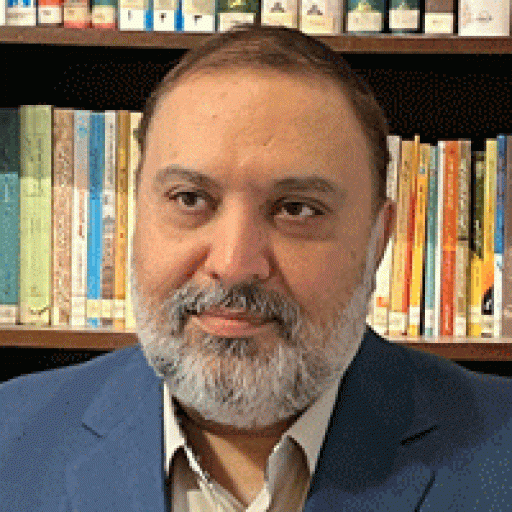
Dr. Reza Gholami’s Lecture at the Islamic Philosophy Workshop, University of Vienna, Institute for Philosophy, April 7, 2025
Thank you, professor George Karamanolis, for the workshop and for your introduction. There are lots of words about Islamic philosophy and I hope this institute always welcomes discussions about Islamic philosophy.
I am going to articulate my disscotion into 7 chapters.
1- Introduction and Basic Definitions
First of all, allow me to Define the Islamic Philosophy and explain its Relationship with Epistemology and Anthropology.
Islamic philosophy is a field of knowledge that explores existence and its truth through logical reasoning. This means it uses arguments to determine what is true or false with certainty. These arguments are based on self-evident principles, which include both primary and secondary obvious truths. The reasoning is also presented within the structure of formal logic. In this system, ontology is seen as the core principle because understanding existence and its truth is the main focus of philosophical thought. At the same time, epistemology looks into the possibilities and limits of understanding, while anthropology gives meaning to existence. This is because the position, purpose, and truth of humans within the system of existence shape the philosophical perspective on the world.
Maybe you like to know about Branches of Islamic Philosophy
In Islamic philosophy, the main branches are Peripatetic, Illuminationist, and Sadraian philosophy. Peripatetic philosophy relies on understanding existence through logical reasoning and self-evident principles, with Avicenna as its most prominent figure. Illuminationist philosophy focuses on light and spiritual insight, closely connected to Khosravani wisdom to explain the spiritual meanings of existence, and it reached its peak with Suhrawardi’s works. On the other hand, Sadraian philosophy emphasizes the unity of existence and the dynamic nature of the universe, while examining the relationship between reason and revelation, with Mulla Sadra as its greatest representative.
But a about Reasons for the Inclination Towards Philosophy in the Islamic World
The interest in philosophy in the Islamic world came from a mix of cultural, historical, and religious factors. One reason was the arrival of Greek philosophy and works from other ancient civilizations, which were widely translated during the Abbasid Caliphate. This helped people share ideas and boost scientific innovation. Islam also encouraged the use of reason and the search for knowledge, urging people to think and ask questions to explain religious ideas. Additionally, financial and cultural support from Islamic governments for scholars and institutions like the House of Wisdom, along with interactions with nearby civilizations, helped build and grow a rich and lively philosophical tradition.
Let me talk shortly about Founder of Islamic Philosophy in the Islamic World
In the development of Islamic philosophy, Arab philosophers such as al-Kindi played an important role in translating and transmitting Greek texts. However, al-Farabi and Avicenna, who are among the most prominent figures in Islamic philosophy, were originally Iranian and introduced new ideas into the Islamic context by drawing on Persian culture and language. Al-Farabi, known as the “Second Teacher” and considered by some as the founder of Islamic philosophy, clearly shows the deep impact Iranians had on philosophical discussions. Additionally, Averroes, with his wide-ranging and deep interpretations of Aristotle’s works, had a significant influence on the growth of Islamic philosophy. Although his ideas later had a great impact on Western philosophy, in the Islamic world his views were not widely accepted due to intellectual opposition and conservative religious attitudes, which led to his ideas being relatively isolated within the Islamic intellectual sphere.
The Role of Iran in the Formation and Expansion of Islamic Philosophy is undoubted
As I said, Iranian philosophers like Farabi, Avicenna, Suhrawardi, and Mulla Sadra played a key role in shaping and growing Islamic philosophy. Farabi, known as the “Second Teacher” after Aristotle, was the first to mix Greek logic and philosophy with Islamic ideas. Avicenna created a clear system for Islamic philosophy by bringing together metaphysics, medicine, and natural sciences. Suhrawardi, the founder of Illuminationist philosophy, opened new ways of thinking through his spiritual and light-based insights. Mulla Sadra explained a deep connection between reason and revelation with his ideas on the movement of existence and the unity of being. Iran, with its rich history of pre-Islamic thought, strong language and literature, and focus on mystical and practical issues, created a space for philosophical ideas to meet and grow. This had a deep and lasting impact on the development of Islamic philosophy.
2- Influences and Connection with Ancient Greek Philosophy
Islamic Philosophy and Ancient Greek Philosophy is an important question
Islamic philosophy started from ancient Greek philosophy, but it’s not exactly the same. Muslims took Greek ideas and brought them into their world. Then, they added their own thoughts, shaped by Islamic teachings. This made a new kind of philosophy. It kept some Greek ideas but also brought new ones about things like existence (what is real), knowledge (how we know things), and ethics (what is right or wrong).
maybe ask me about Islamic Philosophy’s Connection to Plato and Neoplatonism:
Islamic philosophy was influenced by Plato in areas such as the World of Forms, the immortality of the soul, and the role of intuition in knowledge.
Plato said, “Man is a soul, not a body.” This idea plays a self-evident role in Islamic philosophy.
Neoplatonism, especially through philosophers like Al-Farabi, Avicenna, and Suhrawardi, impacted Islamic thought with concepts like the chain of emanation, the Active Intellect, and the levels of existence. These ideas led to a blend of Greek philosophy with Islamic and mystical teachings.
What is Neoplatonism?
Neoplatonism is a philosophical school founded by Plotinus, emphasizing a hierarchy of existence, emanation from the One (God), and the soul’s return to the divine source. This school played a key role in linking Greek philosophy with mystical and religious ideas.
Islamic Philosophy and the Platonic Theory of Forms
How Muslim Philosophers Viewed Plato’s Theory of Forms
- Al-Farabi: He reinterpreted Plato’s Forms as intellectual images in the Active Intellect, rather than an independent world.
- Ibn Sina (Avicenna): He rejected the Theory of Forms and instead proposed universal essences in God’s mind, arguing that Plato’s Forms had no clear connection with the physical world.
- Suhrawardi: He revived the idea of Forms but in a different way, calling them the World of Images (Alam al-Mithal), an intermediate realm between pure intellect and the physical world, which can be understood through mystical experience.
- Mulla Sadra: He introduced the concepts of substantial motion (Harakat Jawhariya) and the primacy of existence (Asalat al-Wujud). Instead of seeing Forms as an external reality, he believed they develop within the soul over time, as part of its spiritual evolution.
Bout about Dependence of Islamic Philosophy on Aristotle
Islamic philosophy was strongly influenced by Aristotle in key areas such as logic, metaphysics, causality, and the philosophy of the soul. Philosophers like Al-Farabi, Avicenna (Ibn Sina), and Averroes (Ibn Rushd) studied and expanded Aristotle’s logic. Avicenna’s theory of necessity and possibility was based on Aristotelian metaphysics and was used to explain the relationship between God and the world as the First Cause. Also, Aristotle’s four causes (material, formal, efficient, and final causes) were developed further in Islamic philosophy and played an important role in discussions about existence and knowledge of God.
In the study of the soul ( علم النفس ), Muslim philosophers adopted Aristotle’s idea of vegetative, animal, and rational souls but combined it with Islamic beliefs. Avicenna and Al-Farabi expanded the concept of the Active Intellect, linking it to divine knowledge and prophecy. Averroes, as the greatest commentator on Aristotle, defended the importance of reason in understanding philosophy and religion. However, Muslim philosophers were not just followers of Aristotle—they modified and improved his ideas, adapting them to Islamic thought.
3- Theoretical Foundations and Basic Concepts
Knowing the Self-Evident Principles in Islamic Philosophy is so helpful
In Islamic philosophy, axioms are fundamental principles that are accepted as true without needing proof. They serve as the foundation for logical and philosophical reasoning. Here are some key axioms:
- Law of Non-Contradiction – A statement cannot be both true and false at the same time.
- Principle of Causality – Everything that happens has a cause.
- Rejection of Infinite Regress and Circular Reasoning – There cannot be an endless chain of causes or a cause that depends on itself.
- Law of Identity – Everything is identical to itself (A = A).
- Cause and Effect Similarity – A cause must have some connection or similarity to its effect.
- Necessary Existence of God – There must be a being (God) whose existence is necessary and cannot be nonexistent.
- Substantial Motion (from Mulla Sadra’s philosophy) – Things change and evolve not only externally but also in their essence.
These principles form the basis of many philosophical and theological discussions in Islamic thought.
Essentialism in Islamic Philosophy is an important feature of this philosophy
Essentialism is the most significant feature of Islamic philosophy. The difference between essentialism in Islamic philosophy and Aristotelian essentialism is that Islamic philosophy leans toward a divine nature governing existence.
Therefore, one could say that Islamic philosophy is incompatible with any form of existentialism.
One of the outcomes of essentialism in Islamic philosophy is that relativism is not taken very seriously in this philosophy.
In fact, the reason Islamic philosophy is dismissive of relativism is the rational foundation it has built for itself based on essentialism.
we should pay attention to the Abstract Nature of Philosophy
Islamic philosophy is often abstract, especially in areas like metaphysics and epistemology. This means it focuses on abstract concepts and non-material worlds such as existence, intellect, the soul, and God, rather than just physical or sensory experiences. Philosophers like Avicenna (Ibn Sina) and Mulla Sadra discussed ideas like abstract existence and the primacy of existence, which go beyond the tangible and are more about intangible, conceptual realities. This abstract thinking is especially evident in theories like substantial motion and the Active Intellect, which relate to the spiritual and metaphysical world.
Let me talking about Main and Common Issues in Islamic Philosophy
Islamic philosophers have addressed many important issues, including:
- **Existence and Essence:** Discussing what things are and how they exist, especially with concepts like “substantial motion.”
- **Knowledge:** How we know things, the role of reason, revelation, and experience in gaining knowledge.
- **Natural Theology:** Arguments for proving God’s existence and discussing His attributes.
- **Revelation:** How divine revelation fits into understanding truth alongside reason.
- **Ethics:** What is good or bad, virtue ethics, and how ethics should guide personal and community life.
- **Political Philosophy:** Ideas about power, justice, Islamic governance, and the relationship between rulers and the people.
- **Metaphysics:** Concepts like the unity of existence, causes of being, and worldviews.
- **Mysticism:** Combining philosophy with mystical teachings, exploring knowing God through inner experiences.
- **Logic:** Using and developing Aristotelian logic and other forms of reasoning.
- **Soul and Body:** The nature of the soul, its relationship with the body, and questions about death and the afterlife.
These issues show how Islamic philosophy interacts with Greek heritage, Islamic religious texts, and local philosophical and mystical thoughts.
Realism and Truth in Islamic Philosophy is very important
Realism and Truth in Islamic Philosophy means that truth or reality is something that has an independent existence outside of the human mind. In this view, truth means that a belief or statement is true if it matches or corresponds with what exists in reality. In Islamic philosophy, Avicenna (Ibn Sina) and Mulla Sadra discussed this idea, believing that truth can be found not only in the material world but also in the intellectual and spiritual realms.
4- Cognitive and Logical Dimensions
if you ask me about Possibility of Attaining Certainty in Islamic Philosophy, i say
In Islamic philosophy, certainty means reaching undoubted and absolute knowledge. Philosophers like Avicenna (Ibn Sina) and Mulla Sadra believe that humans can achieve certainty through logical reasoning, sensory experience, and intellectual intuition. For example, Mulla Sadra emphasizes that truth can be realized through the mind and human experience, and by continually seeking and aligning with reality, one can attain certainty.
well, Questioning, Critique, and Doubt in Islamic Philosophy
All things in Muslim philosophy “depend on”arguments in the logical forms.
As a principle, in Muslim philosophy, everything should be able to be questioned, critiqued, doubted, and corrected.
But about The Role of Logical Reasoning in Islamic Philosophy
An argument based on Aristotelian logic must have three essential features: 1. Logical consistency (the conclusions must necessarily follow from the premises), 2. Non-contradiction (the premises should not contradict each other), and 3. Generality and necessity (the argument should be based on general rules that apply in all similar cases).
5- Religious, Mystical, and Ethical Dimensions
Belief in God and the Divine Worldview in Islamic Philosophy is a reality.
In Islamic philosophy, although belief in God and a divine worldview aren’t stated as philosophical axioms, they have become a fundamental principle.
Of course, God and a divine worldview in Islamic philosophy have not been exempt from proof through rational arguments.
Clarifying about The Meaning of Islamic Description in Islamic Philosophy is super important.
There are different views on the relationship between Islam and Islamic philosophy. Some call it “Muslim philosophy” because, although it emerged in an Islamic context, it is essentially independent of religious doctrines and traditional theology. It is based on free thought and rational inquiry into existence, knowledge, and ethics, rather than simply defending religious teachings.
Others believe that Islamic philosophy is inspired by Islam—it opens up new ideas and opportunities and allows for the criticism and examination of Islamic teachings.
In my opinion, philosophy doesn’t need anything else—like tradition, people who explain dreams, or religion. Philosophy is about thinking freely and finding truth by yourself. So, Islamic philosophy is the philosophy of Muslims. It’s philosophy that happens in the Islamic world.
But about the Relationship Between Islamic Philosophy and Islamic Mysticism
Islamic philosophy and mysticism are two different yet overlapping paths in the search for truth. Islamic philosophy uses rational reasoning and logical analysis of questions about existence, knowledge, and ethics to explain reality, while mysticism emphasizes direct spiritual experience and intuition to reveal hidden mysteries of existence. It is important to note that the methods of philosophy and mysticism are completely separate, even though in theoretical mysticism there is an effort to provide a rational interpretation of practical mysticism. In the Ashraqi school, we see a blend of mystical elements with philosophical thought, and in Sadrian philosophy there is also a connection between rational proofs, mysticism, and the Quran that deepens philosophical insight.
I want to talk shortly about Islamic Philosophy and Ethics
Islamic philosophy emphasizes reason and logical argumentation, playing an important role in explaining and analyzing moral ideas. In this view, ethics are seen not only as religious rules but also as rational guides for living a good life. Islamic philosophers use discussions about existence and knowledge to build ethical foundations for understanding values, justice, and the common good in a logical and thoughtful way. For example, Ibn Sina, one of the great philosophers, explored issues of existence, logic, and ethics in his works. He believed that ethics are essential for achieving human happiness and that personal growth and excellence come from cultivating moral virtues and acquiring knowledge. This shows how deeply Islamic philosophy is concerned with the moral dimensions of human life.
6- Modern Approaches and Contemporary Critiques
But about comparative Philosophy
Comparing Islamic philosophy with modern Western philosophy is not impossible, but remember that, as Wittgenstein said, the language games of these philosophies are different, which can lead to many mistakes.
Maybe ask me about the Relationship Between Islamic Philosophy and Modern Western Philosophy
Islamic philosophy and modern Western philosophy belong to two different worlds and have fundamental differences in method, principles, and goals. Islamic philosophy is based on metaphysics and rational argumentation, drawing influence from Islamic teachings to explain the nature of existence, knowledge, and human happiness. In contrast, modern Western philosophy, which developed after Descartes and Kant, focuses more on skepticism, empiricism, and the scientific method. It seeks to understand knowledge through experience and reason, independent of religion and metaphysics. While Islamic philosophy aims to stay close to religious thought, explore metaphysical realms, and remain at the level of general concepts, modern Western philosophy emphasizes the independence of reason from religion and metaphysics, focusing instead on practical human issues.
The Detachment of Philosophy from Everyday Life is a reality
The abstract nature of Islamic philosophy, with its focus on concepts like existence, intellect, and the soul, often leads it to move away from practical, everyday concerns. While it addresses deep metaphysical and intellectual topics, these ideas may seem disconnected from day-to-day living because they deal with theoretical and non-material worlds. This emphasis on abstract principles can make Islamic philosophy feel remote from the practical realities people face in their daily lives.
However, there’s one exception, and that’s when Islamic philosophers deal with political philosophy. In these discussions, they come down from the heavens to earth.
7- Final Critique and Future Outlook
Maybe ask me about Advantages and Disadvantages of Islamic Philosophy
to me, Advantages of Islamic Philosophy are:
- Metaphysical Depth: It gives special attention to questions about existence and the transcendent.
- Ability to Give Meaning and Purpose to Existence: It tries to explain the role and meaning of human beings and the world in a clear and organized system.
- Logical and Demonstrative Development: It emphasizes using arguments and formal logic to reach the truth.
- Fusion of Different Ideas: It combines religious, philosophical, and mystical teachings to offer a complete and multi-layered view of reality.
Also Disadvantages of Islamic Philosophy are:
- Simplification in Epistemology and Underestimating Relativity: It focuses too much on absolute knowledge and pays little attention to the relative aspects of knowing.
- Lack of Dialogue with Other Philosophical Traditions: There is little direct interaction with other philosophical schools and thinkers.
- Not Closely Connected to new Existential Issues: Many discussions remain abstract and do not fully address the challenges of new life.
- No Clear Boundary with Mysticism and Islamic Theology: The line between rational argument, mystical intuition, and theological discussions is not well defined.
- Insufficient Historical Continuity: In some periods, Islamic philosophy has stagnated and missed new ideas.
- Limited Ability to Address Practical Matters and Contemporary Problems: It does not adapt well enough to solve modern social and practical issues.
Let me talk about Mulla Sadra and the Revival of Islamic Philosophy in the Safavid Era
The philosophical views of Mulla Sadra in Islamic philosophy were groundbreaking. He introduced the concept of “substantial motion” and combined mysticism, philosophy, and theology, which created new perspectives that remain influential to this day.
Tabatabaei and Nou-Sadrian Philosophy
Since time is short, I can’t talk about Tabatabai and his role in the continuation of Sadra’s philosophy. Let me just say that Tabatabai brought Sadra’s philosophy face-to-face with new issues.
I hope in the future there will be a chance to talk in detail about Mulla Sadra and Tabatabai.
Thank you for your attention.