A Comparative and Systematic Study of Intellectual Transformations in Islam
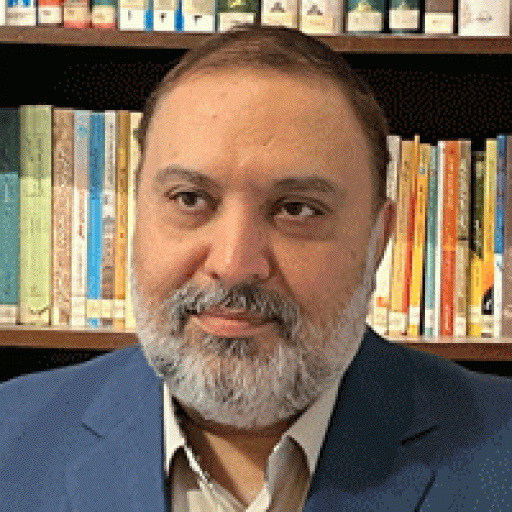
Reza Gholami
Senior Lecturer in Political Philosophy, Cultural Studies, and Civilization Studies
(Nov. 24, 2024, Iranian Wisdom House, Vienna)
Introduction
Throughout history, Islam, as a comprehensive intellectual and doctrinal system, has constantly faced internal and external challenges. This confrontation has led to the emergence of two primary paths: Historical Islam and Contemporary Islam. Historical Islam emphasizes adherence to the past and uncritical imitation of the circumstances and requirements of early Islamic society, while Contemporary Islam is rooted in adaptability, rationality, and the reinterpretation of foundational principles to address the needs of the present age.
Historical Islam: Stagnation in the Past
Historical Islam represents a version of Islam frozen in the conditions of the early Islamic era, unable to transcend this framework. It remains loyal to the outward aspects and historical traditions of early Islam, failing to adequately engage rationality or re-examine principles to adapt to new circumstances and evolving needs.
Key Characteristics of Historical Islam
- Extreme Superficiality
Historical Islam prioritizes the external and superficial aspects of religion over its essence and foundational principles. This approach neglects the core teachings of Islam in favor of rigid adherence to its outward forms. In contrast, Contemporary Islam seeks to uncover the essence of Islamic teachings while respecting the protective role of outward practices.
- Lack of Flexibility
Due to its heavy reliance on early Islamic traditions, Historical Islam lacks the flexibility to adapt to new contexts. In contrast, Contemporary Islam maintains its flexibility while safeguarding its principles, utilizing independent reasoning (ijtihad) and rationality to provide innovative solutions.
- A Distorted Image of Islamic Teachings
A critical observation by the late scholar Martyr Morteza Motahhari is that Historical Islam often conflates fundamental principles with secondary issues. By prioritizing secondary matters and marginalizing primary ones, Historical Islam presents an imbalanced, repelling, and inefficient image of the religion.
- Susceptibility to Superstitions
Historical Islam, due to its excessive reliance on a particular historical narrative and insufficient emphasis on rationality, is vulnerable to the infiltration of superstitions, myths, and unfounded stories. In this framework, dreams, imaginative interpretations, and unscientific beliefs often replace Islam’s rational and progressive teachings.
- Irrelevance in the Modern World
Historical Islam functions as though it is an outdated religion meant to be preserved in museums. Some individuals, often clergy, present it as a relic, introducing it to the public in exchange for personal gain. Such an Islam rarely addresses the needs of modern Muslims or offers practical solutions to contemporary challenges. While similar issues have surfaced in Christianity, Muslim leaders have not sufficiently learned from these experiences.
Contemporary Islam: Dynamism and Adaptability
In contrast to Historical Islam, Contemporary Islam emerges as a dynamic and adaptable approach. By employing rational methodologies and systematically reinterpreting Islam’s foundational principles, it seeks to respond effectively to the demands of the modern world.
Key Characteristics of Contemporary Islam
- Focus on the Spirit of Islam
Unlike Historical Islam, Contemporary Islam emphasizes the essence and core teachings of Islam. This approach allows it to adapt to changing circumstances while remaining rooted in the universal and enduring principles of the faith.
- Flexibility with Adherence to Principles
Contemporary Islam preserves its adaptability without compromising its foundational principles. This balance enables Muslims to embrace scientific, technological, and social advancements while contributing to global progress with creativity and open-mindedness.
- Realism Over Utopianism
While Historical Islam often relies on vague predictions about a guaranteed future for Muslims, Contemporary Islam adopts a realistic perspective. It emphasizes rational planning and scientific calculations to navigate the present and future while maintaining faith in divine support.
- Selective Engagement with History
Contemporary Islam excludes non-universal events of early Islamic history from modern Muslim life, revisiting them only when practical lessons can be drawn. This “sculpting” of Islam’s body lightens the burden of unnecessary historical baggage, enabling Muslims to move forward.
- Peaceful Coexistence with Islamic Sects
By detaching itself from the divisive aspects of early Islamic history, Contemporary Islam sees no reason for conflict with other Islamic sects—or, by extension, other Abrahamic religions. By embracing pluralism in the understanding and practice of religion, it fosters peaceful interaction and cooperation among Islamic sects, mitigating sectarian violence.
- Advancement in Science and Technology
Contemporary Islam finds no inherent conflict with science and technology, except where ethical principles are violated. This perspective places Islam as an ally in the pursuit of human well-being and progress, drawing on its rich history of contributions to civilization.
- A Living Engagement with the Quran and Authentic Hadiths
Contemporary Islam approaches the Quran and authentic Hadiths as living and relevant sources, as though they were revealed in the present moment. This dynamic interpretation keeps Islam vibrant and effective in addressing current challenges.
Comparison Between Historical and Contemporary Islam
To fully grasp the distinctions between Historical and Contemporary Islam, one must set aside preconceived notions. While Contemporary Islam draws essential lessons from history, particularly from the transformative early Islamic period, it does not remain trapped in the past. The following table summarizes the key differences between these two approaches:

Prerequisites for Achieving Contemporary Islam
The path to Contemporary Islam involves several key steps, which can be summarized as follows:
- Reconstructing Islamic Theology
A systematic and rational reconstruction of Islamic theology is necessary to identify and understand Islam’s universal principles.
- Reforming Islamic Jurisprudence
Islamic jurisprudence must be restructured to embrace collective rationality and its outcomes.
- Purifying Cultural Practices
Muslims must critically reevaluate cultural practices, rituals, and secondary traditions that lack a clear connection to Islam’s spirit and stem from historical stagnation.
- Cultural Preparedness
Communities must be prepared to counter the resistance from opportunistic clerics and their supporters, who may incite unrest to protect their vested interests in Historical Islam.
Conclusion
Historical Islam and Contemporary Islam represent two divergent faces of a single religion, each shaped by its historical and social context. Historical Islam, with its focus on fixed principles tied to early Islamic events, has struggled to adapt to the complexities of the modern world. By contrast, Contemporary Islam emphasizes universal and foundational principles, leveraging rationality and an understanding of contemporary realities to address the challenges facing Muslim societies today.
In the face of rapid advancements, particularly in cyberspace and artificial intelligence, Islam must embrace the principles of Contemporary Islam to remain relevant and influential in the modern world. This shift is not merely an adaptation to scientific and social progress but a reinvigoration of Islam’s rational and universal teachings to enhance human welfare and foster the progress of Muslim communities. To ensure Islam’s survival and efficacy in today’s complex and evolving landscape, it must transcend historical rigidity and move toward growth, innovation, and renewal.